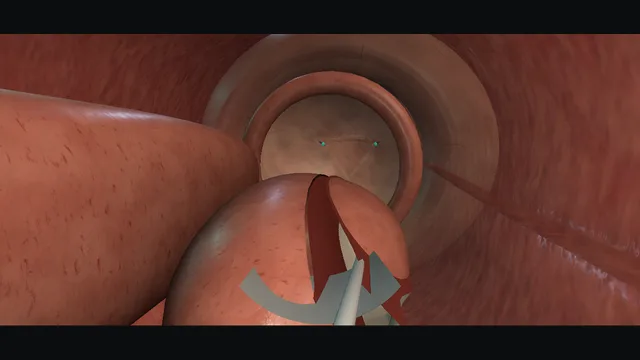
The plane between adenoma and surgical capsule is the operation: open it with grooves at 5 and 7 o'clock, take the median lobe, release the apex early, then peel each lateral lobe off the capsule and morcellate them in a full bladder.
The external sphincter at the apex is the structure the whole case is organised to protect, and the whole specimen goes to histology.
Advanced tierFRCS endourology, BPH / LUTSInteractive 3D
The adenoma inside its capsuleThe enlarged transition zone sits inside the surgical capsule like fruit in its peel, with a thin plane between them. The operation is that plane: enucleate along it and the whole adenoma comes away while the capsule stays. Small perforating vessels cross the plane from the capsule, and they are what bleed. Distal to the verumontanum lies the external sphincter, the structure the case is built to protect.
Cystoscopic surveyThe bladder is surveyed for trabeculation, diverticula, stones and tumours. Both ureteric orifices are found against the bladder neck, because a median lobe can hide them. The verumontanum and external sphincter fix the distal limit, and the prostatic urethral length and lobe sizes are read before the first cut. Laser settings (owner-supplied): a high-power holmium platform of 100 to 120 W, about 2 J at 40 to 50 Hz for enucleation; coagulation at lower energy or a longer pulse, or defocused by drawing the 550 micron fibre back slightly.
Bladder neck incisions at 5 and 7 o'clockEach groove runs from the bladder neck to just proximal to the veru, either side of the median lobe, and is deepened through adenoma until the white circular fibres of the capsule show at its floor. The orifices are watched whenever the fibre works near the bladder neck. where it bites: a groove taken lateral at the bladder neck reaches the orifice.
Median lobeThe grooves are joined distally by a transverse incision just proximal to the veru. The plane under the median lobe is developed distal to proximal: the beak of the scope lifts the adenoma off the capsule while the laser divides the fibrous bands. Capsular vessels are coagulated as they appear, the fibre drawn back slightly to defocus. The lobe is freed at the bladder neck and pushed into the bladder, without undermining the trigone. where it bites: undermining the trigone puts the orifices at risk.
Early apical releaseAn inverted U is scored in the mucosa at the apex, lateral to the veru on each side, at low power and with minimal traction. The mucosal strip at 12 o'clock over the apex is divided early, so the sphincter mucosa is never stretched or torn as the lateral lobes come away. where it bites: traction or heat at the apex is the stress-incontinence mechanism.
Lateral lobesA 12 o'clock incision from the bladder neck to the apex defines the top of each lateral lobe. The plane is entered at the apex from the median-lobe groove and swept laterally and upward, retrograde, the beak retracting and the laser taking bands and vessels. Each lobe is peeled round until it hangs only at the bladder neck, then divided and pushed into the bladder. The other side is the same, and the capsule is kept in view as the safety line throughout.
HaemostasisIrrigation is turned down to reveal the small bleeders, and each is coagulated defocused or at low energy. The bladder neck and apex are inspected and both orifices confirmed intact. The finished cavity is wide and smooth, lined by capsule.
MorcellationThe resectoscope is exchanged for the nephroscope and morcellator (examples include VersaCut, Piranha and DrillCut). The bladder is filled fully on dual inflow first, because a collapsed bladder brings the wall to the blades. The window faces up, towards the tissue and away from the wall. Suction first draws tissue into the window, then the blades cut, and only when adenoma, not wall, is in the window. The tip stays central and the tissue is brought to it; chips go to the trap for histology. A mushroom fragment stuck at the bladder neck is trimmed with a loop. where it bites: a collapsed bladder or a blind bite takes detrusor.
FinishA final look confirms the wall is intact, no fragments remain and the cavity is dry. A three-way 20 to 22 Fr catheter goes in with continuous irrigation, with traction only for bleeding at the bladder neck. Trial without catheter is often on day 1, and selected patients go home the same day. The whole specimen goes to histology: enucleation sees the whole adenoma and finds cancers that loop resection can miss.
The spatial relationships the animation is built to make automatic. Before you read each one, ask yourself: at this point in the operation, what is about to go wrong, and what is my first move? The save for each sits in the Complications tab.
RiskThe apex at 12 to 6 o'clock - where sphincter, adenoma and capsule converge; the last cuts decide continence.
RiskCapsular breach - 5 and 7 o'clock on the floor: venous sinuses open and irrigant finds the circulation.
RiskMorcellator in an under-filled bladder - detrusor is one blind bite away; vision and distension are the two protections.
Trigger each of these live in the Animation tab, then read the save: the first move, the escalation trigger, and the line that goes in the op note.
Capsular perforation
the plane breaks through into periprostatic venous sinuses; irrigant and fluid are absorbed.
The save
Recognise the dark venous welling and the sudden loss of a clean plane; finish the pass, do not deepen it.first move
Laser the visible sinuses point by point and drop irrigation pressure.
Complete the case expeditiously and catheterise with traction for tamponade.
Watch for fluid absorption: nausea, hypertension then hypotension, falling sodium; saline irrigation makes classic TUR syndrome rare but volume overload is real.escalation trigger
Op note: site of breach, irrigation volumes and duration, electrolytes checked, catheter plan.document
Stress incontinence (sphincter injury)
laser or traction injury at the apex; early leak is common and mostly recovers, persistent leak is the injury that matters.
The save
Prevention is operative discipline: distal limit at the veru, short apical strokes, no traction on apical tissue.first move
Early post-op leak: reassure appropriately, refer for pelvic-floor training, and give it time.
Review at three to six months with pad weights and a symptom diary.
Persistent stress incontinence at a year → urodynamics and continence options including slings and the artificial urinary sphincter.escalation trigger
Op note: apical technique, distal limit honoured, leak observed and rehabilitation plan.document
Bladder injury at morcellation
the morcellator engages detrusor with the bladder under-filled or tissue out of view.
The save
Stop the blades the moment the wall appears in the field; disengage under vision.first move
Re-fill the bladder fully and re-establish the working space before resuming.
Inspect the site: mucosal injury is observed; a full-thickness defect needs decisions now.
Full-thickness or intraperitoneal suspicion → catheter drainage, imaging, and repair with washout where peritoneal.escalation trigger
Op note: event, wall status, drainage and imaging plan.document
Ureteric orifice injury
a groove taken lateral at the bladder neck, or a median lobe freed by undermining the trigone, reaches the orifice.
The save
Find both orifices before the first cut and keep the bladder-neck work medial to them.first move
If an orifice has been cut or charred, stop working at the neck on that side and look at it with the flow turned down.
An injured orifice is stented at the end of the case and the stent removal date recorded.
Loin pain, fever or a rising creatinine afterwards → imaging for obstruction or leak, with drainage.escalation trigger
Op note: which orifice, the injury seen, stent placed and its removal date.document
Clot retention
clot collects at the bladder neck after the case and the catheter blocks.
The save
Washout through the catheter; change to a larger three-way catheter if it keeps blocking.first move
Keep continuous irrigation running fast enough to stay pink, not red.
Check haemoglobin and clotting, and stop or reverse anticoagulants on the right advice.
Clot that cannot be cleared, or bleeding that continues → evacuation and haemostasis in theatre.escalation trigger
Op note: volume of clot, irrigation, bloods and the decision taken.document
The examiner stems this scene prepares you for. Try to answer out loud first, then reveal, and learn the discriminator, the detail that turns a pass into a strong pass.
QCompare HoLEP with TURP for a 90 g prostate.reveal answer
Above roughly 70 to 100 grams, loop resection becomes a long, bloody, staged affair while HoLEP is size-independent: the enucleation plane exists whatever the gland weighs, so clearance, flow outcomes and durability are equivalent to open simple prostatectomy without the incision.
HoLEP is saline-based, which removes the classic dilutional hyponatraemia of monopolar TURP, its transfusion needs are lower in the larger glands, and it produces tissue for histology across the whole adenoma.
The trade is the learning curve, the equipment, and morcellation as a second skill with its own complication profile.
For the patient on anticoagulation or with retention, HoLEP is often the better operation in larger glands, and it is also the durable answer for the young man with a big gland who does not want repeat procedures.
The honest answer names the curve: the first cases take longer than the equivalent TURP.
Strong pass
The plane is size-independent; the learning curve is the cost
Argument→Size-independence of the plane
Cost→The learning curve, not instant equivalence
Examiner note
Making size-independence of the plane the argument, and naming the learning curve as the real cost rather than pretending equivalence is immediate.
QWhy does HoLEP cause more transient stress incontinence than TURP, and what do you tell the patient?reveal answer
The enucleation dissects along the capsule all the way to the apex, and at the apex the adenoma is closest to the external sphincter;
thermal and traction effects on the sphincter and its support produce early leak in a visible minority of patients.
Most recover within weeks to months as swelling resolves and pelvic-floor function compensates.
I counsel patients before surgery: early leak is common, pads for a period are normal, and pelvic-floor exercises start once the catheter is out;
a small number have persistent stress incontinence at a year, and those men are investigated with urodynamics and offered the full continence ladder, including bulking, slings and the artificial urinary sphincter.
Framing the risk honestly before surgery is part of the operation, because a warned patient works with the rehabilitation and an unwarned patient litigates it.
Strong pass
Say all three
Giving the recovery timeline with numbers framed as a minority
The year-one audit point with urodynamics
Not just reassurance
Examiner note
Giving the recovery timeline with numbers framed as a minority, and the year-one audit point with urodynamics, not just reassurance.
QYour patient develops confusion and hypotension in recovery after an unexpectedly long enucleation. What is happening?reveal answer
Assume fluid absorption until proven otherwise, even with saline irrigation.
A long case with open venous sinuses absorbs a volume of Normal saline, which presents as volume overload with a normal or high sodium, rather than the dilutional hyponatraemia of glycine TURP syndrome, though a mixed picture and other causes, including sepsis from bacteriuria and peri-operative cardiac events, are on the list.
I would check electrolytes, consider a chest film for pulmonary oedema, involve the anaesthetist early, treat volume overload with oxygen, diuresis and electrolyte correction, and culture urine and blood.
The operative lesson is upstream: sinus breach plus long irrigation time is the setup, so the response to a dark welling field is to finish the pass, haemostase and exit, not to persist.
Strong pass
Distinguishing saline volume overload from classic glycine TURP syndrome while still acting on it as an emergency.
QWhat is the role of histology after HoLEP for benign disease?reveal answer
The whole adenoma goes to pathology, and that is one of the quiet advantages of enucleation: incidental prostate cancer is found in a proportion of specimens, including anterior and transition-zone tumours that systematic biopsies undersample.
A finding of cancer changes surveillance and can change the patient's whole pathway, including MRI and MDT discussion, so the specimen is bagged completely and labelled, never discarded.
It also works in reverse: a known low-risk cancer patient needing obstruction surgery has a discussion about HoLEP as debulking histology, with clear counselling that enucleation is not cancer treatment.
The teaching point is that in HoLEP the pathologist sees more gland than in any loop resection, and the team must be ready for what that finds.
Strong pass
Say both
Naming transition-zone detection as the mechanism
Having a ready answer for the incidental cancer pathway
Examiner note
Naming transition-zone detection as the mechanism and having a ready answer for the incidental cancer pathway.
Say it aloud, then reveal. Reading is not remembering.
01The relationshipSay the critical spatial relationship out loud, then reveal.reveal
Memory frame
Sphincter · veru · adenoma · capsule · bladder neck
Plane→The millimetres between adenoma and capsule
Safe→Exactly as long as the plane stays there
Why?
From inside the urethra the anatomy is a line along the axis: sphincter, verumontanum, adenoma, capsule, bladder neck. The operation happens in the millimetres between adenoma and capsule, and everything is safe exactly as long as the plane stays there.
02The first moveCapsular perforation. Your first move?reveal
First move
Finish the pass, do not deepen it
Dark venous welling
Sudden loss of a clean plane
More detail
Recognise the dark venous welling and the sudden loss of a clean plane; finish the pass, do not deepen it.
03The escalation triggerCapsular perforation. What makes you call for help?reveal
Escalate when
Watch for fluid absorption
Nausea
Hypertension, then hypotension
Falling sodium
Saline makes classic TUR syndrome rare; volume overload is real.
More detail
Watch for fluid absorption: nausea, hypertension then hypotension, falling sodium; saline irrigation makes classic TUR syndrome rare but volume overload is real.
04The discriminatorWhat turns a pass into a strong pass?reveal
Strong pass
The plane is size-independent; the learning curve is the cost
Argument→Size-independence of the plane
Cost→The learning curve, not instant equivalence
Examiner note
Making size-independence of the plane the argument, and naming the learning curve as the real cost rather than pretending equivalence is immediate.
05The pitfallWhere does this operation bite first?reveal
Pitfall
The apex, 12 to 6 o'clock
Sphincter, adenoma and capsule converge; the last cuts decide continence.
Why?
The apex at 12 to 6 o'clock: where sphincter, adenoma and capsule converge; the last cuts decide continence.
Revision practice with self-marked answers, not an assessment of clinical competence. Kept in
this browser only; it does not sync between devices.