
HoLEP and endoscopic enucleation of the prostate
Anatomical endoscopic enucleation of the prostatic adenoma from the surgical capsule, followed by tissue retrieval, usually by intravesical morcellation.
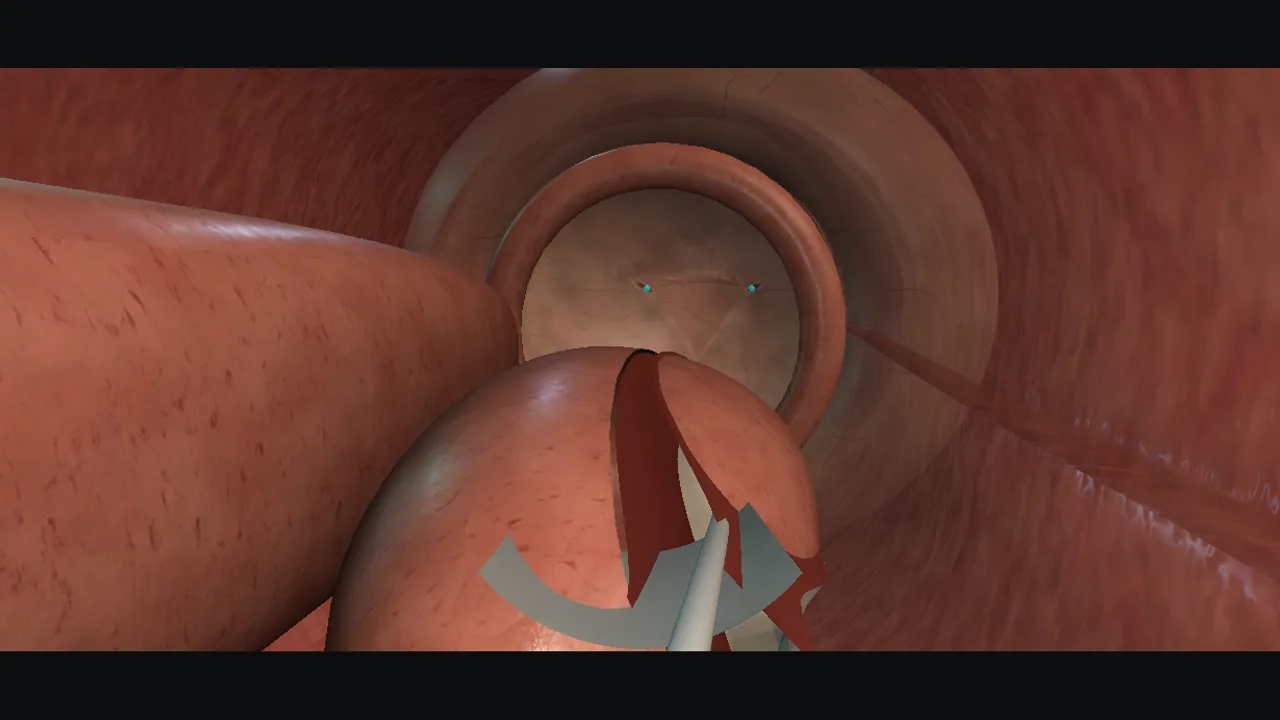 Interactive 3D Interactive operative model Open the 3D animation
Teaching catalogue only. This coverage record is not a patient pathway or operative instruction.
Typical place in practice
Benign prostatic obstruction across a broad range of gland sizes when an enucleation pathway and expertise are available.
Alternatives and neighbouring procedures
TURP, vaporisation, simple prostatectomy, catheter strategies or other minimally invasive outlet procedures.
Same procedure family, explicit technique branches
These are variations of this canonical operation. Complication modules below identify whether they apply to all branches or only to named approaches.
Holmium laser enucleation
Holmium energy supports capsular dissection and haemostasis before morcellation.
Thulium laser enucleation
Thulium energy is used for anatomical enucleation with device-specific tissue and haemostatic effects.
Bipolar endoscopic enucleation
Bipolar electrosurgery develops the adenoma–capsule plane and controls bleeding.
En-bloc enucleation
The adenoma is mobilised as one main unit with early or progressive apical release.
Multi-lobe enucleation
Lobes are separated and enucleated in a defined sequence before tissue retrieval.
High-level sequence
Coverage outline only; not a step-by-step technical guide.
- Identify bladder neck, ureteric orifices, verumontanum and sphincter
- Enter and maintain the surgical-capsule plane
- Release apical adenoma while protecting sphincter fibres
- Achieve haemostasis and move tissue fully into the bladder
- Morcellate only with a distended, clearly visualised bladder and account for tissue
The operation, step by step
A step that touches one of this module's danger zones is marked and cross-linked below.
- SetupGeneral or regional anaesthesia, lithotomy position, continuous-flow resectoscope with the enucleation laser (holmium or thulium) or bipolar system set up and tested, and the morcellator assembled and checked before starting.
- AccessPass the sheath under vision and survey the outlet: verumontanum centred at 6 o’clock, external sphincter just distal to it, bladder neck above, both ureteric orifices in view.
- Fix the landmarks before any laser: veru, sphincter, bladder neck and both ureteric orifices at the bladder neck. danger zone: Ureteric orifices at the bladder neck
- Develop the median-lobe plane at 5 and 7 o’clock, keeping the laser on adenoma because the capsule and venous sinuses beyond it are the bleeding plane. danger zone: Capsule and venous sinuses
- Enucleate the median lobe downwards from the bladder neck and detach it fully into the bladder.
- Enucleate each lateral lobe in the same capsular plane, working from the bladder neck towards the apex with the capsule in view as the safety line.
- Release the apex last with short, deliberate strokes that stay proximal to the sphincter, preserving the apical sphincter and mucosal strip. danger zone: Apical sphincter and mucosal strip
- Divide residual mucosal tags so every lobe moves freely inside the bladder.
- Paint the fossa dry: walk the laser along the capsular surface and treat each bleeding point before moving to the next.
- Morcellate with the bladder fully distended, the blades in view and tissue identified before every close, so no bite reaches the bladder wall during morcellation. danger zone: Bladder wall during morcellation
- Collect and send all specimen for histology.
- Place a two- or three-way catheter and apply traction per protocol for the night.
- ClosureNo sutured closure: catheter traction controls the fossa, and the field is inspected dry before the sheath leaves.
- AftercareTraction off and irrigation stopped the next morning, trial void within 24 to 48 hours, and warn about transient stress leakage while the sphincter recovers.
Operative notes
Concise operative notes covering the key steps, landmarks and watch points, in the order you encounter them.
HoLEP
What it does: laser the adenoma off its capsule, then morcellate it in the bladder.
- Calibrate the meatus. Dilate to 28 to 30 Fr. Landmarks first: both orifices, veru, sphincter. Read the lobes.
- Laser (owner's settings): 100 to 120 W platform. About 2 J at 40 to 50 Hz to enucleate. 550 micron fibre, held by a laser bridge or a 6 Fr stabilising catheter. 26 to 28 Fr continuous-flow laser scope, 30 degree lens. Saline.
- Grooves at 5 and 7 o'clock. Bladder neck to just above the veru. Deepen till the white capsular fibres show.
- Join the grooves above the veru.
- Median lobe: work distal to proximal. Beak lifts, laser cuts the bands. Coagulate the vessels as they come.
- Coagulate: lower energy, longer pulse, or pull the fibre back a little. Defocused.
- Free it at the bladder neck. Push it into the bladder. Do not undermine the trigone.
- Early apical release: inverted U lateral to the veru, each side. Low power. No traction.
- Divide the 12 o'clock apical mucosal strip early. The sphincter mucosa is never stretched.
- 12 o'clock incision, bladder neck to apex. Defines the top of each lateral lobe.
- Lateral lobes: in at the apex, sweep laterally and up, retrograde. Beak retracts. Peel round till it hangs at the bladder neck. Divide. Into the bladder. Other side the same.
- Haemostasis: turn the flow down to see the bleeders. Coagulate each one. Orifices intact?
- Morcellation: swap to the nephroscope (about 26 Fr) and morcellator. Full bladder, dual inflow. Window up, away from the wall. Suck, then cut. Tip central. Bring the tissue to it. Chips to the trap.
- View lost or bladder empties? Stop the blades. Mushroom at the neck: trim it with a loop.
- 3-way catheter, 20 to 22 Fr. Continuous irrigation. Traction only for bladder-neck bleeding.
- Watch: The plane is the operation. Leave the capsule: sinuses. Stay in adenoma: tissue left. Laser settings are the owner's typical values.
From the UroRef Operative Quick Guide. Open the note page →
Every failure mode is its own module.
Timing and variation coverage are recorded for each module.
Capsular perforation or extravasation
Loss of the capsular plane can create a defect, bleeding and irrigation-fluid extravasation.
Applies to: Holmium laser enucleation · Thulium laser enucleation · Bipolar endoscopic enucleation · En-bloc enucleation · Multi-lobe enucleationBleeding or clot retention
Capsular vessels may bleed during dissection or after catheter removal despite energy-assisted haemostasis.
Applies to: Holmium laser enucleation · Thulium laser enucleation · Bipolar endoscopic enucleation · En-bloc enucleation · Multi-lobe enucleationBladder injury during morcellation
Poor visibility, loss of distension or tissue adherence to the wall can allow the morcellator to injure bladder mucosa or perforate the bladder.
Applies to: Holmium laser enucleation · Thulium laser enucleation · Bipolar endoscopic enucleation · En-bloc enucleation · Multi-lobe enucleationMorcellator failure or retained adenoma
Equipment failure, firm tissue, bleeding or unsafe visibility may prevent complete tissue retrieval in the same session.
Applies to: Holmium laser enucleation · Thulium laser enucleation · Bipolar endoscopic enucleation · En-bloc enucleation · Multi-lobe enucleationUrinary infection
Instrumentation, devascularised tissue, bacteriuria and catheterisation contribute to postoperative infection.
Applies to: Holmium laser enucleation · Thulium laser enucleation · Bipolar endoscopic enucleation · En-bloc enucleation · Multi-lobe enucleationTransient or persistent urinary incontinence
Urgency, temporary sphincter dysfunction or direct apical injury can cause leakage, with technique and anatomy influencing persistence.
Applies to: Holmium laser enucleation · Thulium laser enucleation · Bipolar endoscopic enucleation · En-bloc enucleation · Multi-lobe enucleationRetrograde ejaculation or sexual-function change
Anatomical removal of outlet tissue commonly alters ejaculation and may affect orgasmic or erectile experience.
Applies to: Holmium laser enucleation · Thulium laser enucleation · Bipolar endoscopic enucleation · En-bloc enucleation · Multi-lobe enucleationUrethral stricture or bladder-neck contracture
Large-calibre instrumentation, thermal injury and healing can produce delayed narrowing.
Applies to: Holmium laser enucleation · Thulium laser enucleation · Bipolar endoscopic enucleation · En-bloc enucleation · Multi-lobe enucleationSources for this module
Contemporary outlet procedures, selection, variants and functional trade-offs.
Accessed 2026-08-03 · opens source European Association of Urology EAU Guidelines on Urological InfectionsInfection prevention, recognition and procedure-associated infection context.
Accessed 2026-08-03 · opens source British Association of Urological Surgeons Patient information leaflets by procedureUK patient-facing procedure, alternatives, recovery and complication framing.
Accessed 2026-08-03 · opens source