
GreenLight photoselective vaporisation of the prostate
Endoscopic laser vaporisation of obstructing prostatic tissue to create an outlet channel without routine chip resection.
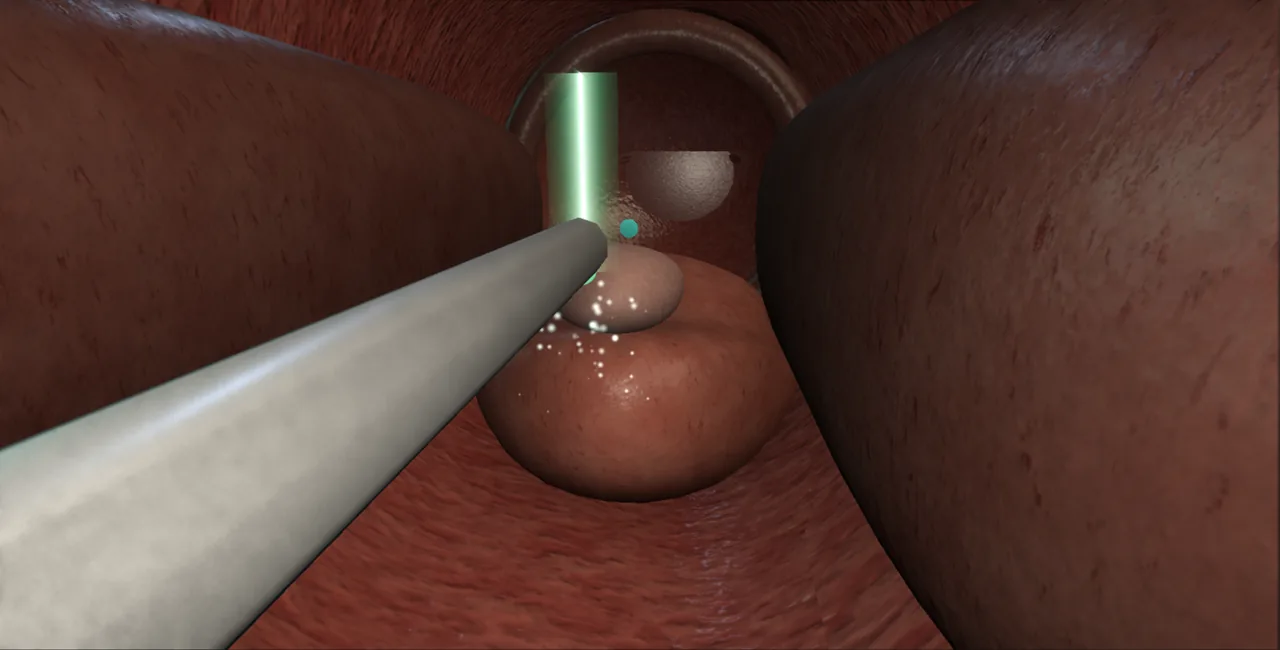 Interactive 3D Interactive laser vaporisation Open the 3D animation
Teaching catalogue only. This coverage record is not a patient pathway or operative instruction.
Typical place in practice
Selected benign prostatic obstruction where vaporisation and its haemostatic profile suit gland anatomy and patient factors.
Alternatives and neighbouring procedures
TURP, endoscopic enucleation, simple prostatectomy, incision or other minimally invasive outlet procedures.
Same procedure family, explicit technique branches
These are variations of this canonical operation. Complication modules below identify whether they apply to all branches or only to named approaches.
Standard GreenLight vaporisation
Obstructing tissue is vaporised in a systematic sweep while landmarks and depth are maintained.
Anatomical vaporisation
Vaporisation follows an anatomical plane more closely while leaving no enucleated tissue for morcellation.
Vapo-enucleation technique
A hybrid technique combines tissue separation and vaporisation, with retrieval requirements depending on execution.
High-level sequence
Coverage outline only; not a step-by-step technical guide.
- Inspect bladder, outlet and key landmarks
- Create working space and identify the correct tissue plane
- Vaporise systematically with controlled fibre distance and sweep
- Protect apex, bladder neck and ureteric orifices
- Confirm haemostasis, channel and catheter plan
The operation, step by step
A step that touches one of this module's danger zones is marked and cross-linked below.
- SetupRegional or general anaesthesia, lithotomy position, laser-safety checks and eye protection for the room, GreenLight machine and fibre prepared, continuous-flow sheath connected.
- AccessPass the instrument under vision and complete a full cystoscopy, recording lobe configuration, median lobe and urethral length.
- Identify both ureteric orifices and their relation to the bladder neck and median lobe before the first firing.
- Set the non-contact working distance of about a millimetre and confirm the beam path is clear of the laser fibre near non-target mucosa or equipment before every firing. danger zone: Laser fibre near non-target mucosa or equipment
- Open the channel from the bladder neck to the verumontanum, vaporising an obstructing median lobe first.
- Work each lateral lobe from bladder neck to apex in overlapping sweeps, rotating the fibre rather than dragging it.
- Judge depth by the colour change at the capsule and venous sinuses and stop there: opened sinuses bleed and absorb irrigant. danger zone: Capsule and venous sinuses
- Treat the apex with short, timed sweeps directed away from the external sphincter at the apex. danger zone: External sphincter at the apex
- Treat bleeding points with short, aimed, defocused bursts that keep heat off the bladder neck and ureteric orifices. danger zone: Bladder neck and ureteric orifices
- Inspect at low flow and confirm a channel that accepts the sheath without recoil.
- ClosureCatheter drainage only; no drains.
- AftercareCatheter for a day or two then trial void, with irritative symptoms expected to peak in the first week while the slough heals.
Every failure mode is its own module.
Timing and variation coverage are recorded for each module.
Bleeding or clot retention
Although vaporisation is haemostatic, capsular or bladder-neck vessels can bleed during treatment or recovery.
Applies to: Standard GreenLight vaporisation · Anatomical vaporisation · Vapo-enucleation techniqueCapsular perforation or thermal injury
Excessive depth, stationary energy or loss of landmarks can breach the capsule or damage adjacent tissue.
Applies to: Standard GreenLight vaporisation · Anatomical vaporisation · Vapo-enucleation techniqueDysuria, urgency or urinary retention
Oedema, sloughed tissue and thermal irritation may cause marked storage symptoms or impaired emptying.
Applies to: Standard GreenLight vaporisation · Anatomical vaporisation · Vapo-enucleation techniqueUrinary infection
Instrumentation, catheterisation and devitalised tissue contribute to infection risk.
Applies to: Standard GreenLight vaporisation · Anatomical vaporisation · Vapo-enucleation techniqueSphincter or ureteric-orifice injury
Laser energy applied beyond the intended outlet tissue can affect continence or upper-tract drainage.
Applies to: Standard GreenLight vaporisation · Anatomical vaporisation · Vapo-enucleation techniqueRetrograde ejaculation or sexual-function change
Bladder-neck and prostatic tissue treatment can change ejaculation and other aspects of sexual function.
Applies to: Standard GreenLight vaporisation · Anatomical vaporisation · Vapo-enucleation techniqueUrethral stricture, bladder-neck contracture or residual obstruction
Healing or inadequate tissue removal may produce recurrent obstruction and further treatment.
Applies to: Standard GreenLight vaporisation · Anatomical vaporisation · Vapo-enucleation techniqueSources for this module
Contemporary outlet procedures, selection, variants and functional trade-offs.
Accessed 2026-08-03 · opens source European Association of Urology EAU Guidelines on Urological InfectionsInfection prevention, recognition and procedure-associated infection context.
Accessed 2026-08-03 · opens source British Association of Urological Surgeons Patient information leaflets by procedureUK patient-facing procedure, alternatives, recovery and complication framing.
Accessed 2026-08-03 · opens source