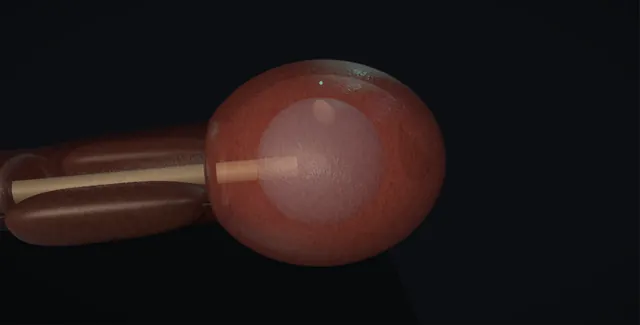
One dose of mitomycin C through the catheter within hours of a bladder tumour resection, held for an hour, to kill the cells set loose by the loop before they settle on the raw bladder.
It reduces recurrence in low and intermediate-risk disease, and it is dangerous in the bladder that has been perforated. This page is the reasoning, the patients who must not have it, the dose and the clamp, and the cytotoxic discipline around it.
Core tierFRCS bladder cancer, non-muscle-invasive diseaseInteractive 3D
Why a single doseA resection scatters tumour cells into the irrigant and they implant on the resection bed and on any other raw patch of urothelium; many early recurrences are these implants rather than new tumours. A single dose of chemotherapy within 24 hours, and ideally within six hours, of the resection kills the floating cells before they attach, and reduces recurrence in low and intermediate-risk non-muscle-invasive disease by about a third relative, roughly fourteen per cent absolute at five years. It does not reduce progression, and it does little for the patient with frequent recurrences or high-risk disease, who needs a full course of BCG or chemotherapy instead. The dose is planned before the resection begins, not remembered afterwards.
Who does not get itAnyone in whom the bladder may not be intact. A perforation seen at resection, fat or a hole at the bed, or an irrigant deficit that suggests one; a deep or extensive resection where the wall is thin and a perforation is possible; and bleeding that needs continuous irrigation, because the dose cannot be held in a bladder that is being washed and the bleeding bed absorbs the drug. Mitomycin instilled into the perivesical tissue through a perforation causes chemical necrosis and there are reported deaths. A known allergy to the agent is the other bar. If there is doubt about the wall, the dose is omitted and the omission is written down with the reason. where it bites: a perforation, suspected or seen, cancels the dose; mitomycin outside the bladder is necrosis.
At the end of the TURBTThe resection is finished, the bed and every other part of the bladder is inspected once more with the irrigation slowed, and the surgeon makes the decision aloud: the wall is intact, the bleeding is controlled, the dose is given. A two-way catheter of 16 to 20 French goes in, or a three-way if irrigation might be needed later, and the bladder is drained to empty so that 40 ml of drug is not diluted in a bladder full of irrigant. The catheter position is confirmed by drainage of clear irrigant, and the balloon is up and seated. The instillation is then given in theatre or in recovery, by whoever the local protocol names, from a prescription written before the case.
The doseMitomycin C 40 mg in 40 ml of water or saline is the common UK dose, though some units use 40 mg in 20 ml; epirubicin and gemcitabine are alternatives with similar evidence and the local agent is used. The dose is prepared by pharmacy in a closed system and arrives labelled as cytotoxic. Whoever gives it wears gloves, a gown and eye protection, checks the patient, the drug and the dose against the prescription with a second person, and connects the syringe or bag to the catheter through a closed connector. Mitomycin on skin causes dermatitis and on the eye causes injury; a spill is contained with the cytotoxic spill kit, not wiped with a paper towel. where it bites: handled as cytotoxic from the syringe to the bag: gloves, gown, eye protection, a closed connector and the spill kit within reach.
Instilled and clamped for an hourThe drug runs in slowly through the catheter into the empty bladder, followed by a small saline flush so that none is left in the catheter, and the catheter is clamped. The clamp is timed and written on the chart: one hour, occasionally up to two, but never left unclamped by default or forgotten. The patient is turned every fifteen minutes between prone, supine and each side so that the whole urothelium is bathed; in recovery this is the nurse turning a drowsy patient. Pain in the bladder or abdomen, a rising pulse or a distended abdomen during the dwell means the drug may be outside the bladder, and the clamp comes off at once. where it bites: abdominal pain or distension during the dwell is extravasation until proved otherwise; unclamp and drain immediately.
Drained, flushed, protected, disposedAt the hour the clamp is released and the bladder drains into a closed bag. The catheter is flushed with saline so that the drug does not sit in the lumen against the urethra, and the bag is changed. The drained fluid, the bag, the syringe and the connector are cytotoxic waste in the purple-lidded bin, and the gloves and gown follow them. The perineal and genital skin is checked and washed if any drug has leaked around the catheter, because mitomycin causes a contact dermatitis and, rarely, a rash of the palms and genitals. For the next six hours the urine is treated as cytotoxic: gloves for any handling of the bag, and the toilet flushed twice with the lid down after a void.
The catheter and the wardThe catheter stays until the urine is clear, usually overnight, and comes out in the morning for a day-case or short-stay patient; a resection that was small and bloodless can have the catheter removed a few hours after the drug is drained. The patient is warned about dysuria, frequency and urgency for a day or two, which is chemical cystitis and is treated with fluids and analgesia, and about mild haematuria. Fever, severe pain, a distended abdomen or a rash is reported. The note records the drug, dose and volume, the time in and out, the clamp time, the turning, the catheter, the skin check and any exception.
The recurrence pathwayThe histology arrives within a fortnight and decides the rest. Low-risk disease, a single small low-grade Ta tumour, has had its treatment with the resection and the single dose and goes to surveillance cystoscopy at three months and then twelve months, then yearly for five years. Intermediate-risk disease may have a course of intravesical chemotherapy or BCG for a year on top of the single dose. High-risk disease, high-grade or T1 or carcinoma in situ, was never going to be treated by a single dose: it needs a re-resection where indicated and induction and maintenance BCG, or cystectomy for the highest risk. The single dose is the beginning of the pathway, not a substitute for it.
The spatial relationships the animation is built to make automatic. Before you read each one, ask yourself: at this point in the operation, what is about to go wrong, and what is my first move? The save for each sits in the Complications tab.
RiskThe perforated bladder - seen or suspected: no dose. Mitomycin in the perivesical fat is necrosis.
RiskThe bleeding bed - irrigation needed means the dose is omitted; a bleeding bed absorbs the drug and the clamp cannot be held.
RiskThe misplaced catheter - a balloon in the prostatic urethra or a tip not in the bladder puts the dose outside it; clear drainage before the drug.
RiskThe staff - skin, eyes and the bag; gloves, gown, eye protection, closed system and the spill kit.
Trigger each of these live in the Animation tab, then read the save: the first move, the escalation trigger, and the line that goes in the op note.
Extravasation and chemical injury
the drug through a perforation or a misplaced catheter into the perivesical tissue: pain, a distended abdomen, a rising pulse during or after the dwell.
The save
Unclamp and drain the bladder at once; stop any further instillation.first move
Examine the abdomen, check the catheter position, and image with a CT cystogram.
A confirmed extravasation needs senior review the same hour: drainage, antibiotics, and early exploration and washout with debridement of necrotic tissue if the patient deteriorates.escalation trigger
The patient is told what has happened; incident reporting follows.
Note: the timing, the volume in and out, the imaging, the surgical findings and the plan.document
Chemical cystitis and pain
dysuria, frequency, urgency and bladder spasm for a day or two after the dose; sometimes longer.
The save
Fluids, simple analgesia and an anticholinergic for spasm; reassure that it is expected.first move
Culture the urine to exclude infection.
Symptoms lasting beyond a week or a contracted bladder on cystoscopy: senior review, and note it before any planned course of intravesical treatment.escalation trigger
Note: the severity and duration, and the treatment given.document
Haematuria and clot blocking the catheter
the bed bleeds during the dwell: the catheter blocks, the bladder distends with drug and clot inside it.
The save
Unclamp; if the catheter does not drain, flush it gently with saline and aspirate the clot, wearing gloves and eye protection because the aspirate is cytotoxic.first move
Change to a three-way catheter and irrigate once the drug has been drained; the dose is over.
Bleeding that does not settle with irrigation: return to theatre for haemostasis with senior help.escalation trigger
Note: the time the catheter blocked, the drug drained and how, the catheter change and the irrigation.document
Skin reaction or staff exposure
a dermatitis of the perineum or genitals days later, a rash of the palms, or a splash on the skin or eye of the nurse giving the dose.
The save
Skin: wash immediately with soap and water; eye: irrigate with water or saline for fifteen minutes and go to the eye casualty.first move
Contain a spill with the cytotoxic spill kit; the area is not cleaned with a paper towel and bare hands.
A staff exposure is reported through occupational health and the incident system the same day.escalation trigger
Patient dermatitis: a mild topical steroid and reassurance; it settles in days.
Note: who was exposed, to what, the first aid given and the report made.document
Wrong patient, wrong drug or protocol deviation
a dose given after a perforation, a dose given to the wrong patient, or the clamp forgotten for hours: the pathway harming the patient it was meant to protect.
The save
Stop; unclamp and drain if the drug is still in; assess the patient for harm.first move
Tell the patient and the consultant; the duty of candour applies.
A dose given into a possibly perforated bladder is managed as extravasation: imaging and senior review.escalation trigger
The incident is reported and the two-person check, the written omission and the timed clamp are re-taught to the team.
Note: what happened, when it was discovered, who was told and the action taken.document
When the case turns: the problem, then the next move.
ActionNot sure if the wall was breached - the dose is omitted and the reason written; doubt is a contraindication.
ActionThe catheter drains pink irrigant - a lightly stained field is acceptable; frank blood or clot means irrigation, and no dose.
ActionThe drug will not run in - the catheter is kinked or against the wall; reposition, flush with a little saline, and never push against resistance.
ActionThe patient is in pain during the dwell - unclamp and drain; examine the abdomen; assume extravasation until the catheter and a scan say otherwise.
ActionDrug leaks around the catheter - a bigger catheter or a spasming bladder; drain, wash the skin, and the dose is treated as given.
ActionClamp released early by mistake - the dose is not repeated; note the actual dwell time and move on.
The examiner stems this scene prepares you for. Try to answer out loud first, then reveal, and learn the discriminator, the detail that turns a pass into a strong pass.
QWhat is the evidence for a single immediate instillation after TURBT and who should have it?reveal answer
A single instillation of chemotherapy within 24 hours of resection kills tumour cells set free by the resection before they implant on the raw urothelium, and has been shown in randomised trials and a pooled individual patient data meta-analysis to reduce recurrence in low and intermediate-risk non-muscle-invasive bladder cancer, by roughly a third relative and about fourteen per cent absolute at five years, without an effect on progression.
The benefit is lost in patients with frequent recurrences or a high recurrence risk score, who need a full course instead.
NICE recommends offering a single dose of mitomycin C at the time of, or as soon as possible after, TURBT for all suspected non-muscle-invasive disease, and the EAU recommend it for presumed low and intermediate-risk tumours.
I would give it to a patient with an apparently complete resection of a low or intermediate-risk tumour with an intact bladder wall and no bleeding needing irrigation, and I would omit it, and record why, whenever perforation was seen or suspected or the resection was deep and extensive.
The agent is mitomycin C 40 mg in the UK, with epirubicin and gemcitabine as alternatives.
Strong pass
Say both
Quoting the effect on recurrence with the caveat that it does not affect progression
Naming the patients in whom it is omitted
Examiner note
Quoting the effect on recurrence with the caveat that it does not affect progression, and naming the patients in whom it is omitted.
QDescribe how the dose is given safely.reveal answer
The dose is prescribed before the case and prepared by pharmacy in a closed system.
At the end of the resection I would inspect the whole bladder with the irrigation slowed and confirm aloud that the wall was intact and haemostasis achieved.
I would place a 16 to 20 French catheter, drain the bladder to empty, confirm clear drainage, and seat the balloon.
Wearing gloves, gown and eye protection, and with a second person checking the patient, drug and dose, I would connect the syringe through a closed connector and instil 40 mg of mitomycin C in 40 ml slowly, flush with a little saline, and clamp the catheter with the time written on the chart.
The patient is turned every fifteen minutes for one hour.
Pain, distension or a rising pulse during the dwell means I would unclamp and drain immediately.
At the hour I would release the clamp into a closed bag, flush the catheter, wash any skin the drug had touched, and dispose of the fluid, bag and equipment as cytotoxic waste.
I would document the drug, volume, times and skin check, and leave the catheter until the urine was clear.
Strong pass
Say all three
The wall confirmed intact and the bladder emptied before the drug
The timed clamp with turning
Cytotoxic handling from syringe to bin
Examiner note
The wall confirmed intact and the bladder emptied before the drug, the timed clamp with turning, and cytotoxic handling from syringe to bin.
QWhy is the dose dangerous after a perforation, and what would you do if it had been given?reveal answer
Mitomycin C is a cytotoxic alkylating agent that is safe on intact urothelium because very little is absorbed, but in the perivesical tissue it causes chemical inflammation and necrosis of fat, muscle and bowel, and there are reported cases of severe pelvic necrosis and death after instillation through a perforated bladder.
An extraperitoneal perforation lets the drug into the perivesical space and an intraperitoneal one lets it reach bowel.
That is why perforation, seen or suspected, and an extensive or deep resection, are absolute contraindications, and why bleeding needing irrigation is another.
If a dose had been given and the patient developed abdominal pain, distension, a rising pulse or an irrigant deficit, I would unclamp and drain the bladder immediately, examine the abdomen, confirm the catheter position and obtain a CT cystogram.
A confirmed extravasation needs senior involvement at once: catheter drainage, broad-spectrum antibiotics, and a low threshold for early exploration with washout and debridement if the patient deteriorates, with intensive care support.
I would tell the patient, report the incident, and document the sequence in full.
Strong pass
Say all three
The mechanism of necrosis outside the bladder and the immediate drain
Image and explore pathway
Rather than observation
Examiner note
The mechanism of necrosis outside the bladder and the immediate drain, image and explore pathway, rather than observation.
QWhat happens after the single dose depending on the histology?reveal answer
The histology assigns the risk group and the single dose is the beginning of the pathway rather than the whole of it.
Low-risk disease, a single small low-grade Ta tumour, has been treated by the resection and the single instillation and goes to surveillance cystoscopy at three months, twelve months and then yearly for five years, with discharge thereafter if clear.
Intermediate-risk disease, multiple or recurrent low-grade Ta tumours, benefits from a further course of intravesical chemotherapy or BCG for up to a year, with cystoscopy at three and twelve months and then yearly for a longer period.
High-risk disease, high-grade Ta or T1 or carcinoma in situ, was never adequately treated by a single dose: it needs a re-resection at two to six weeks where indicated, induction and maintenance BCG for one to three years, and radical cystectomy for the highest-risk subgroup or after BCG failure, with cystoscopy every three months for the first two years.
Upper tract imaging is added for high-risk disease.
The multidisciplinary meeting confirms the group and the plan.
Strong pass
Say both
Mapping the three risk groups to their treatment and their surveillance intervals
Knowing that the single dose was never enough for high-risk disease
Examiner note
Mapping the three risk groups to their treatment and their surveillance intervals, and knowing that the single dose was never enough for high-risk disease.
Say it aloud, then reveal. Reading is not remembering.
01The relationshipSay the critical spatial relationship out loud, then reveal.reveal
Memory frame
The catheter lies through the urethra with its balloon on the neck and the bladder empty around it, the resection bed raw on the wall.
Why?
Forty millilitres of drug runs in and lies across the bed and the trigone; the patient turns so it reaches the dome and each side. The one structure that matters is the wall itself: intact, the drug stays in and does its work; breached, it reaches the fat.
02The first moveExtravasation and chemical injury. Your first move?reveal
First move
Unclamp and drain the bladder at once; stop any further instillation.
03The escalation triggerExtravasation and chemical injury. What makes you call for help?reveal
Escalate when
A confirmed extravasation needs senior review the same hour
More detail
A confirmed extravasation needs senior review the same hour: drainage, antibiotics, and early exploration and washout with debridement of necrotic tissue if the patient deteriorates.
04The discriminatorWhat turns a pass into a strong pass?reveal
Strong pass
Say both
Quoting the effect on recurrence with the caveat that it does not affect progression
Naming the patients in whom it is omitted
Examiner note
Quoting the effect on recurrence with the caveat that it does not affect progression, and naming the patients in whom it is omitted.
05The pitfallWhere does this operation bite first?reveal
Pitfall
The perforated bladder
Why?
seen or suspected: no dose. Mitomycin in the perivesical fat is necrosis.
Revision practice with self-marked answers, not an assessment of clinical competence. Kept in
this browser only; it does not sync between devices.