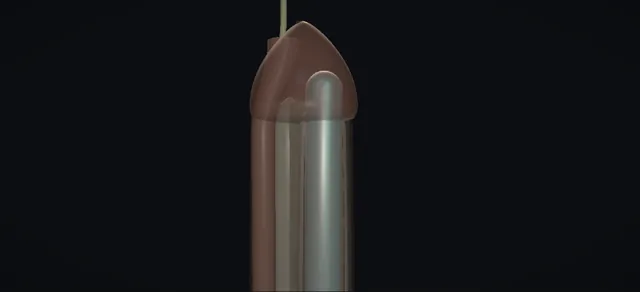
Schematic model of a generic malleable device. No manufacturer represented; not device instructions for use.
Operative animation, Malleable prosthesis
Malleable penile prosthesis: penoscrotal approach
One component in each corpus and nothing else: a firm rod that the man positions by hand.
The operation is a vertical penoscrotal incision, a corporotomy lateral to the spongiosum, dilation along the lateral corporal wall toward the crus and the mid-glans, measurement of both bodies, and a rod folded in and straightened.
The case is won at the dilation and the measurement; the complications live there.
Advanced tierFRCS andrology, prosthetic surgery, sexual medicineInteractive 3D
How to use this module. Play through the nine steps, or use Back and Next. Watch the track along the lateral wall, the two readings on the panel, the rod folded in and straightened, and the final bend down and up. Try a trigger to see a wrong track and its correction.
From the penoscrotal raphe incision along the lateral tunica to the crura and glans. Schematic, not to scale; relationships only.
From one vertical incision at the penoscrotal junction both corpora are reached lateral to the ventral spongiosum;
each track runs along the lateral corporal wall from the crus to the mid-glans with the septum medial, the urethra ventral and the dome distal, and the rod lies straight along that track once it has been folded in.
›Median raphe and the penoscrotal junction - the vertical incision; dartos and the superficial layer of Buck's fascia beneath it.
›Corpus spongiosum and urethra - ventral and midline through the whole approach; retracted to one side so the tunica lateral to it can be opened.
›Tunica albuginea of the corpora - opened between two stay sutures; the lateral wall is the dilator's guide in both directions.
›The septum - medial to each track and thin; crossover goes through it into the other corpus.
›The crura - the proximal limit of each track; the rear tip extender seats here, and a dilator that goes further perforates.
›The distal dome and the glans - the distal limit; the rod tip sits under the mid-glans, and the glans droops if the rod stops short.
Choose the device: one componentA man in his sixties with erectile dysfunction after failed medical therapy has chosen a malleable device because his hands cannot work a pump; the guideline names limited dexterity as one reason to choose a semi-rigid device. He has been told that the penis stays firm at all times, that it is bent down to conceal and up to use, and that concealment is poorer than with an inflatable device. The alternatives were named: a two- or three-piece inflatable device, the infrapubic or subcoronal routes to the same corpora, and, in a different man, immediate malleable insertion after refractory ischaemic priapism. Nothing here is reversible.
Penoscrotal exposureSupine, prepped and draped, a urethral catheter in so the urethra is felt throughout. A vertical incision on the median raphe at the penoscrotal junction, carried through the dartos and the superficial layer of Buck's fascia, and a self-retaining retractor set. The corpus spongiosum is retracted to one side and the corpus cavernosum of the first side identified; the deep layer of Buck's fascia comes off it to expose the tunica albuginea. where it bites: the spongiosum and urethra are ventral and in the midline; the tunica to be opened is lateral to them, never under them.
CorporotomyTwo absorbable stay sutures are placed laterally in the tunica and a corporotomy made between them. The stays hold the edges up, keep the opening where it was planned and will be tied over the rod at the end. Cavernosal tissue shows in the opening. where it bites: a corporotomy that wanders ventrally brings the spongiosum into the field and the urethra under the dilator.
Dilate proximally: the lateral wallDissecting scissors with the tips pointed laterally tunnel the corpus toward the ischial tuberosity, then dilators of rising size follow along the lateral corporal wall until the crus is reached. The feel is the feedback: a smooth glide is the channel, a sudden give is a perforation. Saline with antibiotic is irrigated into the corpus. where it bites: the septum is medial and thin; a dilator that drifts medially crosses into the other corpus. A dilator that drives on past the crus perforates it.
Dilate distally: the ventral urethraThe same scissors and dilators pass distally along the lateral wall to the mid-glans. The hand on the catheter feels where the urethra is. The glans is supported so the distal dome is not driven through. where it bites: ventral drift puts the dilator through the thin ventral tunica into the urethra; over-eager distal passage perforates the dome.
Measure both sidesWith the penis on stretch the measuring and insertion tool is passed proximally and then distally and the length of each read at the corporotomy; the sum is the corporal length. The second corpus is exposed, opened, dilated and measured in the same way. The two sums are compared before any rod is chosen. where it bites: a side-to-side mismatch means a wrong track on one side, not a difference in the man; it is investigated, not averaged.
Size and trimRod diameter is chosen from the dilated channel and rod length from the two readings; the rods are soaked in antibiotic solution. The end is trimmed to the measured length and a rear tip extender added to each rod so the proximal end seats in the crus. where it bites: a rod too short leaves the glans unsupported and drooping; one too long pistons against the dome and erodes.
Place the rodsWith the penis on stretch the rod is positioned distally to the mid-glans, then partially folded on itself so the proximal end can be placed in the ipsilateral crus; it straightens and lies along the whole corpus with the distal tip under the mid-glans. The second rod goes in the same way and its position is confirmed. Nothing is forced. where it bites: a rod that will not lie straight is telling the surgeon the track or the length is wrong; forcing it perforates.
Close and positionThe stay sutures are tied over the rod to close each corporotomy watertight, the needle kept clear of the rod. The wound is irrigated, haemostasis secured and the retractor removed. Dartos is closed with a running absorbable suture and the skin with a subcuticular stitch; the penis is dressed and taped to the abdomen to limit swelling, with the catheter on free drainage. Before he leaves he is shown the bend down and the bend up. where it bites: a needle through the rod at closure damages the device that was just placed.
The spatial relationships the animation is built to make automatic. Before you read each one, ask yourself: at this point in the operation, what is about to go wrong, and what is my first move? The save for each sits in the Complications tab.
RiskThe septum - medial to every pass; a dilator that leaves the lateral wall crosses into the other corpus, and the two measurements then disagree.
RiskThe ventral urethra - under the corpus with the catheter in it; ventral drift of a dilator perforates it, and no rod goes in on that side the same day.
RiskThe crus and the distal dome - the two ends of the track; a dilator driven past either perforates the tunica, and a rod then migrates or erodes.
RiskThe rod at closure - the needle that ties the stays or closes the dartos must stay off the device.
Trigger each of these live in the Animation tab, then read the save: the first move, the escalation trigger, and the line that goes in the op note.
Septal crossover
the dilator drifts medially through the septum into the other corpus; the first sign is often a side-to-side mismatch in the measurements.
The save
Stop and withdraw the dilator; do not place a rod on that side until the track is proven.first move
Re-establish the ipsilateral track along the lateral wall under vision, with the other side dilated first if it helps to feel the septum.
Measure both sides again and accept only readings that match.
A septum that cannot be re-established, or a rod that still crosses, needs the senior implanter now.escalation trigger
Op note: the side, the level of the crossover, how the track was re-established and the final readings on both sides.document
Urethral perforation
ventral drift of a dilator through the tunica into the urethra, felt as a give and seen as the dilator tip against the catheter or urine in the corpus.
The save
Stop dilating that side and confirm the injury: the catheter is seen or felt through the perforation.first move
Do not place a rod on that side today; a prosthesis next to a urethral breach infects and erodes.
Leave the catheter to drain the urethra for the period the senior implanter sets; the contralateral rod may be placed only on a senior decision.
The decision to abandon, to place one rod or to repair the urethra belongs to the senior implanter.escalation trigger
Op note: the side and site of the perforation, what was and was not implanted, the catheter plan and the date to review.document
Proximal crural perforation
a dilator or the rod driven on past the crus through the proximal tunica; a rod placed in that corpus migrates proximally and the penis loses support.
The save
Stop; recognise the loss of resistance at the crus for what it is.first move
Secure the rod's position before closure so it cannot migrate proximally.
A perforation that cannot be managed through the corporotomy needs the senior implanter.escalation trigger
Op note: the side, the level, how the rod was secured and the review plan.document
Undersized rod and drooping glans
a rod that stops short of the mid-glans leaves the glans unsupported, drooping over the tips; the book lists this deformity among the complications.
The save
Recognise it on the table: the glans droops over the rod tips when the penis is held up.first move
Remeasure both the proximal and distal lengths and resize from both readings.
A glans that still droops with correctly sized rods needs the senior implanter's opinion on the distal fixation.escalation trigger
Op note: the readings before and after, the rods removed and placed, and what the glans did when the penis was held up.document
When the case turns: the problem, then the next move.
ActionThe dilator meets resistance early in the proximal track - withdraw, point the scissors tips laterally again and re-establish the track along the lateral wall; resistance is tissue, not a reason to push.
ActionThe two measurements disagree - the track is wrong on one side; dilate again along the lateral wall and measure again before any rod is chosen.
ActionThe rod will not lie straight in the corporotomy - it is too long or the track is wrong; take it out, remeasure and trim, rather than force it.
ActionUrine or the catheter is seen during dilation - the urethra is perforated; stop that side and call the senior implanter.
ActionBleeding from the corporotomy - cavernosal bleeding settles with the stays tied over the rod; haemostasis of the wound is with diathermy before closure.
The examiner stems this scene prepares you for. Try to answer out loud first, then reveal, and learn the discriminator, the detail that turns a pass into a strong pass.
QA man with erectile dysfunction asks whether he should have a malleable or an inflatable prosthesis. How do you counsel him?reveal answer
The guideline says no device and no approach is superior, so the choice is his, made on an honest account of each.
A malleable device is one component with nothing to fail mechanically and a simpler operation;
the penis is firm at all times, positioned by hand, which suits a man whose hands cannot work a pump, and he must accept an unnatural persistent erection and poorer concealment.
An inflatable device gives a more natural flaccid and erect state at the cost of a pump, a reservoir and the complications that come with them.
Both are irreversible: the cavernosal tissue is dilated away.
I would show him both, ask him to describe how he would use each in his own words, and record the choice and the counselling.
Infection is the complication that loses a device of either kind.
Strong pass
Say both
Stating that the guideline finds no device or approach superior
Naming dexterity as a reason to choose the malleable device
Examiner note
Stating that the guideline finds no device or approach superior, and naming dexterity as a reason to choose the malleable device.
QTake me through the insertion of a malleable penile prosthesis.reveal answer
Supine, antibiotics, catheter.
A vertical incision on the median raphe at the penoscrotal junction, through dartos and the superficial layer of Buck's fascia, with a self-retaining retractor.
I retract the spongiosum, identify the first corpus and take the deep layer of Buck's fascia off its tunica.
Two stay sutures laterally and a corporotomy between them.
Scissors with the tips lateral tunnel proximally and distally, then dilators of rising size along the lateral wall to the crus and the mid-glans without perforating the tunica, and I irrigate with antibiotic solution.
With the penis on stretch I measure the distal and proximal lengths with the insertion tool and add them.
The second side the same, and I compare the sums.
I choose the diameter from the dilation and the length from the readings, trim the ends and add rear tip extenders.
The rod goes in distally to the mid-glans, is folded so the proximal end enters the crus, and lies straight; the second the same.
I tie the stays over the rods without touching them, irrigate, secure haemostasis, close dartos and skin, dress, and tape the penis to the abdomen.
Strong pass
Say both
Dilating along the lateral wall with the scissors tips lateral
Comparing the two measurement sums before choosing a rod
Examiner note
Dilating along the lateral wall with the scissors tips lateral, and comparing the two measurement sums before choosing a rod.
QWhy does the dilator hug the lateral wall, and why is the catheter in before you dilate?reveal answer
Each corpus is bounded medially by the septum and ventrally by the thin tunica over the urethra.
A dilator that leaves the lateral wall and drifts medially crosses the septum into the other corpus; the two measurements then disagree, which is the check that catches it.
A dilator that drifts ventrally perforates into the urethra, and the catheter is there so the hand can feel where the urethra is before that happens, and so the perforation is recognised at once if it does.
The lateral wall is the one surface with nothing beyond it that a rod can harm.
Proximally the crus is the limit and distally the dome; driving past either perforates, and a rod in a perforated corpus migrates or erodes.
Strong pass
Say both
Linking a measurement mismatch to crossover
The catheter to both prevention and recognition of urethral perforation
Examiner note
Linking a measurement mismatch to crossover, and the catheter to both prevention and recognition of urethral perforation.
QA man has a drooping glans after his malleable prosthesis. What has happened and what do you do?reveal answer
The rods stop short of the mid-glans, so the glans has no support and droops over the tips; the book lists this deformity among the complications of the operation, and undersizing is the usual cause.
I would examine him with the penis held up to confirm it and exclude the other causes of a floppy glans, and review the operation note for the two readings and the rod length chosen.
The remedy is to remeasure both the proximal and distal lengths and resize from both readings;
if the rods are the right length and the glans still droops, the distal fixation is the senior implanter's problem, and I would not improvise it.
Erosion is the other thing to exclude in a man with a device and new glans symptoms.
Strong pass
Say all three
Naming undersizing as the cause
Resizing from both readings as the remedy
Rather than a distal fixation improvised by the trainee
Examiner note
Naming undersizing as the cause and resizing from both readings as the remedy, rather than a distal fixation improvised by the trainee.
Curriculum. Supports learning relevant to the ISCP Urology Curriculum syllabus topic Erectile dysfunction and penile prosthesis surgery. Not a workplace-based assessment and not evidence of competence.
Two minutes
Close the lap: recall it before you leave.
Say it aloud, then reveal. Reading is not remembering.
01The relationshipSay the critical spatial relationship out loud, then reveal.reveal
Memory frame
From one vertical incision at the penoscrotal junction both corpora are reached lateral to the ventral spongiosum;
Why?
each track runs along the lateral corporal wall from the crus to the mid-glans with the septum medial, the urethra ventral and the dome distal, and the rod lies straight along that track once it has been folded in.
02The first moveSeptal crossover. Your first move?reveal
First move
Stop and withdraw the dilator; do not place a rod on that side until the track is proven.
03The escalation triggerSeptal crossover. What makes you call for help?reveal
Escalate when
A septum that cannot be re-established, or a rod that still crosses, needs the senior implanter now.
04The discriminatorWhat turns a pass into a strong pass?reveal
Strong pass
Say both
Stating that the guideline finds no device or approach superior
Naming dexterity as a reason to choose the malleable device
Examiner note
Stating that the guideline finds no device or approach superior, and naming dexterity as a reason to choose the malleable device.
05The pitfallWhere does this operation bite first?reveal
Pitfall
The septum
Why?
medial to every pass; a dilator that leaves the lateral wall crosses into the other corpus, and the two measurements then disagree.
Revision practice with self-marked answers, not an assessment of clinical competence. Kept in
this browser only; it does not sync between devices.