Operative Dictations in Urologic Surgery
Armenakas NA, Fracchia JA, Golan R. Operative Dictations in Urologic Surgery. Wiley, 2019
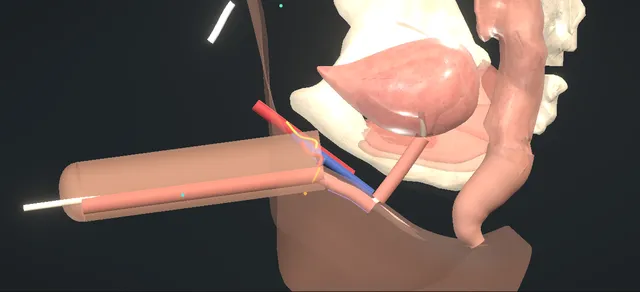
Searched for this operation and found to have no chapter on gender-affirming phalloplasty, metoidioplasty or urethral lengthening; nothing on this page is taken from it. The order of the steps follows the hub sequence for this procedure (define goals; plan donor tissue, lengthening and staging; create a perfused phallus and tension-aware urethral continuity; scrotal and prosthetic stages after healing; lifelong follow-up) and the sources below. The operative detail of the steps (the vaginectomy, the flaps of the pars fixa, the tube within a tube, the groin anastomosis, the suprapubic catheter, the imaging before catheter removal) is general practice in UK and European units, summarised from the Ghent overview and not from a single operative text. The scene is schematic: the forearm is drawn as a panel beside the field, the vaginectomy as the vagina fading and the introitus closing, and the phallus is not drawn to a measured size.
Open guideline
WPATH
Coleman E, Radix AE, Bouman WP, et al. Standards of Care for the Health of Transgender and Gender Diverse People, Version 8. Int J Transgend Health 2022;23(Suppl 1):S1-S259. Chapter 13, Surgery and postoperative care, read 19 October 2026
Statement 13.6: genital procedures considered in eligible adults stable on their current treatment, which may include at least 6 months of hormone treatment unless hormone therapy is not desired or is contraindicated. 13.4: reproductive options discussed before gonadectomy. 13.8: a comprehensive multidisciplinary team consulted for individually customised surgery. 13.9: surgeons caring for people who have had metoidioplasty or phalloplasty encourage lifelong urological follow-up. The text says urethral lengthening is an option for both metoidioplasty and phalloplasty; that if colpectomy is performed a hysterectomy must also be performed; reports urethral strictures of 35 to 58% and lists fistulae, diverticula and hair in the neourethra; lists prosthesis complications as infection (8 to 12%), malfunction, urethral erosion, skin extrusion and dislocation of the bone fixation; and describes follow-up for stricture with bladder ultrasound for residual, urethrography and endoscopy. Read through a fetch tool that returned short quotations.
Open guideline
European Association of Urology
EAU Guidelines on Urethral Strictures: disease management in transgender patients, read 19 October 2026
Do not perform endoscopic incision or urethroplasty within six months after neophalloplasty (strong). Do not perform more than two endoscopic incisions for strictures in trans men unless with palliative intent (strong). Perform staged urethroplasty for strictures at the neophallic urethra if open reconstruction is indicated. The text describes the anastomosis between the neophallic urethra and the fixed part of the urethra; a suprapubic catheter as first-line for obstructive symptoms, recurrent infection or retention, with perineostomy the alternative; a first endoscopic incision patency of 37 to 45.5%. The EAU Sexual and Reproductive Health guideline online had no chapter on this surgery when checked, and BAUS has no operation-specific guidance that was found; neither is quoted.
Open guideline
Plastic and Reconstructive Surgery
Monstrey S, Hoebeke P, Selvaggi G, et al. Penile reconstruction: is the radial forearm flap really the standard technique? Plast Reconstr Surg 2009;124:510-518
Abstract read 19 October 2026. 287 radial forearm phalloplasties by one team: a reliable technique, mostly in two stages, always allowing voiding standing and in most cases sexual satisfaction; the disadvantages are the high number of initial fistulas, the forearm scar and potential long-term urological complications; the authors hold a multidisciplinary approach between plastic surgeon and urologist to be essential. No rates are given in the abstract.
Open guideline
Seminars in Plastic Surgery
Monstrey SJ, Ceulemans P, Hoebeke P. Sex reassignment surgery in the female-to-male transsexual. Semin Plast Surg 2011;25:229-244
Abstract read 19 October 2026. The genital stage includes a vaginectomy, reconstruction of the horizontal part of the urethra, a scrotoplasty and a penile reconstruction, usually with a radial forearm flap; after about one year, when sensation has returned to the tip, erectile and testicular prostheses can be implanted. The source for the order of the stages on this page.
Open guideline
Sexual Medicine Reviews
Wang AMQ, Tsang V, Mankowski P, et al. Outcomes following gender affirming phalloplasty: a systematic review and meta-analysis. Sex Med Rev 2022;10:499-512
Abstract read 19 October 2026. 39 studies, 1731 patients; radial forearm free flap in 75.1%; overall complication rate 76.5%; urethral fistula 34.1% and urethral stricture 25.4%; tactile sensation 93.9% and voiding standing 92.2% where reported. The authors judge the evidence weak.
Open guideline
Journal of Plastic, Reconstructive and Aesthetic Surgery
Hu CH, Chang CJ, Wang SW, Chang KV. A systematic review and meta-analysis of urethral complications and outcomes in transgender men. J Plast Reconstr Aesthet Surg 2022;75:10-24
Abstract read 19 October 2026. 21 studies, 1566 patients: tube in tube in 8 studies (1061 patients), prelaminated flap in 9, second flap in 6. The prelaminated flap had significantly more strictures than the tube in tube. Pooled urethral fistula or stenosis 48.9%; voiding standing 91.5%; prosthesis complications 27.9%; satisfaction 90.5%.
Open guideline
Sexual Medicine
Jolly D, Wu CA, Boskey ER, et al. Is clitoral release another term for metoidioplasty? A systematic review and meta-analysis of metoidioplasty surgical technique and outcomes. Sex Med 2021;9:100294
Abstract read 19 October 2026. 7 series, 403 patients; four techniques, all including urethral lengthening; most voided standing; fistula 5 to 37% and stricture 2 to 35% depending on technique, lowest with the Belgrade technique.
Open guideline
European Urology
Hoebeke PB, Decaestecker K, Beysens M, et al. Erectile implants in female-to-male transsexuals: our experience in 129 patients. Eur Urol 2010;57:334-340
Abstract read 19 October 2026. 129 patients with a neophallus and an erectile prosthesis, mean follow-up 30.2 months; 41.1% needed removal or revision for infection, erosion, dysfunction or leak; across 185 prostheses, infection 11.9%, protrusion 8.1%, leak 9.2%, dysfunction 13%, malposition 14.6%. The authors still regard a hydraulic prosthesis as the best option for intercourse.
Open guideline