
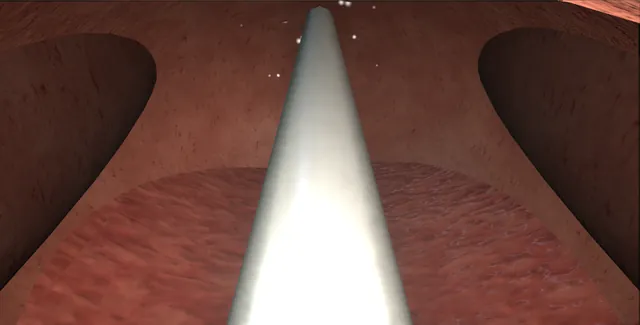
UrOops3D, danger-zone atlas
Operative animation, Rezum water-vapour therapy

Rezum water-vapour thermal therapy

A needle into the transition zone and nine seconds of steam: the vapour spreads between the cells, condenses, and kills the tissue it touches, stopping at the capsule.

Nothing is removed on the day, the urethra swells and a catheter is expected, and the gland shrinks over the following weeks. This page is the map from the neck to the veru, the median lobe done from the neck, and the honest conversation about the first fortnight.

Core tier FRCS core urology, BPH / LUTS and the minimally invasive options Interactive 3D

Operative visualisation

Schematic scene preview: Rezum water-vapour therapy
Preparing the 3D anatomy…

UrOops3D · UroRef · © Nity G

Click me next Section 2 of 8 Anatomy The structures this operation works between, and the one it must not cross.

The structures in the scene

Rezum water-vapour therapy: how the structures relateAlong the prostatic urethra from the cystoscope, veru to bladder neck. Membranous urethra and sphincter: nothing is injected distal to the veru Verumontanum (danger). Verumontanum: last treatment a centimetre short of the veru Transition zone. Transition zone: vapour spreads through the zone and stops here The capsule. Transition zone: first treatment a centimetre distal to the neck Bladder neck. Bladder neck: needle angled away from the trigone behind Median lobe and the trigone behind it (danger).Distal: membranous urethraProximal: bladder!Membranous urethra andsphincterVerumontanumTransition zoneThe capsuleBladder neck!Median lobe and thetrigone behind itnothing is injected distal tothe verulast treatment a centimetreshort of the veruvapour spreadsthrough the zoneand stops herefirst treatment a centimetredistal to the neckneedle angled away from thetrigone behindTargetDangerLandmark
Along the prostatic urethra from the cystoscope, veru to bladder neck. Schematic, not to scale; relationships only.
  • From the veru the prostatic urethra runs to the neck between two lateral lobes and over a median lobe.
  • The treatments sit in a band from a centimetre inside the neck to a centimetre short of the veru, at nine and three, spaced a centimetre apart, each a centimetre deep in the transition zone;
  • the vapour spreads within the zone and stops at the capsule.
  • The median lobe is reached from the neck with the needle pointed away from the trigone behind it.
  • ›Transition zone - the adenoma the needle enters a centimetre deep; the vapour spreads through it and stops at its boundaries.
  • ›The capsule - the barrier the vapour does not cross; the reason the treatment is contained.
  • ›Verumontanum - the distal limit; the last treatment a centimetre proximal to it.
  • ›Bladder neck - the proximal limit; the first treatment a centimetre distal to it.
  • ›The median lobe and the trigone behind it - treated from the neck with the needle angled away from the orifices.
  • ›The needle - deployed about a centimetre into the lobe; nine seconds of vapour at 103 degrees.
  • ›The oedematous urethra - the reason for the catheter: it obstructs before the tissue involutes.
Click me next Section 3 of 8 Steps The operation in order, with the landmark that guards each move.

Operative steps

  1. Who gets vapour The man with a prostate of about thirty to eighty grams, a median lobe allowed, who wants a day-case under local anaesthetic, keeps ejaculation in most cases, and will accept a catheter for a few days and a delayed result. It suits the man who is not fit for a general anaesthetic and the man who wants to stop his tablets. It does not suit the man in chronic retention with a very large gland, or the man who needs a fast result. The gland is sized by ultrasound and the median lobe assessed by cystoscopy before the day, and the PSA and examination are reassuring because there is no histology.
  2. Consent and the room The consent names retention as expected rather than a complication, with a catheter for three to seven days; dysuria, urgency and frequency for several weeks; haematuria as the treated tissue sloughs; infection and epididymitis; and the effect arriving at one to three months rather than on the day. Retrograde ejaculation is uncommon. Retreatment in a proportion over the years is stated. Antibiotics are given, an alpha-blocker started beforehand, and the room has lidocaine gel, a prostatic block or sedation, and the device with its generator.
  3. The device and the limits An 18 French rigid device with a telescope and a retractable needle at its tip, connected to a generator that makes vapour from sterile water. It is passed under vision like a rigid cystoscope. The verumontanum is the distal limit: the last treatment sits about a centimetre proximal to it and nothing is injected beyond it, because the vapour spreads. The bladder neck is the proximal limit: the first treatment about a centimetre distal to it. The length between the two decides the number of treatments per lobe: one for a short urethra, two or three for a long one, spaced about a centimetre apart.
    where it bites: the two limits are measured, not guessed: a centimetre from the neck, a centimetre short of the veru.
  4. The first treatment The device is turned to nine o'clock and pushed gently against the right lateral lobe. The needle is deployed about a centimetre into the lobe, through the urethral wall into the transition zone, and the pedal is pressed: nine seconds of water vapour at about 103 degrees is injected through the needle's side holes and spreads through the interstitial spaces of the tissue, condensing and releasing its heat, and stopping at the capsule and the boundaries of the zone. The mucosa blanches over the treated area. The needle is held still for a second or two after the injection so the vapour finishes condensing, then retracts, and the lobe is left to die over the following weeks.
  5. The map A centimetre further toward the verumontanum on the same lobe, nine o'clock again, and a third if the urethra is long. Then the left lobe at three o'clock, from the neck toward the veru, the mirror. Two to three treatments a side for most glands; larger glands take more. The last treatment on each side is checked against the veru and its needle angled away from it. Each treatment is counted and its position noted as it is done.
  6. The median lobe A median lobe is treated from the neck: the device is angled down at six o'clock and the needle deployed into the lobe, angled away from the trigone and the ureteric orifices that lie behind it. A look from the bladder side afterwards confirms that the needle went into the lobe and not through it into the bladder. One or two treatments deal with most median lobes; a lobe that hangs far into the bladder is treated with the needle angled to stay within it or is better served by another operation.
    where it bites: the median lobe needle is angled away from the trigone; through the lobe is the bladder and the orifices.
  7. The end of the day Five to seven treatments in total for a typical gland and the device comes out. The urethra is already swelling. A catheter goes in for three to seven days because the oedema obstructs before the tissue involutes; an alpha-blocker and antibiotics continue, and the patient is warned about the first fortnight: burning, urgency, blood and debris in the urine as the treated tissue sloughs. The note records the number of treatments and their positions, the median lobe treated or not, the catheter and the date of the trial without catheter.
  8. The weeks after The treated zones necrose and are resorbed over weeks, the lobes shrink and the channel opens without anything having been cut. Symptom scores fall by about half at three months and flow improves; ejaculation is usually preserved. The trial without catheter can fail once and succeed a week later. A few men need a resection or another procedure years on, which remains possible. The result is reviewed at three months with a symptom score and a flow rate.
Click me next Section 4 of 8 Danger zones Where this operation bites, and why it bites there.
Critical relationship

Danger zones

The spatial relationships the animation is built to make automatic. Before you read each one, ask yourself: at this point in the operation, what is about to go wrong, and what is my first move? The save for each sits in the Complications tab.

  • RiskBeyond the veru - vapour in the membranous urethra and the sphincter: nothing is injected distal to the veru.
  • RiskThrough the median lobe - the bladder and the trigone with the orifices; the needle is angled away.
  • RiskThe first fortnight - retention, infection and sloughing: expected, prepared for and explained.
  • RiskThe very large gland - not enough shrinkage to help; another operation.
Practise it Take me into the scene Opens the animation at a danger moment and asks you to predict the mechanism and your first move before it reveals.
Click me next Section 5 of 8 Complications The save for each one: the first move, the escalation trigger, the op-note line.

Complications and immediate saves

Trigger each of these live in the Animation tab, then read the save: the first move, the escalation trigger, and the line that goes in the op note.

Retention after the catheter

  • the trial without catheter fails at day three or five: oedema still obstructing.
The save
  1. Recatheterise; it is the oedema, not the treatment, that has failed for now. first move
  2. Continue the alpha-blocker and try again in a week.
  3. A second failure: flexible cystoscopy for a slough plug, a clot or an untreated median lobe. escalation trigger
  4. Note: the residual, the plan, and the date of the next trial. document

Injected beyond the veru

  • a treatment placed distal to the verumontanum: vapour in the membranous urethra and the sphincter.
The save
  1. Nothing can be undone once the vapour is in; stop and reassess the map from the veru. first move
  2. No further treatment in that sector.
  3. Tell the patient; pelvic floor physiotherapy from the start; a continence assessment if leakage persists beyond three months. escalation trigger
  4. Note: the position, what was seen of the veru, and the plan. document

Needle through the median lobe into the bladder

  • the median lobe needle went through the lobe into the bladder or the trigone: vapour where it does not belong, an orifice at risk.
The save
  1. Withdraw the needle and look from the bladder side. first move
  2. Treat the lobe from further distal with the needle angled down and away from the trigone.
  3. An orifice that has been treated: ultrasound at two weeks and three months for obstruction; stent if it obstructs. escalation trigger
  4. Note: the site, what was seen, and the imaging plan. document

Infection and epididymitis

  • necrotic tissue and a catheter: fever or a painful epididymis in the first fortnight.
The save
  1. Culture the urine and start antibiotics that cover the likely organisms. first move
  2. Check the catheter is draining; a blocked catheter behind sloughing tissue is the usual cause.
  3. Sepsis: admit, intravenous antibiotics, and a scan for an abscess in the prostate. escalation trigger
  4. Note: the cultures, the antibiotics, and the catheter plan. document

Haematuria and sloughing

  • pink urine and debris as the treated zones slough in the second week; clot retention is rare.
The save
  1. Reassure and push fluids; this is the treatment working. first move
  2. Clot retention: a catheter and a bladder syringe washout.
  3. Bleeding that will not settle: admission and a rigid look. escalation trigger
  4. Note: the advice given and the safety net. document
Click me next Section 6 of 8 Troubleshooting When the case turns: the problem, then the next move.

Intra-operative troubleshooting

When the case turns: the problem, then the next move.

  • ActionCannot see the veru to measure from - draw the device back until the sphincter and the veru are seen; nothing is injected until the distal limit is known.
  • ActionThe needle will not deploy - the device is not against the tissue or the needle is bent: reposition, or change the device.
  • ActionNo blanching after the injection - the needle was in the lumen, not the lobe: reposition and push the tip against the tissue before deploying.
  • ActionThe patient cannot tolerate it - more block, sedation, or list for a general anaesthetic; a treatment is not rushed.
  • ActionThe catheter blocks in the first week - slough: a bladder syringe washout and a fresh catheter; not a return to theatre.
  • ActionNo improvement at six weeks - too early: the involution takes up to three months; review with a score and a flow at three months.
Click me next Section 7 of 8 FRCS viva Say it out loud, then mark yourself against the model answer.

FRCS viva questions

The examiner stems this scene prepares you for. Try to answer out loud first, then reveal, and learn the discriminator, the detail that turns a pass into a strong pass.

QHow does water-vapour therapy work and who is it for?reveal answer
  • Rezum uses convective thermal energy: sterile water is heated to vapour by radiofrequency in the generator and injected for nine seconds through a needle deployed about a centimetre into the transition zone of the prostate.
  • The vapour spreads through the interstitial spaces and condenses on the tissue, releasing the latent heat of vaporisation, which raises the tissue to about seventy degrees and causes cell death.
  • Because it moves by convection through the tissue and stops at the capsule and the boundaries of the transition zone, the treatment is contained and the dose is uniform within the zone.
  • The dead tissue is resorbed over weeks, the lobes shrink and the channel opens.
  • It suits a man with a prostate of about thirty to eighty grams, a median lobe included, who wants a day-case under local anaesthetic, preservation of ejaculation, and will accept a catheter for a few days and a result that arrives at one to three months.
  • It does not suit the man in chronic retention with a very large gland or the man who needs an immediate result.
Strong pass

Say both

  • Convection with the latent heat released on condensation and the capsule as the boundary
  • The delayed result with the expected catheter
Examiner note
Convection with the latent heat released on condensation and the capsule as the boundary, and the delayed result with the expected catheter.
QDescribe the technique and the map of treatments.reveal answer
  • With antibiotics given and lidocaine gel, a prostatic block or sedation, I would pass the 18 French rigid device under vision, identify the external sphincter and the verumontanum as the distal limit, and the bladder neck as the proximal limit, and enter the bladder to check the orifices and the median lobe.
  • The map is from about a centimetre distal to the neck to a centimetre proximal to the veru, with treatments a centimetre apart.
  • I would turn the device to nine o'clock, push it gently against the right lobe, deploy the needle a centimetre into the transition zone and give the nine-second injection, watching the mucosa blanch, then move a centimetre toward the veru and repeat, with two or three treatments per lobe depending on the length.
  • I would then treat the left lobe at three o'clock the same way, and a median lobe from the neck with the needle angled down and away from the trigone, confirming from the bladder side that the needle stayed in the lobe.
  • I would place a catheter for three to seven days, prescribe an alpha-blocker and antibiotics, and document the number and positions of the treatments.
Strong pass

Say all three

  • The limits measured from the neck and the veru
  • The needle a centimetre deep and treatments a centimetre apart
  • The median lobe done from the neck angled away from the trigone
Examiner note
The limits measured from the neck and the veru, the needle a centimetre deep and treatments a centimetre apart, and the median lobe done from the neck angled away from the trigone.
QWhat do you tell a patient to expect in the first month after Rezum?reveal answer
  • I would tell him that this treatment gets worse before it gets better.
  • He will go home with a catheter for three to seven days because the prostate swells after the vapour, and a trial without catheter can fail once and succeed a week later; that is expected, not a failure.
  • For two to four weeks he will have burning, frequency and urgency, and his urine will be pink with bits of dead tissue in it as the treated areas slough, which is the treatment working.
  • He should drink well, take the alpha-blocker and any antibiotics prescribed, and come back with a fever, inability to pass urine once the catheter is out, or heavy bleeding with clots.
  • The improvement in his symptoms comes at one to three months as the gland shrinks, and I would see him at three months with a symptom score and a flow rate.
  • Ejaculation is usually preserved.
  • A proportion of men need further treatment in later years, and a resection remains possible.
Strong pass

Retention and sloughing framed as expected, the safety-net symptoms named, and the honest timescale to benefit.

QCompare Rezum, UroLift and TURP for a 65-year-old with a 50 g prostate who wants to preserve ejaculation.reveal answer
  • All three are reasonable for a 50 g gland and the choice turns on what he values.
  • TURP gives the largest and most durable improvement in symptoms and flow, with tissue for histology, but needs a general or spinal anaesthetic, a catheter and a night in hospital, and causes retrograde ejaculation in most men, so it does not meet his priority.
  • UroLift is a day-case under local anaesthetic with no catheter for most, preserves ejaculation and erections, and gives an immediate result, but the improvement is smaller and about a third need a further procedure within five years;
  • it suits lateral lobe anatomy best.
  • Rezum is also a day-case under local anaesthetic and preserves ejaculation in most, treats a median lobe, and gives an improvement between the two, but the result is delayed by one to three months, a catheter for a few days is expected, and the first fortnight is unpleasant with retreatment in a proportion over the years.
  • For a man prioritising ejaculation I would offer UroLift or Rezum depending on his anatomy and his tolerance of a catheter and a delayed result, with TURP explained as the more durable option he can still have later.
Strong pass

Say both

  • Matching the priority to the trade-offs for each option
  • With the delayed result and catheter of Rezum and the durability gap of both minimally invasive options stated
Examiner note
Matching the priority to the trade-offs for each option, with the delayed result and catheter of Rezum and the durability gap of both minimally invasive options stated.
Click me next Section 8 of 8 Evidence The guidance each of these answers is built on.

Evidence and guidance

Two minutes

Close the lap: recall it before you leave.

Say it aloud, then reveal. Reading is not remembering.

  1. 01 The relationship Say the critical spatial relationship out loud, then reveal. reveal
    Memory frame

    From the veru the prostatic urethra runs to the neck between two lateral lobes and over a median lobe.

    Why?
    The treatments sit in a band from a centimetre inside the neck to a centimetre short of the veru, at nine and three, spaced a centimetre apart, each a centimetre deep in the transition zone; the vapour spreads within the zone and stops at the capsule. The median lobe is reached from the neck with the needle pointed away from the trigone behind it.
  2. 02 The first move Retention after the catheter. Your first move? reveal
    First move

    Recatheterise; it is the oedema, not the treatment, that has failed for now.

  3. 03 The escalation trigger Retention after the catheter. What makes you call for help? reveal
    Escalate when

    A second failure: flexible cystoscopy for a slough plug, a clot or an untreated median lobe.

  4. 04 The discriminator What turns a pass into a strong pass? reveal
    Strong pass

    Say both

    • Convection with the latent heat released on condensation and the capsule as the boundary
    • The delayed result with the expected catheter
    Examiner note
    Convection with the latent heat released on condensation and the capsule as the boundary, and the delayed result with the expected catheter.
  5. 05 The pitfall Where does this operation bite first? reveal
    Pitfall

    Beyond the veru

    Why?
    vapour in the membranous urethra and the sphincter: nothing is injected distal to the veru.

Revision practice with self-marked answers, not an assessment of clinical competence. Kept in this browser only; it does not sync between devices.