Nothing is cut: a needle fired through each lateral lobe anchors a tab on the capsule and a monofilament tensions it to a tab on the mucosa, so the lobes are held apart like curtains. Local anaesthetic, no catheter for most, ejaculation kept.
This page is who it suits, the map of where the implants go and where they never go, and the third of men who need something more within five years.
Core tierFRCS core urology, BPH / LUTS and the minimally invasive optionsInteractive 3D
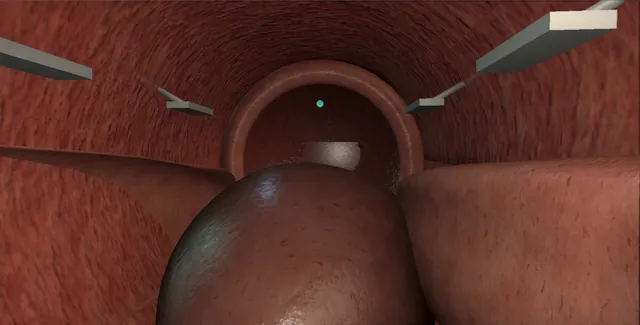
From the veru along the prostatic urethra to the bladder neck. Schematic, not to scale; relationships only.
From the veru the two lateral lobes press in from either side and meet in the midline; the lift pulls each one back toward its own capsule with a thread between two tabs.
The implants sit anterolaterally at ten and two, in a band that starts 1.5 cm distal to the neck and ends a centimetre short of the veru, so nothing reaches the bladder at one end or the sphincter at the other.
›The lateral lobes at ten and two - anterolateral, where there is tissue to compress and a capsule to anchor to.
›Twelve o'clock - no lobe to hold and the dorsal venous complex: never here.
›Six o'clock and the veru - the ejaculatory ducts: never here, and the last pair a centimetre proximal to the veru.
›The bladder neck - 1.5 cm proximal to the first pair; closer and the tab goes through into the bladder.
›The capsular tab - nitinol, beyond the capsule, holding the monofilament.
›The urethral end piece - stainless, cut flush on the mucosa; it must not stand off into the lumen.
›The delivery device - 20 French rigid, 2.9 mm telescope, a needle that fires through the lobe.
Who gets a liftThe man with bothersome symptoms and a prostate between thirty and eighty grams who wants to keep ejaculation and erections, avoid a catheter and a general anaesthetic, and go home the same day, and who understands that the effect is smaller than a resection. Lateral lobe obstruction is the anatomy it treats; an obstructing median lobe was once a contraindication and can now be treated with a specific technique, but a large intravesical lobe is still better served by another operation. A man in retention can be treated, with a small catheter afterwards. The gland size and the median lobe are assessed by ultrasound and cystoscopy before the day.
Consent and the roomThe consent names dysuria, urgency and haematuria for two to four weeks; pelvic discomfort; a small risk of retention needing a catheter for a few days; infection; the implant that ends up in the bladder or the urethral lumen and encrusts; and the retreatment rate, about a third within five years, with TURP or another procedure still possible afterwards. The implants are MRI-conditional, which is told to the patient and written in the note. The room is an endoscopy room or a day-case theatre with lidocaine gel, a prostatic block or sedation, and the delivery device with its cartridges counted.
The device and the cystoscopyThe delivery device is a rigid 20 French instrument carrying a 2.9 millimetre telescope, a needle that fires through the lobe, and the implant: a capsular tab of nitinol, a monofilament, and a stainless urethral end piece. It is passed under vision like a rigid cystoscope. The sphincter, the verumontanum, the lateral lobes kissing in the midline, the length from the veru to the bladder neck, and the neck itself are noted; the bladder is entered to see both orifices and to look back at the median lobe, because a lobe that hangs into the bladder changes the plan.
The mapThe implants go into the anterolateral lobe at ten and two o'clock, never at twelve, where there is no lobe to hold and the dorsal venous complex lies, and never at six, where the veru and the ejaculatory ducts are. The first pair sits about 1.5 centimetres distal to the bladder neck, so the capsular tab does not go through into the bladder, and the last pair about a centimetre proximal to the verumontanum, so nothing sits in the membranous urethra. Two pairs for a typical gland, three for a long prostatic urethra. The map is decided before the first implant, not made up as it goes along. where it bites: too close to the neck and the tab goes through into the bladder; too far distal and the implant sits in the membranous urethra.
The first implantThe device is turned to ten o'clock and its tip pushed against the right lobe to compress it toward the capsule, so that the needle path is short and the lobe is already displaced when the implant is set. The needle is fired: it passes through the lobe and the capsular tab deploys beyond the capsule. The needle withdraws, the monofilament is tensioned, and the urethral end piece is deployed flush on the mucosa and cut. The lobe is now held back. The implant is looked at: the tab flat on the mucosa and no thread across the lumen.
The other threeTwo o'clock on the left lobe at the same level is the mirror. Then the second pair a centimetre further toward the apex, still short of the veru and checked against it. Four implants for a typical gland, six for a long urethra; a median lobe, if it is to be treated, is lifted with its own technique from the neck. Each implant is inspected after it is cut, and the cartridges are counted against the implants placed.
The checkThe lens looks down the channel from the neck: the lobes held apart and the urethra open from the neck to the veru. Each urethral tab is flush on the mucosa, no monofilament crosses the lumen, and nothing has been left in the bladder, which is looked at again before the device comes out. The bladder is emptied and the device withdrawn. Most men need no catheter; the man treated in retention, or with a bloody urethra, has a small catheter overnight. where it bites: an implant end that stands off the mucosa or a tab in the bladder is a stone in a year; every implant is looked at after it is cut.
The note and the adviceThe note records the number of implants, each one's clock position and distance from the neck, the lot numbers, the median lobe treated or not, the channel seen, the catheter or not, and that the implants are MRI-conditional. The patient is told to expect burning and blood for two weeks, that the symptoms improve by about a month, that ejaculation and erections are unchanged, and that a third of men need something more within five years, which the lift does not prevent.
The spatial relationships the animation is built to make automatic. Before you read each one, ask yourself: at this point in the operation, what is about to go wrong, and what is my first move? The save for each sits in the Complications tab.
RiskToo close to the neck - the capsular tab passes through the bladder wall and the implant sits in the bladder, where it encrusts.
RiskToo far distal - an implant at or beyond the veru sits in the membranous urethra: pain and continence at risk.
RiskTwelve o'clock - no lobe and the dorsal vein; six o'clock the ducts.
RiskThe implant end in the lumen - the nucleus of a stone within the year.
Trigger each of these live in the Animation tab, then read the save: the first move, the escalation trigger, and the line that goes in the op note.
Implant into the bladder
fired too close to the neck: the capsular tab through the bladder wall, the implant in the bladder.
The save
Recognise it now: look into the bladder after every implant near the neck.first move
A free implant is retrieved with graspers; an anchored one has its thread cut and both ends removed.
The next implant goes further distal, measured from the neck.
An implant found in the bladder later, encrusted: cystoscopy under anaesthetic, the stone fragmented and the implant removed.escalation trigger
Note: the implant removed, the count corrected, and the lot number.document
Haematuria
a vessel in the lobe pierced by the needle: brisk bleeding from the tab site.
The save
Irrigate and look; almost all stops within minutes.first move
A urethra that will not clear: a small catheter overnight.
Clot retention or a falling haemoglobin: admission, washout, and a rigid look with a button electrode.escalation trigger
Note: the bleeding, the catheter, and the advice given; blood for two weeks was in the consent.document
Retention afterwards
oedema around the implants, or a median lobe that was not addressed: cannot void on the first day.
The save
A small catheter and an alpha-blocker.first move
A trial without catheter in a few days to a week as the oedema settles.
A second failure: flexible cystoscopy for a median lobe or an implant across the lumen; the man with a big median lobe needs another operation.escalation trigger
Note: the residual, the catheter, and the date of the next trial.document
Encrustation and a stone
an implant end left in the lumen or the bladder becomes the nucleus of a stone months later.
The save
Prevention is the inspection of every implant after it is cut: tab flush, nothing standing off, nothing in the bladder.first move
Irritative symptoms, infection or haematuria months later: flexible cystoscopy.
A stone on an implant: rigid cystoscopy, the stone fragmented, the implant removed.escalation trigger
Note: the implant removed and the lot number reported.document
Too distal: the sphincter
a pair placed at or beyond the veru sits in the membranous urethra: pain, and continence at risk.
The save
Recognise it against the veru before the next implant.first move
Cut the thread and remove both ends under vision.
The next pair is placed by the map, measured from the veru, not by the eye.
Persisting pain or leakage: urology review and a continence assessment.escalation trigger
When the case turns: the problem, then the next move.
ActionThe lobe will not compress - the device is not turned enough toward it, or the tissue is fibrous: push the tip firmly against the lobe at ten or two before firing.
ActionThe thread is across the lumen after cutting - the end piece did not seat: retension if the device allows, or remove the implant and place another.
ActionCannot see the neck to measure from - into the bladder and back; the map is measured, not estimated.
ActionBlood obscures the view - irrigate, wait a minute; the next implant is not placed blind.
ActionA median lobe hangs into the bladder - a specific median lobe technique or another operation; the lift of the lateral lobes alone will not open the channel.
ActionThe cartridge count does not match - stop and look in the bladder and the urethra for the missing implant before the device comes out.
The examiner stems this scene prepares you for. Try to answer out loud first, then reveal, and learn the discriminator, the detail that turns a pass into a strong pass.
QWhich patients are suitable for a prostatic urethral lift and what do you tell them about outcomes?reveal answer
The lift suits a man with bothersome lower urinary tract symptoms from benign prostatic obstruction, a prostate of about thirty to eighty grams with lateral lobe anatomy, who prioritises preserving ejaculation and sexual function, wants to avoid a catheter and a general anaesthetic, and accepts a smaller and less durable benefit than a resection.
An obstructing median lobe was a contraindication and can now be treated with a specific technique, but a large intravesical lobe is better served by another procedure.
I would tell him that it is done under local anaesthetic as a day case, that symptoms improve by about a month with a fall in symptom score of around half, that flow improves modestly, that ejaculation and erectile function are preserved, and that he should expect dysuria, urgency and haematuria for two to four weeks.
I would explain that about a third of men need a further procedure within five years and that TURP remains possible afterwards, and that the implants are MRI-conditional.
I would document the counselling and the alternatives discussed, including medication, Rezum and TURP.
Strong pass
Say all three
The size and lateral lobe anatomy
Preservation of ejaculation as the reason to choose it
The retreatment rate stated honestly
Examiner note
The size and lateral lobe anatomy, preservation of ejaculation as the reason to choose it, and the retreatment rate stated honestly.
QDescribe where you place the implants and why.reveal answer
The implants go into the anterolateral lobes at about ten and two o'clock, because that is where there is lobe to compress and a capsule to anchor to, and where retraction opens the channel.
They are never placed at twelve o'clock, where there is no lobe and the dorsal venous complex lies, or at six, where the verumontanum and the ejaculatory ducts are.
Along the urethra, the first pair sits about 1.5 centimetres distal to the bladder neck so that the capsular tab does not pass through the bladder wall and end up in the bladder, and the last pair about a centimetre proximal to the veru so that nothing lies in the membranous urethra near the sphincter.
Two pairs are usual; three for a long prostatic urethra.
I would decide the map at cystoscopy, measure from the neck and the veru rather than estimate, and inspect each implant after it is cut so that the urethral tab is flush and no thread crosses the lumen.
Strong pass
Say both
Ten and two with the reasons for avoiding twelve and six
The 1.5 cm and 1 cm margins from the neck and the veru with what each prevents
Examiner note
Ten and two with the reasons for avoiding twelve and six, and the 1.5 cm and 1 cm margins from the neck and the veru with what each prevents.
QWhat are the complications of the prostatic urethral lift?reveal answer
Early symptoms are the rule rather than a complication: dysuria, urgency, pelvic discomfort and haematuria for two to four weeks, and these are in the consent.
Retention occurs in a small proportion, from oedema or an untreated median lobe, and is managed with a temporary catheter.
Infection is uncommon.
Device-related complications are the implant misplaced into the bladder from firing too close to the neck, which encrusts and must be removed;
an implant end standing off the mucosa or a thread across the lumen, which becomes the nucleus of a stone;
and an implant placed too distally in the membranous urethra.
Sexual function is preserved, which is the point of the operation, and there is no significant incontinence when the map is respected.
The main late issue is a lack of durability, with about a third needing a further procedure within five years.
The implants are MRI-conditional.
I would prevent the device complications by measuring the map from the neck and the veru and inspecting every implant after it is cut.
Strong pass
Say both
Separating expected early symptoms from true device complications
Naming the misplaced or encrusted implant with its prevention
Examiner note
Separating expected early symptoms from true device complications, and naming the misplaced or encrusted implant with its prevention.
QA man is in retention after a prostatic urethral lift done last week. What do you do?reveal answer
Retention after a lift is usually oedema around the implants in the first days, or a median lobe that was not treated;
the immediate management is a small urethral catheter, passed gently because the urethra is inflamed and the implants are new, and an alpha-blocker if not already prescribed.
I would check for infection and for a clot in the bladder.
I would plan a trial without catheter in a few days to a week when the oedema has settled.
If that fails, I would arrange a flexible cystoscopy to look for a median lobe obstructing the outlet, an implant or thread lying across the lumen, or a clot, and I would check the operation note for the number and positions of the implants and whether a median lobe was noted.
If the obstruction is a median lobe, the lift alone was the wrong operation for him and he will need a further procedure such as a resection, which is possible with the implants in place.
I would document each step and keep the patient informed.
Strong pass
Say both
Oedema versus an untreated median lobe as the two causes
With a gentle catheter now and flexible cystoscopy if the second trial fails
Examiner note
Oedema versus an untreated median lobe as the two causes, with a gentle catheter now and flexible cystoscopy if the second trial fails.
Say it aloud, then reveal. Reading is not remembering.
01The relationshipSay the critical spatial relationship out loud, then reveal.reveal
Memory frame
From the veru the two lateral lobes press in from either side and meet in the midline; the lift pulls each one back toward its own capsule with a thread between two tabs.
Why?
The implants sit anterolaterally at ten and two, in a band that starts 1.5 cm distal to the neck and ends a centimetre short of the veru, so nothing reaches the bladder at one end or the sphincter at the other.
02The first moveImplant into the bladder. Your first move?reveal
First move
Recognise it now: look into the bladder after every implant near the neck.
03The escalation triggerImplant into the bladder. What makes you call for help?reveal
Escalate when
An implant found in the bladder later, encrusted: cystoscopy under anaesthetic, the stone fragmented and the implant removed.
04The discriminatorWhat turns a pass into a strong pass?reveal
Strong pass
Say all three
The size and lateral lobe anatomy
Preservation of ejaculation as the reason to choose it
The retreatment rate stated honestly
Examiner note
The size and lateral lobe anatomy, preservation of ejaculation as the reason to choose it, and the retreatment rate stated honestly.
05The pitfallWhere does this operation bite first?reveal
Pitfall
Too close to the neck
Why?
the capsular tab passes through the bladder wall and the implant sits in the bladder, where it encrusts.
Revision practice with self-marked answers, not an assessment of clinical competence. Kept in
this browser only; it does not sync between devices.