
Water-vapour thermal therapy of the prostate
Transurethral delivery of metered water vapour into selected prostatic transition-zone tissue, producing delayed tissue ablation and volume reduction.
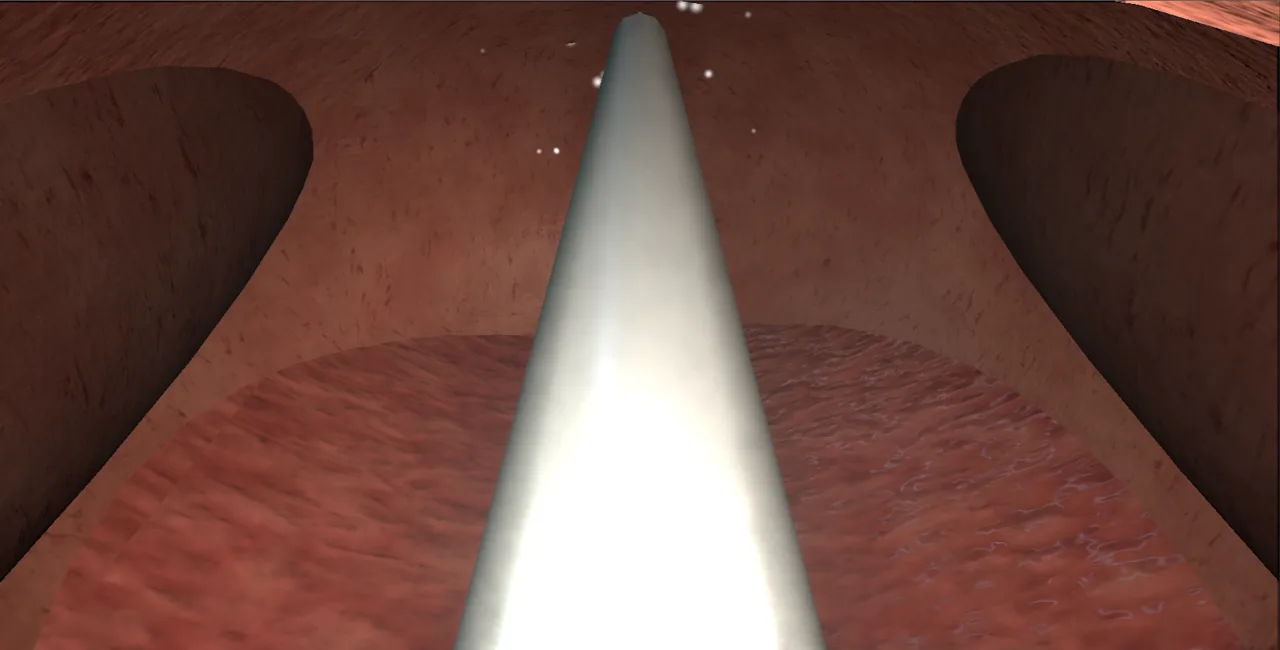 Interactive 3D Interactive water-vapour therapy Open the 3D animation
Teaching catalogue only. This coverage record is not a patient pathway or operative instruction.
Typical place in practice
Selected benign prostatic obstruction where anatomy, expected delayed response and preservation priorities fit a minimally invasive thermal option.
Alternatives and neighbouring procedures
Medication, prostatic urethral lift, TURP, enucleation, vaporisation, Aquablation or catheter strategies.
Same procedure family, explicit technique branches
These are variations of this canonical operation. Complication modules below identify whether they apply to all branches or only to named approaches.
Lateral-lobe water-vapour treatment
Treatments are mapped along obstructing lateral lobes while avoiding sphincter and bladder neck.
Median-lobe water-vapour treatment
An obstructing median lobe is assessed and treated with orientation to bladder neck and trigone.
Water-vapour treatment with planned catheter pathway
Temporary postoperative drainage is incorporated because oedema can worsen obstruction before tissue involution.
High-level sequence
Coverage outline only; not a step-by-step technical guide.
- Confirm outlet anatomy, including median lobe and urethral length
- Inspect bladder neck, verumontanum and treatment zones
- Place each needle deployment within planned adenoma tissue
- Complete mapped treatments without encroaching on sphincter or bladder
- Provide drainage and follow-up that reflect delayed swelling and response
The operation, step by step
A step that touches one of this module's danger zones is marked and cross-linked below.
- SetupLocal anaesthesia with sedation or general anaesthesia, lithotomy position, Rezum console with the sterile delivery device prepared and a continuous-flow cystoscope sheath.
- AccessPass the sheath under vision and survey the outlet, measuring prostate length and defining the lobes.
- Build the treatment map: lateral-lobe treatments about every centimetre from bladder neck to verumontanum, plus median-lobe treatments when a median lobe obstructs.
- Identify the bladder neck, trigone and ureteric orifices before every puncture. danger zone: Bladder neck, trigone and ureteric orifices
- Place the needle under vision inside adenoma tissue, judged so that no treatment reaches through the prostatic capsule beyond the treatment needle. danger zone: Prostatic capsule beyond the treatment needle
- Confirm the needle tip sits clear of the external sphincter and verumontanum before firing. danger zone: External sphincter and verumontanum
- Deliver the vapour cycle and hold the needle still through the delivery and the pause that follows.
- Work systematically across the map, alternating sides, one puncture at a time.
- Survey at the end: an open channel present, the sphincter region free of blistering, and the orifices spared.
- Leave a catheter and document the number and position of treatments.
- ClosureNo closure: catheter drainage only.
- AftercareCatheter for about a week scaled to retention risk, warn that a swelling phase makes symptoms worse before improvement over six weeks, and review at three months with a flow study.
Every failure mode is its own module.
Timing and variation coverage are recorded for each module.
Acute urinary retention
Expected inflammatory swelling can transiently worsen obstruction and prolong or recreate the need for drainage.
Applies to: Lateral-lobe water-vapour treatment · Median-lobe water-vapour treatment · Water-vapour treatment with planned catheter pathwayDysuria, urgency or pelvic discomfort
Thermal inflammation and tissue necrosis can cause bothersome urinary and pelvic symptoms during healing.
Applies to: Lateral-lobe water-vapour treatment · Median-lobe water-vapour treatment · Water-vapour treatment with planned catheter pathwayUrinary infection
Instrumentation, retention, necrotic tissue and catheterisation can contribute to infection.
Applies to: Lateral-lobe water-vapour treatment · Median-lobe water-vapour treatment · Water-vapour treatment with planned catheter pathwayHaematuria or haematospermia
Needle puncture and tissue inflammation can cause urinary or seminal bleeding.
Applies to: Lateral-lobe water-vapour treatment · Median-lobe water-vapour treatment · Water-vapour treatment with planned catheter pathwayBladder-neck, sphincter or extraprostatic thermal injury
Incorrect needle depth or treatment location may affect non-target structures and produce pain, continence or outlet consequences.
Applies to: Lateral-lobe water-vapour treatment · Median-lobe water-vapour treatmentSexual-function change
The procedure is designed to limit sexual adverse effects, but ejaculatory, erectile or sensory changes can still occur.
Applies to: Lateral-lobe water-vapour treatment · Median-lobe water-vapour treatment · Water-vapour treatment with planned catheter pathwayPersistent obstruction or need for retreatment
Incomplete tissue response, unsuitable anatomy or progressive adenoma can leave symptoms and require another intervention.
Applies to: Lateral-lobe water-vapour treatment · Median-lobe water-vapour treatment · Water-vapour treatment with planned catheter pathwaySources for this module
Contemporary outlet procedures, selection, variants and functional trade-offs.
Accessed 2026-08-03 · opens source European Association of Urology EAU Guidelines on Urological InfectionsInfection prevention, recognition and procedure-associated infection context.
Accessed 2026-08-03 · opens source British Association of Urological Surgeons Patient information leaflets by procedureUK patient-facing procedure, alternatives, recovery and complication framing.
Accessed 2026-08-03 · opens source