
Ileal conduit urinary diversion
Incontinent urinary diversion using an isolated ileal segment connected to the ureters and brought to the abdominal wall as a stoma.
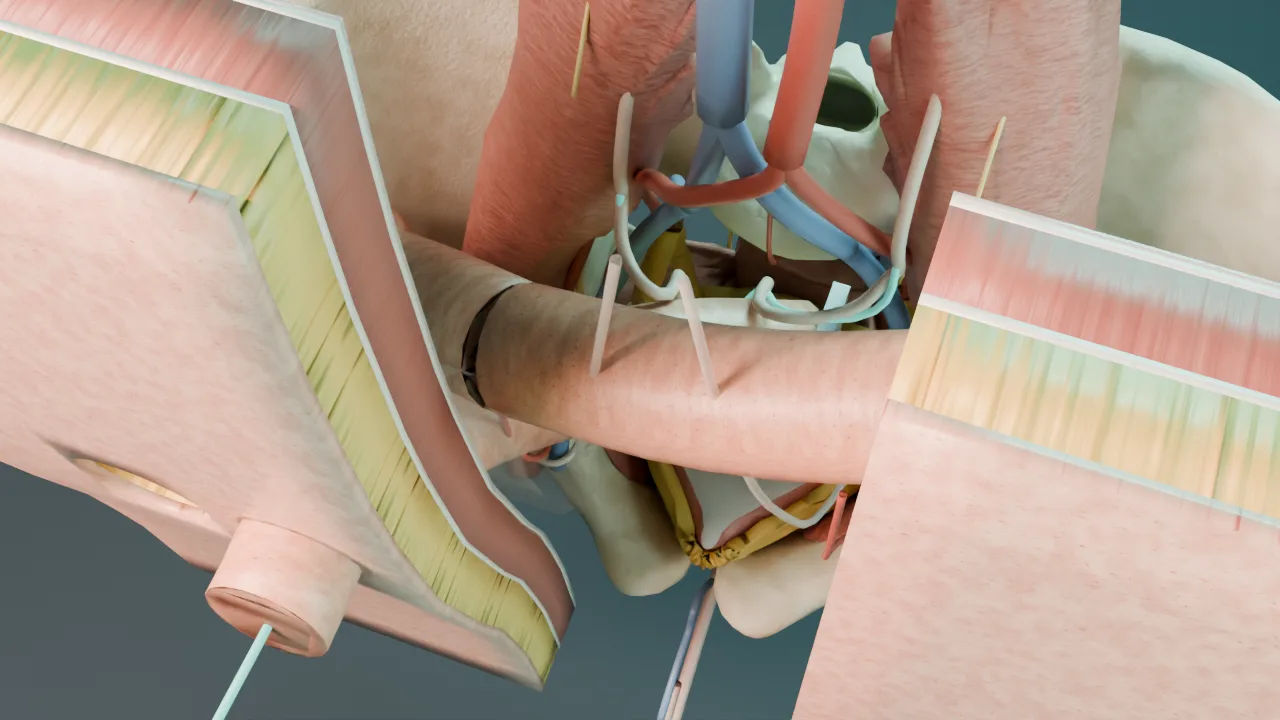 Interactive 3D Interactive open supratrigonal cystectomy + conduit Open the 3D animation
Teaching catalogue only. This coverage record is not a patient pathway or operative instruction.
Typical place in practice
Urinary diversion after cystectomy or for selected benign end-stage bladder conditions when a conduit is the preferred reconstruction.
Alternatives and neighbouring procedures
Orthotopic neobladder, continent cutaneous diversion, ureterostomy or non-operative drainage according to context and suitability.
Same procedure family, explicit technique branches
These are variations of this canonical operation. Complication modules below identify whether they apply to all branches or only to named approaches.
Bricker separate ureteroileal anastomoses
Each ureter is implanted separately into the conduit segment.
Wallace common-plate anastomosis
Ureters are joined into a common plate before implantation, changing stricture and recurrence implications.
Intracorporeal ileal conduit
Bowel isolation, ureteric implantation and conduit formation occur within the abdomen robotically.
Extracorporeal ileal conduit
The bowel and conduit reconstruction are completed through an incision after open or robotic extirpation.
High-level sequence
Coverage outline only; not a step-by-step technical guide.
- Confirm stoma site, bowel suitability and ureteric reach
- Isolate a well-vascularised ileal segment and restore bowel continuity
- Mobilise ureters while preserving blood supply
- Construct tension-free, watertight ureteroileal anastomoses
- Mature a viable protruding stoma and confirm drainage and device plan
Operative notes
Concise operative notes covering the key steps, landmarks and watch points, in the order you encounter them.
Ileal conduit
What it does: urine out through a short piece of bowel.
- 15 cm ileum. At least 15 cm from the caecum.
- Longer mesentery cut at the far end (it must reach the skin). Short cut near end = better supply.
- Bowel divided with a linear stapler. Rejoined ABOVE the conduit: stapled side to side, the open end stapled across.
- Ureters spatulated 2-3 cm.
- Sewn into 1 "plate", 4/0, starting at the heel.
- Plate joined to bowel, 3/0, running up each side. 8Fr feeding tubes up the ureters, through first.
- Flush 50 mL saline in. Leaks? Rescue stitches.
- Bury the join behind peritoneum. Contains leaks. Protects at future surgery.
- Stoma: skin + fat disc at the marked site. Cruciate cut in the rectus sheath. 4 corner stitches, sheath to bowel wall (stops hernia beside the stoma).
- Conduit out. Mature as a spout, skin to bowel.
- Close the gap beside it. Drain near, not on, the join.
- Watch: Big abdomen? Turnbull loop stoma. Know the name.
From the UroRef Operative Quick Guide. Open the note page →
Every failure mode is its own module.
Timing and variation coverage are recorded for each module.
Ureteroileal leak
Ischaemia, tension or anastomotic failure can produce urinary leakage, collection and infection.
Applies to: Bricker separate ureteroileal anastomoses · Wallace common-plate anastomosis · Intracorporeal ileal conduit · Extracorporeal ileal conduitUreteroileal stricture and upper-tract obstruction
Ischaemia, scarring or recurrence can narrow an anastomosis and threaten renal drainage.
Applies to: Bricker separate ureteroileal anastomoses · Wallace common-plate anastomosis · Intracorporeal ileal conduit · Extracorporeal ileal conduitBowel leak, ileus or obstruction
Bowel isolation and re-anastomosis can fail or lead to delayed gastrointestinal recovery and adhesive obstruction.
Applies to: Bricker separate ureteroileal anastomoses · Wallace common-plate anastomosis · Intracorporeal ileal conduit · Extracorporeal ileal conduitUrinary, intra-abdominal or wound infection
Urine, bowel and abdominal wounds create overlapping infection sources.
Applies to: Bricker separate ureteroileal anastomoses · Wallace common-plate anastomosis · Intracorporeal ileal conduit · Extracorporeal ileal conduitStoma ischaemia, retraction or mucocutaneous separation
Mesenteric tension, poor perfusion or abdominal-wall geometry can compromise early stoma healing and appliance fit.
Applies to: Bricker separate ureteroileal anastomoses · Wallace common-plate anastomosis · Intracorporeal ileal conduit · Extracorporeal ileal conduitParastomal hernia, prolapse or stenosis
The abdominal-wall conduit aperture can enlarge, narrow or permit bowel herniation over time.
Applies to: Bricker separate ureteroileal anastomoses · Wallace common-plate anastomosis · Intracorporeal ileal conduit · Extracorporeal ileal conduitMetabolic, renal or nutritional consequences
Urine contact with bowel and altered bowel length can contribute to electrolyte, acid-base, renal and nutritional problems.
Applies to: Bricker separate ureteroileal anastomoses · Wallace common-plate anastomosis · Intracorporeal ileal conduit · Extracorporeal ileal conduitConduit or upper-tract stones
Mucus, infection, foreign material and impaired drainage can promote calculus formation.
Applies to: Bricker separate ureteroileal anastomoses · Wallace common-plate anastomosis · Intracorporeal ileal conduit · Extracorporeal ileal conduitCommon-plate obstruction affecting both kidneys
A problem at the shared anastomosis can compromise bilateral drainage rather than one ureter alone.
Applies to: Wallace common-plate anastomosisSources for this module
Radical cystectomy, lymph-node dissection and urinary diversion.
Accessed 2026-08-03 · opens source European Association of Urology EAU Guidelines on Urological InfectionsInfection prevention, recognition and procedure-associated infection context.
Accessed 2026-08-03 · opens source British Association of Urological Surgeons Patient information leaflets by procedureUK patient-facing procedure, alternatives, recovery and complication framing.
Accessed 2026-08-03 · opens source