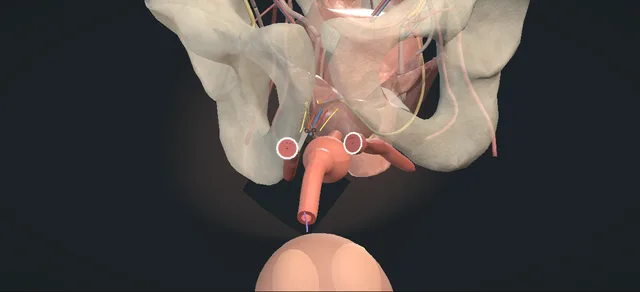
Operative Dictations in Urologic Surgery
Armenakas NA, Fracchia JA, Golan R. Total penectomy. Chapter 32. Wiley, 2019
The indication (cancer whose location precludes a functional remnant); the six essential steps (cover the tumour, a cuff of healthy tissue proximal to it, a haemostatic closure of each corpus individually, no angulation of the urethra in the tunnel, a patulous perineal urethrostomy, a catheter); the perineal inverted-Y variation; the complication list. The book's margin figure, a cuff of at least 2 cm, is given once, in the margin viva answer, beside the guideline; its figures for the ellipse, the catheter and the sutures are kept out of the teaching text. Keeping length on the proximal urethra, the stay suture, stopping the dissection at the edge of the bulb and the check for a twist are authored from general practice, not from the chapter.
Open guideline
EAU-ASCO Guidelines
Penile Cancer: Disease management, treatment of the primary tumour (sections 6.1.2 to 6.1.5), read 13 October 2026
No clear evidence for an oncologically safe width of negative margin. Frozen section helpful but not routine; recommended (weak) when completeness of resection is in doubt. Perineal urethrostomy reserved for men whom a safe resection would leave unable to void standing. Total penectomy with perineal urethrostomy for large invasive tumours not amenable to partial amputation (strong). Total phallic reconstruction may be offered; flaps may be needed for the defect; induction chemotherapy or chemoradiotherapy for non-resectable disease (weak).
Open guideline
Urologic Oncology
de Vries HM, Chipollini J, Slongo J, et al. Outcomes of perineal urethrostomy for penile cancer: a 20-year international multicenter experience. Urol Oncol 2021;39(8):500.e9-500.e13
299 men, seven centres, 2000 to 2020; described by its authors as the most extensive series at publication. Complications within 30 days in 19 per cent, 79 per cent of them Clavien-Dindo I or II; wound infection 11 per cent, dehiscence 4.0 per cent. Stenosis in 12 per cent (35 of 299), of which 74 per cent needed surgical revision; only two stenoses after two years. The abstract reports rates; it does not attribute stenosis to any step of the operation (abstract read 13 October 2026).
Open guideline
Journal of Clinical Medicine
Velarde Ramos L, Martins F. Role of perineal urethrostomy in reconstructive urology. J Clin Med 2026;15(11):4133
Review. Perineal urethrostomy is the definitive urinary diversion after total penectomy and is designed on the same reconstructive principles as any other; it requires preserved sphincteric continence and no proximal urethral stenosis (abstract read 13 October 2026).
Open guideline