UrOops3D, danger-zone atlas

Schematic model.

Operative animation, Penile inversion vaginoplasty

Gender-affirming feminising urogenital reconstruction: penile inversion vaginoplasty

Vaginoplasty creates a vulva and, when a canal is wanted, a vagina from the genital tissues.

The urologist meets its urinary parts: the orchidectomy, the space between the prostate and the rectum, the urethra shortened and spatulated to a new meatus, and lifelong follow-up of the prostate that remains.

Advanced tier FRCS andrology, genital reconstruction, female and functional urology Interactive 3D

Operative visualisation

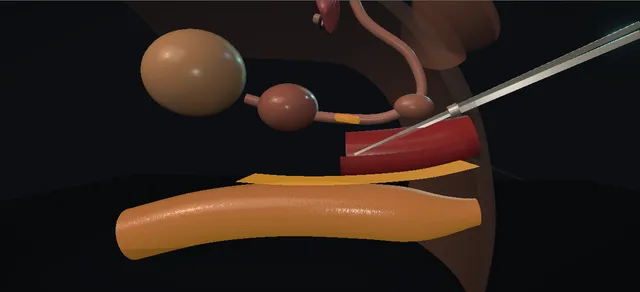
Schematic scene preview: Penile inversion vaginoplasty
Preparing the 3D anatomy…

UrOops3D · UroRef · © Nity G

How to use this module. Play through the nine steps, or use Back and Next. Watch the space open between the prostate and the rectum, the glans wedge fold down on its pedicle, the urethra shorten to the new meatus and the skin tube go in. The triggers show a rectal injury, a tight meatus and spraying.

Click me next Section 2 of 8 Anatomy The structures this operation works between, and the one it must not cross.

The structures in the scene

Penile inversion vaginoplasty: how the structures relateThe neovaginal space between the prostate and the rectum, and what lies round it. Neovaginal space, lined with penile skin: immediately behind the plane Rectum (danger). Neovaginal space, lined with penile skin: in front; examined through the canal Prostate: it remains. Neovaginal space, lined with penile skin: in front of the upper dissection Membranous urethra and sphincter (danger). Neovaginal space, lined with penile skin: just above the introitus New urethral meatus (danger). Neovaginal space, lined with penile skin: at the top of the vestibule Neoclitoris on the dorsal bundle (danger). Neovaginal space, lined with penile skin: either side of the introitus Labia majora from scrotal skin.Neovaginal space, linedwith penile skin!RectumProstate: it remains!Membranous urethraand sphincter!New urethral meatus!Neoclitoris on thedorsal bundleLabia majora fromscrotal skinimmediately behindthe planein front; examinedthrough the canalin front of theupper dissectionjust above theintroitusat the top of thevestibuleeither side of theintroitusTargetDangerLandmarkContext
The neovaginal space between the prostate and the rectum, and what lies round it. Schematic, not to scale; relationships only.
  • In lithotomy the surgeon looks up the perineum from the foot of the table.
  • The space is made in the midline between the bulb and the anus and runs up behind the prostate: the prostate, the membranous urethra and the sphincter lie in front of it, the rectum immediately behind, and the bladder base at its top.
  • ›Testes and spermatic cords - removed by bilateral orchidectomy; each cord tied at the external inguinal ring.
  • ›Penile skin - degloved with its blood supply as the tube that lines the canal.
  • ›Buck's fascia and the dorsal neurovascular bundle - lifted off the corpora as the pedicle of the neoclitoris.
  • ›Glans - a dorsal wedge on the dorsal bundle becomes the neoclitoris.
  • ›Corpora cavernosa - excised back to the crura.
  • ›Urethra and corpus spongiosum - shortened toward the bulb and spatulated to make the new meatus.
  • ›Prostate - stays in place, immediately in front of the canal; examined through the anterior vaginal wall.
  • ›Membranous urethra and external sphincter - at the prostatic apex, in front of the upper part of the dissection.
  • ›Rectum and Denonvilliers fascia - immediately behind the rectoprostatic plane in which the space is made.
  • ›Scrotal skin - tailored into the labia majora; spare skin can extend the tube as a graft.
Click me next Section 3 of 8 Steps The operation in order, with the landmark that guards each move.

Operative steps

  1. Assessment and the plan Genital surgery follows assessment by the gender service and a multidisciplinary team, with hormone treatment stable, fertility options discussed and genital hair removed. The goals are agreed: a canal or a zero-depth vulvoplasty, sensation, sexual function and voiding sitting. Smoking and diabetes are addressed.
    where it bites: a canal is made only when one is wanted; a person who cannot commit to lifelong dilatation is offered the zero-depth option.
  2. Bilateral orchidectomy Through a midline scrotal incision each testis is delivered on its cord. The cord is clamped, transfixed and tied at the external inguinal ring and divided, and the testis removed. The scrotal skin is kept and later becomes the labia majora; the cord stumps retract into the inguinal canals.
    where it bites: a cord stump that slips its tie bleeds into the groin and scrotum; each tie is checked before the stump is let go.
  3. Degloving: the skin tube A circumferential incision is made below the corona and the penile skin is degloved to the base in the plane superficial to Buck's fascia, keeping its blood supply. This skin becomes the tube that lines the canal. Buck's fascia, with the dorsal bundle under it, stays on the corpora.
    where it bites: too deep and the dorsal bundle that will feed the neoclitoris is damaged; too superficial and the skin tube loses its blood supply.
  4. The neovaginal space An inverted U incision is made on the perineum and the flap reflected toward the anus. The central tendon is divided and bulbospongiosus taken off the bulb. The space is then opened in the rectoprostatic plane, the prostate and urethra in front and the rectum behind, up to the level of the bladder base.
    where it bites: the rectum lies immediately behind the plane, and the sphincter at the prostatic apex in front of it; a rectal injury here is the classic intraoperative complication.
  5. The neoclitoris The dorsal neurovascular bundle is lifted off the tunica of both corpora with Buck's fascia. The corpora are excised back to the crura. A dorsal wedge of glans stays attached to the bundle; the rest of the glans is removed, and the pedicle is folded down so the wedge lies at the clitoral position.
    where it bites: the dorsal nerves and arteries in the pedicle: stripped, kinked or under tension, the neoclitoris loses sensation or its blood supply.
  6. Urethra shortened and spatulated The urethra with its spongiosum is freed from the corpora and shortened toward the bulb. It is opened on its ventral side and spatulated so the new meatus is wide and sits just above the introitus, and its edges are sewn to the vestibular skin. Excess spongiosum is trimmed.
    where it bites: a urethra left long or hooded sprays, and a meatus sewn tight narrows; the new meatus is where most of the urological complications begin.
  7. Labia from the scrotal skin The emptied scrotal skin is tailored into the labia majora either side of the vestibule, running from beside the clitoris to the back of the introitus. Redundant scrotal skin may be taken as a full thickness graft to lengthen the skin tube when the penile skin is short.
    where it bites: scrotal skin carries hair; hair that is not removed beforehand grows inside a canal lined with it.
  8. Inversion of the skin tube The skin tube, its distal end closed, is brought down and inverted into the space so that skin lines the canal, with an opening for the meatus and clitoris. It is held at depth by a pack or a stent, the perineal flap is inset into the back wall of the introitus, and a urethral catheter drains the bladder.
    where it bites: a tube under tension or a pack too tight compromises the skin; the catheter keeps urine off the fresh meatus.
  9. Aftercare and dilatation The pack and catheter come out after some days and voiding is checked. Dilatation starts at once on a regime that becomes less frequent with time but continues for life. Follow-up is with the surgeon and then primary care, and the prostate, which remains, is examined through the anterior vaginal wall.
    where it bites: dilatation stopped early lets the canal narrow and shorten; check the void after the catheter comes out, as retention is common in the first days.
Click me next Section 4 of 8 Danger zones Where this operation bites, and why it bites there.
Critical relationship

Danger zones

The spatial relationships the animation is built to make automatic. Before you read each one, ask yourself: at this point in the operation, what is about to go wrong, and what is my first move? The save for each sits in the Complications tab.

  • RiskRectum immediately behind the dissection plane - the space is opened in the rectoprostatic plane, and the anterior rectal wall is the next layer back; a rectal injury becomes a rectovaginal fistula if it is missed.
  • RiskUrethral sphincter and bladder neck - the membranous urethra and its sphincter sit at the apex, in front of the upper dissection; the urethra is shortened toward the bulb, never into the sphincter.
  • RiskNeurovascular supply to sensate clitoral tissue - the dorsal nerves and arteries under Buck's fascia carry the sensation and blood supply of the glans wedge; they are lifted with the fascia, never stripped.
  • RiskBowel and mesentery in substitution procedures - in a bowel vaginoplasty a segment of sigmoid or small bowel on its mesentery lines the canal; the pedicle, the anastomosis and the rectum are the added risks.
Practise it Take me into the scene Opens the animation at a danger moment and asks you to predict the mechanism and your first move before it reveals.
Click me next Section 5 of 8 Complications The save for each one: the first move, the escalation trigger, the op-note line.

Complications and immediate saves

Trigger each of these live in the Animation tab, then read the save: the first move, the escalation trigger, and the line that goes in the op note.

Rectal injury or rectovaginal fistula

  • the dissection enters the anterior rectal wall behind the rectoprostatic plane;
  • recognised at the time it is repaired, and missed or breaking down it presents later as a rectovaginal fistula with flatus or faeces from the canal.
The save
  1. Stop the dissection, identify the injury with a finger in the rectum, and wash out the field. first move
  2. Repair the rectal wall in layers and interpose healthy tissue where it can be found before the canal is lined.
  3. Ask a colorectal surgeon to see the repair and decide on a defunctioning stoma; a later fistula is managed by a colorectal and reconstructive team. escalation trigger
  4. Record the site and size of the injury, the repair, the colorectal opinion and the plan for diet and bowel care. document

Meatal stenosis with retention

  • the new meatus narrows: a slow, spraying, straining stream, recurrent infection, and in the end retention with a distended bladder.
The save
  1. For retention, pass a urethral catheter; if the meatus will not take one, place a suprapubic catheter. first move
  2. Assess with examination, a flow rate and a residual; calibrate the meatus and look for a stricture further in.
  3. A tight meatus is revised by meatoplasty; a longer stricture is referred to a reconstructive urologist. escalation trigger
  4. Record the calibre, the residual, the catheter and the plan. document

Urethral fistula or spraying

  • a misdirected or spraying stream from a urethral stump left too long or hooded, a meatus placed too far forward, or a fistula from the urethra to the vestibule.
The save
  1. Examine the vulva while the patient voids if possible, and find where the urine comes from. first move
  2. Many early sprays settle as swelling goes down; persistent spraying is treated by revision of the meatus, and a fistula by excision and layered closure.
  3. A fistula with stricture, or one after a revision, goes to a reconstructive urologist. escalation trigger
  4. Record the stream, the site of any fistula and the plan. document

Neovaginal stenosis or loss of depth

  • without regular dilatation the skin-lined canal contracts and shortens; scarring at the introitus or the apex can trap secretions, and a stenosed canal can no longer be used to examine the prostate.
The save
  1. Restart a supervised dilatation programme with graded dilators as soon as it is noticed. first move
  2. Examine for granulation tissue or a band at the introitus; treat granulation and release a band.
  3. Loss of depth that does not respond goes back to the gender surgeon for revision with a graft, a peritoneal flap or bowel. escalation trigger
  4. Record the depth and calibre, the dilatation regime and any referral. document

Bleeding, collection or skin necrosis

  • bleeding from the corporal stumps or the spongiosum, a pelvic collection, or loss of part of the skin tube, the flaps or the neoclitoris.
The save
  1. Take down the dressing, look, compress, and check the haemoglobin and clotting. first move
  2. Manage infection and small areas of necrosis with dressings and debridement; keep the pack and catheter as needed.
  3. Bleeding that needs transfusion or a collection that does not drain goes back to theatre. escalation trigger
  4. Record the findings, the transfusion and the return to theatre. document
Click me next Section 6 of 8 Troubleshooting When the case turns: the problem, then the next move.

Intra-operative troubleshooting

When the case turns: the problem, then the next move.

  • ActionToo little penile skin for the depth wanted - a full thickness graft of scrotal skin extends the tube; a peritoneal flap or a bowel segment is the alternative when genital skin is very short.
  • ActionBleeding from the spongiosum at the meatus - the spongiosum is trimmed back and its edge oversewn as the meatus is made; a pressure dressing helps.
  • ActionThe dissection is drifting toward the rectum - a finger in the rectum shows the wall; stay on the prostate side of the plane, close behind the capsule.
  • ActionThe person does not want a canal - a zero-depth vulvoplasty: the same orchidectomy, urethra, clitoris and labia without the space, and no lifelong dilatation.
  • ActionRetention after the catheter comes out - recatheterise, look for a tight meatus or swelling, and try again after some days; a persisting problem needs a flow rate and calibration.
Click me next Section 7 of 8 FRCS viva Say it out loud, then mark yourself against the model answer.

FRCS viva questions

The examiner stems this scene prepares you for. Try to answer out loud first, then reveal, and learn the discriminator, the detail that turns a pass into a strong pass.

QA transgender woman asks about genital surgery. What has to happen before an operation is offered?reveal answer
  • I would see her as part of a multidisciplinary pathway.
  • WPATH Standards of Care version 8 suggests considering genital surgery in eligible adults when they are stable on their treatment, and recommends that surgeons confirm reproductive options have been discussed before gonadectomy and inform patients about aftercare, travel and follow-up before surgery.
  • In practice that means assessment by the gender identity service, hormone treatment established, fertility preservation offered, genital hair removal completed and mental and physical health optimised, including smoking and diabetes.
  • I would explore her goals: a canal or a zero-depth vulvoplasty, sexual function, and voiding sitting.
  • I would explain the lifelong commitment to dilatation if a canal is made, and the complications, so that the choice of technique is hers.
Strong pass

Say all three

  • Placing the operation inside a multidisciplinary pathway
  • Matching the technique to the patient's goals
  • Including zero depth
Examiner note
Placing the operation inside a multidisciplinary pathway and matching the technique to the patient's goals, including zero depth.
QDescribe the penile inversion technique. When would you choose a bowel vaginoplasty instead?reveal answer
  • I would describe penile inversion as the standard technique.
  • After bilateral orchidectomy, the penile skin is degloved as a tube with its blood supply and the space is dissected in the rectoprostatic plane.
  • The corpora are excised and a dorsal wedge of glans on the dorsal neurovascular bundle becomes the neoclitoris.
  • The urethra is shortened and spatulated, the scrotal skin forms the labia, and the skin tube is inverted into the space, extended with a scrotal graft when it is short.
  • WPATH lists inversion, peritoneal and intestinal vaginoplasty.
  • I would choose bowel when genital skin is insufficient, as after puberty suppression with penoscrotal hypoplasia, or for revision.
  • Bouman and colleagues reported 42 primary total laparoscopic sigmoid vaginoplasties, with one rectal perforation oversewn and a mean depth of 16.3 centimetres at one year.
  • Peritoneal flaps are a newer option.
Strong pass

Knowing the indication for bowel: insufficient genital skin, typically after puberty suppression, or revision.

QWhat urological complications would you quote, and how often do they occur?reveal answer
  • I would separate the intraoperative from the late.
  • In Buncamper and colleagues' series of 475 penile inversion vaginoplasties the commonest intraoperative complication was rectal injury, in 2.3 per cent, and three patients, 0.6 per cent, developed a rectoneovaginal fistula;
  • use of psychotropic medication predisposed to postoperative retention.
  • The meta-analysis by Ding and colleagues, 27 studies and 3388 patients, pooled a poor or splayed stream at 11.7 per cent, meatal stenosis at 6.9 per cent, retention needing catheterisation at 5.1 per cent, incontinence at 8.7 per cent, urethral stricture at 4.6 per cent and urinary infection at 5.6 per cent.
  • Blasdel and colleagues warn that reports from outside the operating surgeon's own series show higher rates of voiding dysfunction and misdirected stream.
Strong pass

Quoting sourced rates for rectal injury, fistula, meatal stenosis and spraying, and knowing surgeon-reported series understate them.

QYou recognise a rectal injury while developing the space. What do you do?reveal answer
  • I would stop the dissection and define the injury with a finger in the rectum.
  • A small, clean injury recognised at the time can be repaired in two layers, with a washout and interposition of healthy tissue between the repair and the canal where possible.
  • I would ask a colorectal surgeon to see it and decide on a defunctioning stoma, especially if the injury is large, the bowel was not prepared or the repair is under tension, and I would discuss whether to line the canal now or stage it.
  • Afterwards I would watch for flatus or faeces from the canal.
  • A rectovaginal fistula is investigated with examination and imaging and managed jointly by colorectal and reconstructive surgeons;
  • in the case reported by Elmer-DeWitt and colleagues a recurrent fistula after an intraoperative injury was closed with a buccal mucosa graft.
Strong pass

Say all three

  • Layered repair with tissue interposition
  • A colorectal opinion on diversion
  • The decision whether to line the canal now
Examiner note
Layered repair with tissue interposition, a colorectal opinion on diversion, and the decision whether to line the canal now.
QWhat long-term urological follow-up does she need?reveal answer
  • I would keep her under lifelong follow-up.
  • Dilatation continues for life, less often with time, or the canal narrows and shortens.
  • Voiding is reviewed for spraying, meatal stenosis, infection and incontinence.
  • The prostate remains, immediately in front of the canal: WPATH notes that it is checked according to the guidelines for cisgender populations, through the vaginal canal.
  • De Nie and colleagues found, in 2281 trans women on hormone treatment, a prostate cancer risk lower than in Dutch reference men, a standardised incidence ratio of 0.20, but not zero.
  • PSA is interpreted knowing that oestrogen and the orchidectomy suppress it.
  • A canal lined with skin can also develop disease; Bollo and colleagues reported a squamous carcinoma in a neovagina decades later.
  • WPATH recommends follow-up with the surgeon, primary care or gynaecology.
Strong pass

Say all three

  • Remembering the prostate stays
  • Is examined through the anterior vaginal wall
  • That suppressed PSA is interpreted with care
Examiner note
Remembering the prostate stays, is examined through the anterior vaginal wall, and that suppressed PSA is interpreted with care.
Click me next Section 8 of 8 Evidence The guidance each of these answers is built on.

Evidence and guidance

Operative Dictations in Urologic Surgery
Armenakas NA, Fracchia JA, Golan R. Wiley, 2019
The book has no chapter on vaginoplasty or gender-affirming surgery; it was searched with pypdf on 19 October 2026 for vaginoplasty, neovagina, gender, transgender and penile inversion, with no match. Nothing on this page comes from it. The order follows the hub sequence and variants; the danger lines, the first, escalate and document lines and every save are general UK practice. The scene is schematic.
Open guideline
WPATH
Coleman E, Radix AE, Bouman WP, et al. Standards of Care for the Health of Transgender and Gender Diverse People, Version 8. Int J Transgend Health 2022;23(Suppl 1):S1-S259, chapter 13 Surgery and Postoperative Care
Read 19 October 2026. Statements 13.3 (inform about aftercare and follow-up), 13.4 (reproductive options before gonadectomy), 13.6 (genital procedures in eligible adults stable on treatment), 13.8 (multidisciplinary team for customised surgery) and 13.10 (follow-up after vaginoplasty). Vaginoplasty by inversion, peritoneal and intestinal techniques; vulvoplasty; stenosis and rectovaginal fistula among the complications; dilatation regimens; prostate checks through the vaginal canal.
Open guideline
European Association of Urology and BAUS
EAU Guidelines on Sexual and Reproductive Health and BAUS patient information, searched 19 October 2026
The hub lists the EAU urethral stricture and sexual and reproductive health guidelines; no chapter on vaginoplasty was found at uroweb.org and no BAUS leaflet on it. Nothing on this page is taken from either; the meatal stenosis and stricture saves are general urological practice.
Open guideline
Plastic and Reconstructive Surgery
Buncamper ME, van der Sluis WB, van der Pas RSD, et al. Surgical outcome after penile inversion vaginoplasty: a retrospective study of 475 transgender women. Plast Reconstr Surg 2016;138:999-1007
Abstract read 19 October 2026. 475 penile inversion vaginoplasties, 70 with additional full thickness skin grafts; median follow-up 7.8 years. Rectal injury the commonest intraoperative complication, 11 (2.3 per cent); bleeding needing transfusion 23 (4.8 per cent); three (0.6 per cent) rectoneovaginal fistulas, all successfully treated; revision vaginoplasty 14 (2.9 per cent). Diabetes raised the risk of local infection; psychotropic medication predisposed to urinary retention.
Open guideline
Canadian Urological Association Journal
Ding C, Khondker A, Goldenberg MG, et al. Urinary complications after penile inversion vaginoplasty in transgender women: systematic review and meta-analysis. Can Urol Assoc J 2023;17:121-128
Abstract read 19 October 2026. 27 studies, 3388 patients. Pooled: poor or splayed stream 11.7 per cent, meatal stenosis 6.9 per cent, irritative symptoms 11.5 per cent, retention requiring catheterisation 5.1 per cent, incontinence 8.7 per cent, urethral stricture 4.6 per cent, urinary tract infection 5.6 per cent; satisfaction 80 to 100 per cent.
Open guideline
Plastic and Reconstructive Surgery
Blasdel G, Dy GW, Nikolavsky D, et al. Urinary reconstruction in genital gender-affirming surgery: checking our surgical complication blind spots. Plast Reconstr Surg 2024;153:792e-803e
Abstract read 19 October 2026. Eight systematic reviews of vaginoplasty: meatal stenosis 5 to 16.3 per cent, vaginal stenosis 7 to 14.3 per cent. Outside the operating surgeon's own series, voiding dysfunction 47 to 66 per cent, incontinence 23 to 33 per cent and misdirected stream 33 to 55 per cent, higher than surgeon-reported cohorts.
Open guideline
Plastic and Reconstructive Surgery
Bouman MB, van der Sluis WB, Buncamper ME, et al. Primary total laparoscopic sigmoid vaginoplasty in transgender women with penoscrotal hypoplasia: a prospective cohort study of 42 patients. Plast Reconstr Surg 2016;138:614e-623e
Abstract read 19 October 2026. Indication: penoscrotal hypoplasia after puberty-suppressing hormones making inversion unfeasible. 42 patients; one rectal perforation recognised and oversewn; one death from necrotising fasciitis; reoperation 7.1 per cent; mean depth 16.3 cm at one year.
Open guideline
Female Pelvic Medicine and Reconstructive Surgery
Elmer-DeWitt MA, Wood HM, Hull T, Unger CA. Rectoneovaginal fistula in a transgender woman successfully repaired using a buccal mucosa graft. Female Pelvic Med Reconstr Surg 2019;25:e43-e44
Abstract read 19 October 2026. Risk factors for rectoneovaginal fistula include rectal injury at vaginoplasty; a recurrent fistula after an intraoperative rectal injury was repaired with a buccal mucosa graft after a failed first repair; a multidisciplinary approach may be required.
Open guideline
Journal of Clinical Endocrinology and Metabolism
de Nie I, de Blok CJM, van der Sluis TM, et al. Prostate cancer incidence under androgen deprivation: nationwide cohort study in trans women receiving hormone treatment. J Clin Endocrinol Metab 2020;105:e3293-e3299
Abstract read 19 October 2026. 2281 trans women, median follow-up 14 years; the prostate remains after vaginoplasty; six prostate cancers; standardised incidence ratio 0.20 against Dutch reference men.
Open guideline
International Journal of STD and AIDS
Bollo J, Balla A, Rodriguez Luppi C, et al. HPV-related squamous cell carcinoma in a neovagina after male-to-female gender confirmation surgery. Int J STD AIDS 2018;29:306-308
Abstract read 19 October 2026. A squamous carcinoma in a penile and scrotal skin neovagina 45 years after surgery, infiltrating the urethra, prostate and rectum; long-term follow-up advised.
Open guideline

Curriculum. Supports learning relevant to the ISCP Urology Curriculum syllabus topic Andrology and the special interest module Female, functional and reconstructive urology. Not a workplace-based assessment and not evidence of competence.

Two minutes

Close the lap: recall it before you leave.

Say it aloud, then reveal. Reading is not remembering.

  1. 01 The relationship Say the critical spatial relationship out loud, then reveal. reveal
    Memory frame

    In lithotomy the surgeon looks up the perineum from the foot of the table.

    Why?
    The space is made in the midline between the bulb and the anus and runs up behind the prostate: the prostate, the membranous urethra and the sphincter lie in front of it, the rectum immediately behind, and the bladder base at its top.
  2. 02 The first move Rectal injury or rectovaginal fistula. Your first move? reveal
    First move

    Stop the dissection, identify the injury with a finger in the rectum, and wash out the field.

  3. 03 The escalation trigger Rectal injury or rectovaginal fistula. What makes you call for help? reveal
    Escalate when

    Ask a colorectal surgeon to see the repair and decide on a defunctioning stoma; a later fistula is managed by a colorectal and reconstructive team.

  4. 04 The discriminator What turns a pass into a strong pass? reveal
    Strong pass

    Say all three

    • Placing the operation inside a multidisciplinary pathway
    • Matching the technique to the patient's goals
    • Including zero depth
    Examiner note
    Placing the operation inside a multidisciplinary pathway and matching the technique to the patient's goals, including zero depth.
  5. 05 The pitfall Where does this operation bite first? reveal
    Pitfall

    Rectum immediately behind the dissection plane

    Why?
    the space is opened in the rectoprostatic plane, and the anterior rectal wall is the next layer back; a rectal injury becomes a rectovaginal fistula if it is missed.

Revision practice with self-marked answers, not an assessment of clinical competence. Kept in this browser only; it does not sync between devices.