Operative Dictations in Urologic Surgery
Armenakas NA, Fracchia JA, Golan R. Transsphincteric rectourethral fistula repair (York-Mason procedure). Chapter 65. Wiley, 2019
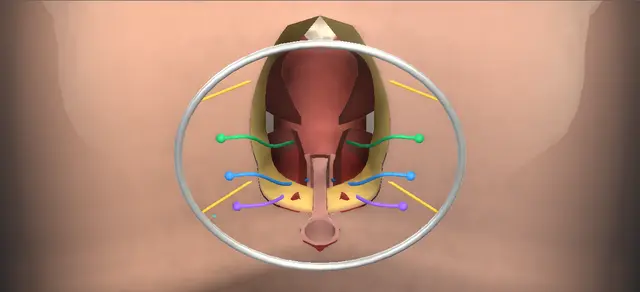
The indication (small, post-surgical rectourethral fistulas), the nine essential steps and their order, the template dictation followed step by step here, the variations (colonoscopy at the start, faecal diversion at the time of the repair, the incision extended to the left of the coccyx, an anterior transsphincteric approach in lithotomy when there is a stricture) and the complication list: infection, faecal or urinary incontinence, recurrent or persistent fistula, increased flatulence, anal stenosis, urethral stricture. The chapter does not name the muscular layers; the three drawn (external sphincter, puborectalis with the levator plate, internal sphincter) are standard anatomy, with one pair shown on each. It says the two anterior layers are perpendicular without saying which way each lies; the scene puts the deep row along the rectum and the mucosal row across it. The scene is schematic. The chapter lists complications without their management: the first, escalate and document steps and the danger lines are general surgical practice. The faecal incontinence picture (a layer tied to the wrong partner) illustrates why the pairs are placed; the chapter gives no mechanism for incontinence.
Open guideline
Diseases of the Colon and Rectum
Hechenbleikner EM, Buckley JC, Wick EC. Acquired rectourethral fistulas in adults: a systematic review of surgical repair techniques and outcomes. Dis Colon Rectum 2013;56:374-383
Abstract read 13 October 2026. Twenty-six retrospective series, 416 patients, 169 (40%) with previous pelvic irradiation or ablation. Nine in ten patients had one of four kinds of repair: transanal 5.9%, transabdominal 12.5%, transsphincteric 15.7%, transperineal 65.9%. Interposition flaps, predominantly gracilis, in 72%; fistula closed in 87.5%; permanent faecal diversion 10.6% and urinary diversion 8.3%. Most high-volume centres used transperineal repair with a flap in every case. The authors note heterogeneity and bias toward the approach each centre prefers.
Open guideline
International Journal of Urology
Dafnis G. Transsphincteric repair of rectourethral fistulas: 15 years of experience with the York Mason approach. Int J Urol 2018;25:290-296
Abstract read 13 October 2026. Twenty consecutive patients, one hospital, 2002 to 2016, a modified York Mason technique: 18 repaired successfully, no recurrence in those 18 at a median of 84.7 months; 12 had a diverting stoma before the repair and 8 at the repair; all 13 whose stoma had been closed reported intact faecal continence and no anal stenosis. Diabetes, smoking and preoperative irradiation were more frequent in the two failures, without a significant difference.
Open guideline
World Journal of Urology
van der Graaf SH et al. Management in robot-assisted radical prostatectomy patients with recto-urethral fistulas: the York-Mason technique. World J Urol 2025;43:604
Abstract read 13 October 2026. Single-centre retrospective cohort, 2011 to 2024: 12 fistulas after robot-assisted prostatectomy, all treated with the York-Mason technique after catheter drainage had failed. Of 10 men with surgery alone, 8 had it as their first operation and all 8 were closed at a median follow-up of 5.1 years. The authors conclude that it works best as the first surgical intervention in men without salvage radiotherapy.
Open guideline
Case Reports in Urology
Yetişir F et al. Management of recurrent rectourethral fistula by York Mason posterior transrectal transsphincteric approach. Case Rep Urol 2015;2015:854365
Full text read 13 October 2026. A single case, used only for its description of the technique: the internal and external sphincters and the puborectalis identified with sutures and incised, the posterior rectal wall opened, the urethral and rectal walls separated sharply, the urethra closed, the anterior rectal wall closed with an advancement flap of mucosa from above, and the sphincter structures repaired one by one by the sutures placed at the start. No figure is taken from it.
Open guideline
EAU Guidelines
Urethral Strictures, 2026: Disease management in males, sections 6.3.5.b.2.a.1 and 6.3.5.b.2.b, read 13 October 2026
Context only. The guideline has no section on the York-Mason repair. In post-traumatic posterior urethral stenosis it says interposition flaps are useful to separate the suture lines when there is a concomitant rectourethral fistula, and recommends a local tissue flap after correction of a concomitant rectourethral fistula (weak). Used for the principle of separating suture lines, in the recurrence answer.
Open guideline