
Bladder trauma and iatrogenic perforation repair
Catheter, endoscopic and operative pathways for traumatic or iatrogenic bladder injury, differentiated by intraperitoneal involvement, complexity and associated injuries.
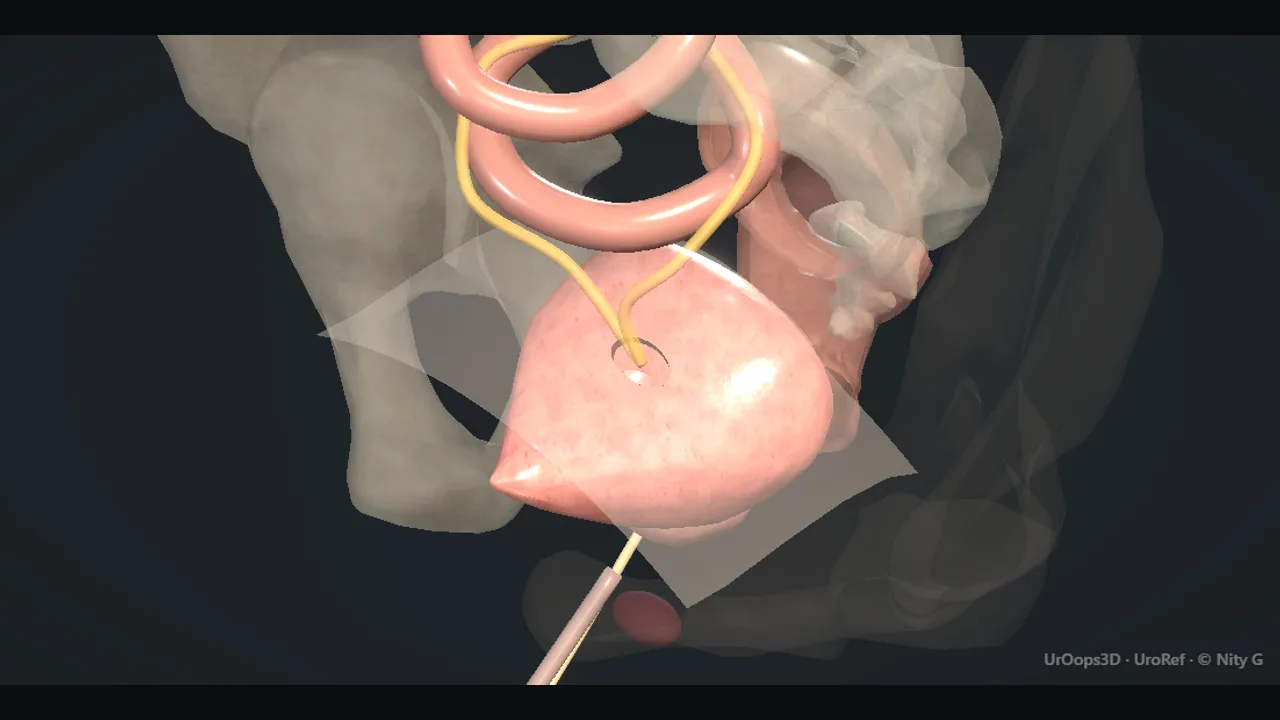 Interactive 3D Interactive operative model Open the 3D animation
Teaching catalogue only. This coverage record is not a patient pathway or operative instruction.
Typical place in practice
Intraperitoneal rupture, complex extraperitoneal injury, ongoing leak, bladder-neck involvement or iatrogenic injury requiring closure.
Alternatives and neighbouring procedures
Catheter drainage with structured reassessment for selected uncomplicated extraperitoneal or small recognised iatrogenic injuries.
Same procedure family, explicit technique branches
These are variations of this canonical operation. Complication modules below identify whether they apply to all branches or only to named approaches.
Catheter drainage
Allows selected uncomplicated injuries to heal without formal closure.
Open repair
Inspects and closes the injury while addressing associated pelvic or abdominal trauma.
Laparoscopic or robotic repair
Closes selected stable intraperitoneal or iatrogenic injuries.
Complex bladder-neck or trigonal reconstruction
Repairs injury involving outlet, ureters or extensive tissue loss.
High-level sequence
Coverage outline only; not a step-by-step technical guide.
- Classify injury and identify pelvic, bowel, ureteric and outlet involvement
- Establish dependable urinary drainage
- Inspect the full defect and debride only non-viable tissue
- Close in a tension-free watertight fashion when indicated
- Test healing and monitor infection, continence and bladder function
Operative notes
Concise operative notes covering the key steps, landmarks and watch points, in the order you encounter them.
Bladder rupture repair
What it does: mend a burst bladder inside the tummy.
- All inside-the-tummy ruptures get surgery.
- Lower midline cut.
- Pelvic fracture cause? Never disturb that haematoma.
- Open the peritoneum. Check the organs. After TURBT: check bowel for burn holes.
- Inside the bladder: check neck and both orifices.
- Cut away dead tissue. Remove bone chips.
- Stitch tears from INSIDE the bladder. You cannot safely get behind it.
- Men: urethral + supra catheter. Women: urethral only.
- Close in 2 layers, 3/0 Vicryl. Drain.
- Catheter 7-10 days. Cystogram before removal.
From the UroRef Operative Quick Guide. Open the note page →
Every failure mode is its own module.
Timing and variation coverage are recorded for each module.
Persistent urinary leak, urinoma or urinary ascites
Inadequate drainage, a missed second injury or closure failure can prolong extravasation.
Applies to: All variantsPelvic or intra-abdominal infection
Urine, haematoma and associated bowel injury can produce abscess or peritonitis.
Applies to: All variantsUreteric obstruction or injury
Repair close to the trigone can narrow, ligate or transect a ureter.
Applies to: Open repair · Laparoscopic or robotic repair · Complex bladder-neck or trigonal reconstructionIncontinence or bladder-neck dysfunction
Outlet injury can impair continence even after bladder closure heals.
Applies to: Complex bladder-neck or trigonal reconstructionReduced capacity, urgency or pain
Scarring and associated pelvic injury can alter bladder storage and sensation.
Applies to: All variantsCatheter blockage, displacement or urethral injury
Drain failure can re-pressurise a healing bladder injury.
Applies to: Catheter drainageMissed associated bowel or pelvic injury
Bladder trauma can be one component of a wider injury complex.
Applies to: All variantsSources for this module
Renal, ureteric, bladder, urethral and genital trauma and reconstruction.
Accessed 2026-08-03 · opens source British Association of Urological Surgeons Patient information leaflets by procedureUK patient-facing procedure, alternatives, recovery and complication framing.
Accessed 2026-08-03 · opens source