
Revision sheet
Cohen cross-trigonal ureteric reimplantation, bilateral
10 steps, each one the authored title and caption from the interactive animation, with the frame captured from that step. Read it before the case, or print it and work through the steps in order.
Teaching only, not for diagnosis or treatment decisions. The text on this sheet is the animation's own step copy, reproduced verbatim.
UrOops3D · UroRef · © Nity G
- 01
Expose the bladder
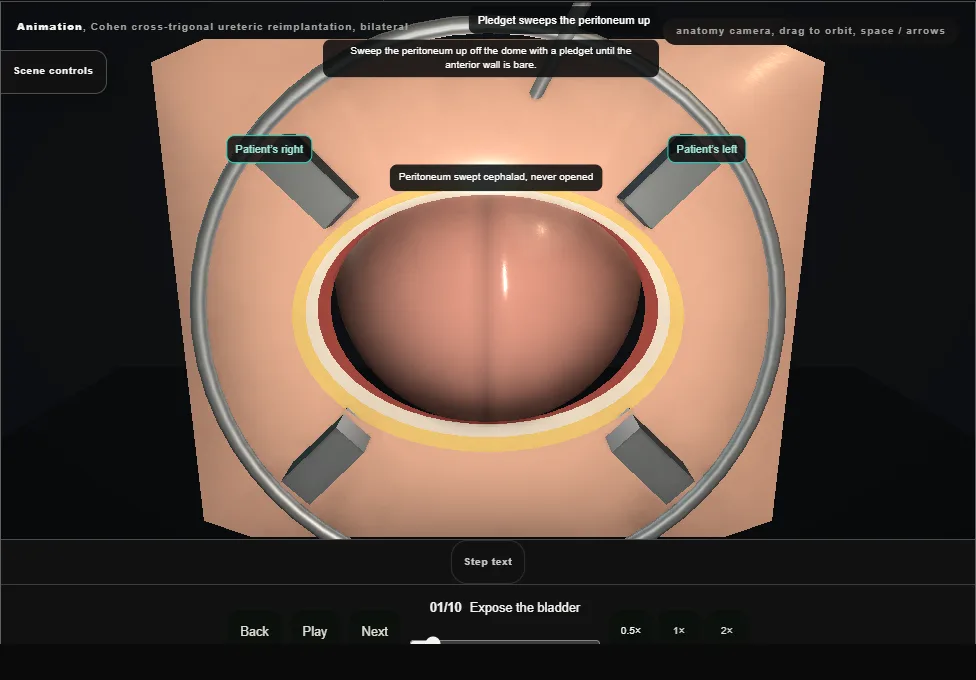
- Supine, the bladder filled through a catheter so the dome rises.
- A small curved transverse skin crease incision above the pubis; then fat and Scarpa’s fascia, the anterior rectus sheath opened across, the recti parted in the midline, transversalis fascia and the prevesical space.
- The peritoneum is swept up off the dome and is not opened.
- The inferior epigastric vessels lie under the recti at the ends of the wound.
- 02
Open the bladder
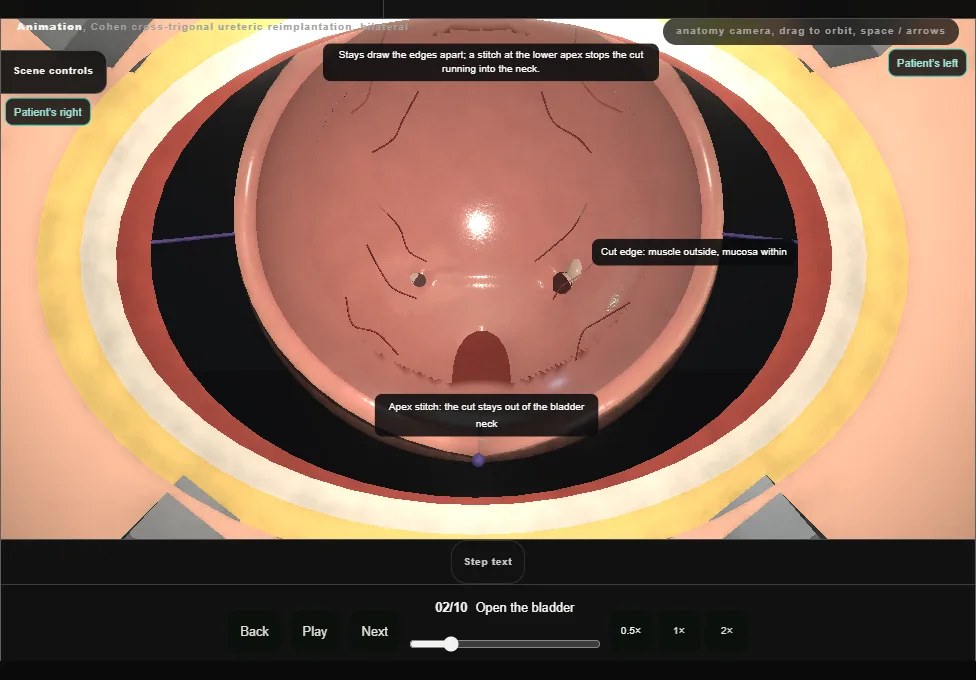
- Two Allis lift the anterior wall and it is opened vertically in the midline, through detrusor and then mucosa, dome toward the neck.
- Stay stitches draw the edges apart and a stitch at the lower apex stops the cut running into the bladder neck.
- A ring retractor with padded blades shows the trigone and both orifices.
- 03
Intubate both ureters
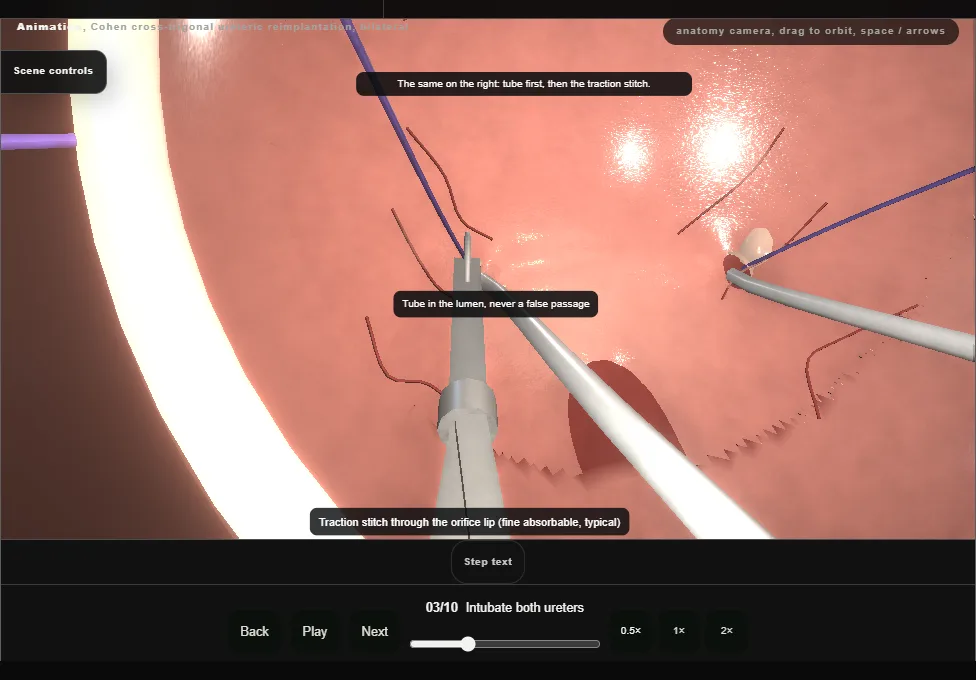
- A fine feeding tube is passed up each ureter in turn; it must run in the lumen, not a false passage.
- A traction stitch through each orifice lip is tied round its tube.
- From here each ureter is handled by that stitch and its cuff, never by its wall.
- 04
Circumscribe the orifices
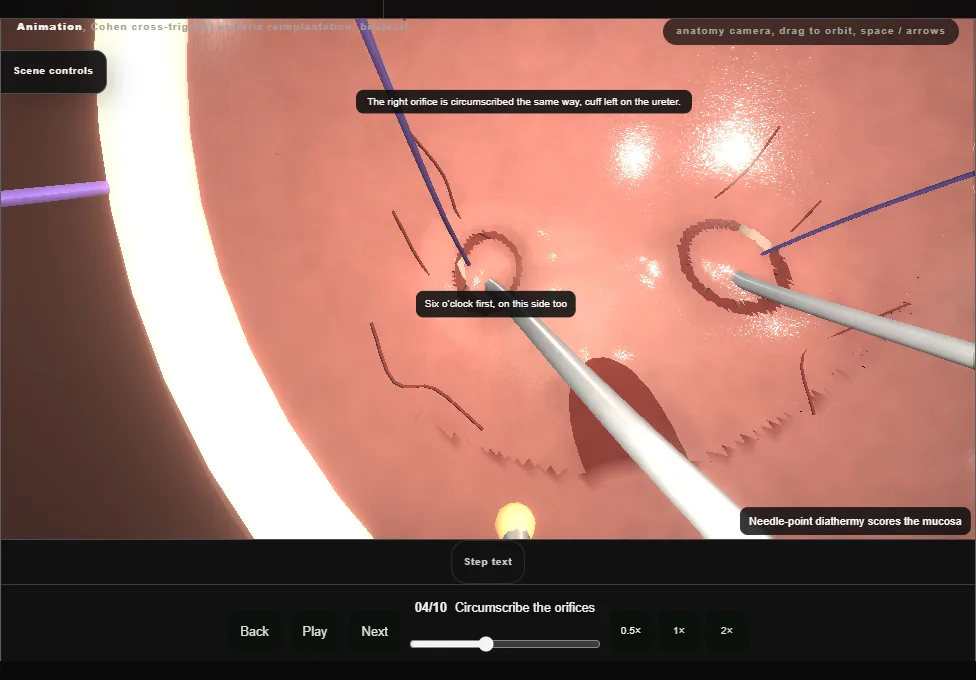
- Traction lifts the orifice and the mucosa is scored in a full circle round it, leaving a cuff of mucosa on the ureter.
- The cut is deepened at six o’clock first, through mucosa and submucosa, to the plane between the ureter and the detrusor.
- Left, then right.
- 05
Mobilise both ureters
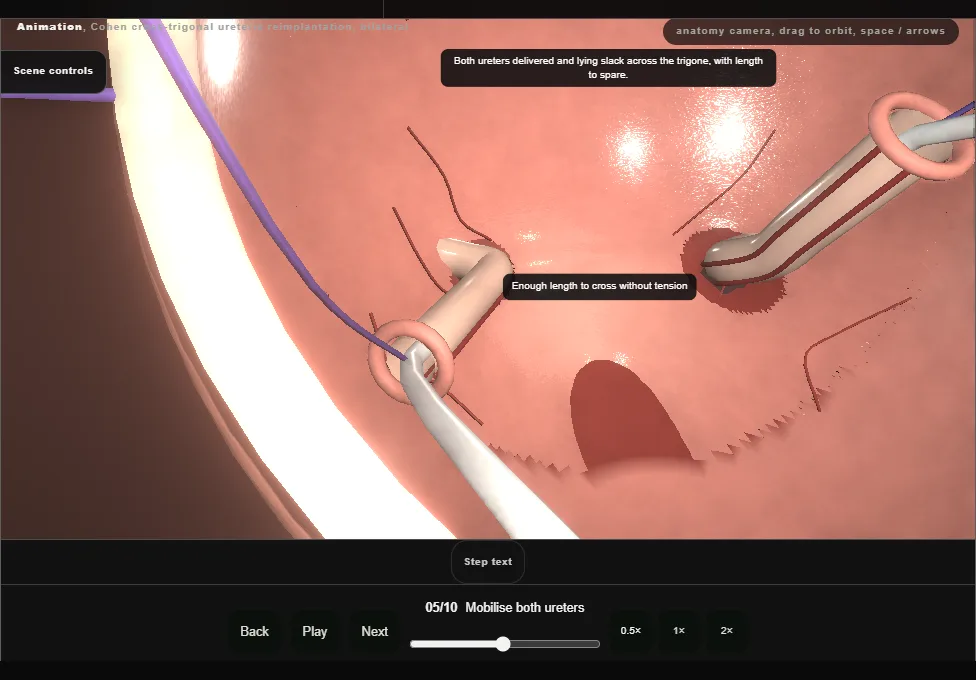
- Fine scissors spread between the adventitial sheath and the detrusor, and the muscle strands are divided one at a time, hard on the muscle.
- The sheath and its longitudinal vessels stay on the ureter: they are its blood supply.
- Traction delivers each ureter until both lie slack across the trigone.
- Behind each hiatus lie the peritoneum and, in a boy, the vas.
- 06
Make two tunnels
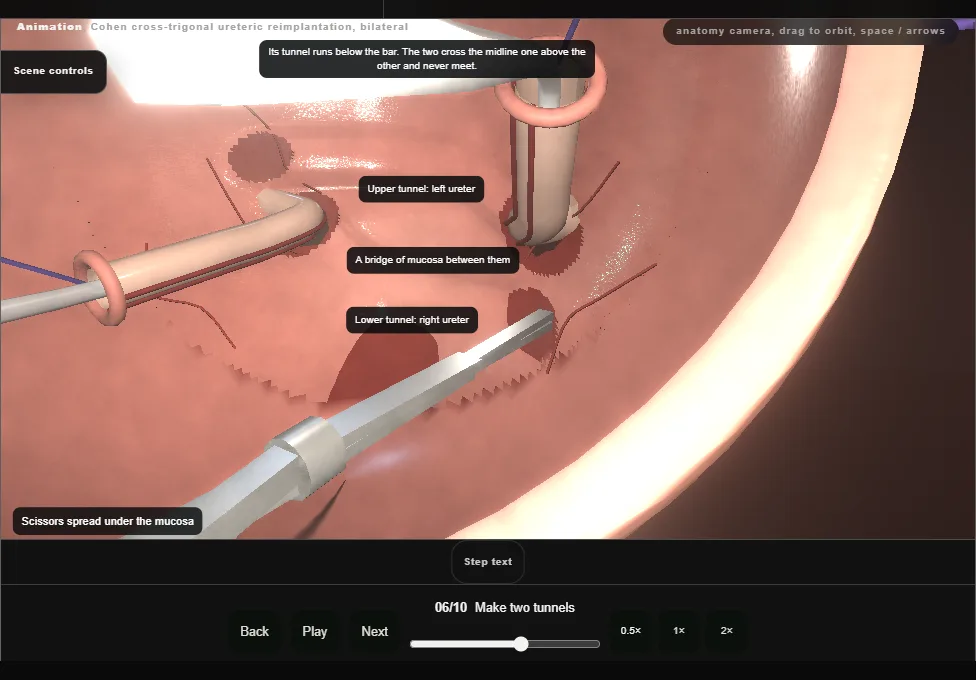
- The more lateral ureter, here the left, takes the upper tunnel to a window above and lateral to the opposite orifice.
- The right takes a lower tunnel to a window at the inferior edge of the left orifice site.
- Each is opened by spreading scissors under the mucosa from the old hiatus: roof of mucosa, floor of detrusor.
- The two tunnels cross the midline one above the other with a bridge of mucosa between them.
- 07
Draw the ureters through
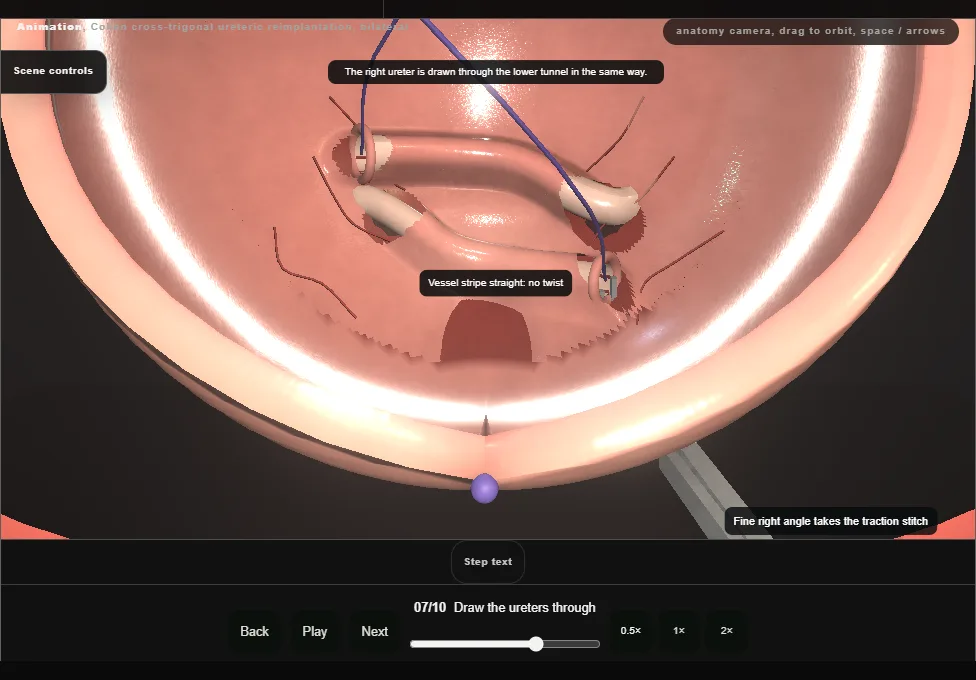
- A fine right angle passed back through each tunnel takes the traction stitch, the feeding tube is removed, and the ureter is drawn across under the mucosa.
- From behind the bladder each ureter still enters by its own hiatus.
- Check both before a single bite: no twist, no kink at the hiatus, no tension.
- 08
Anastomose
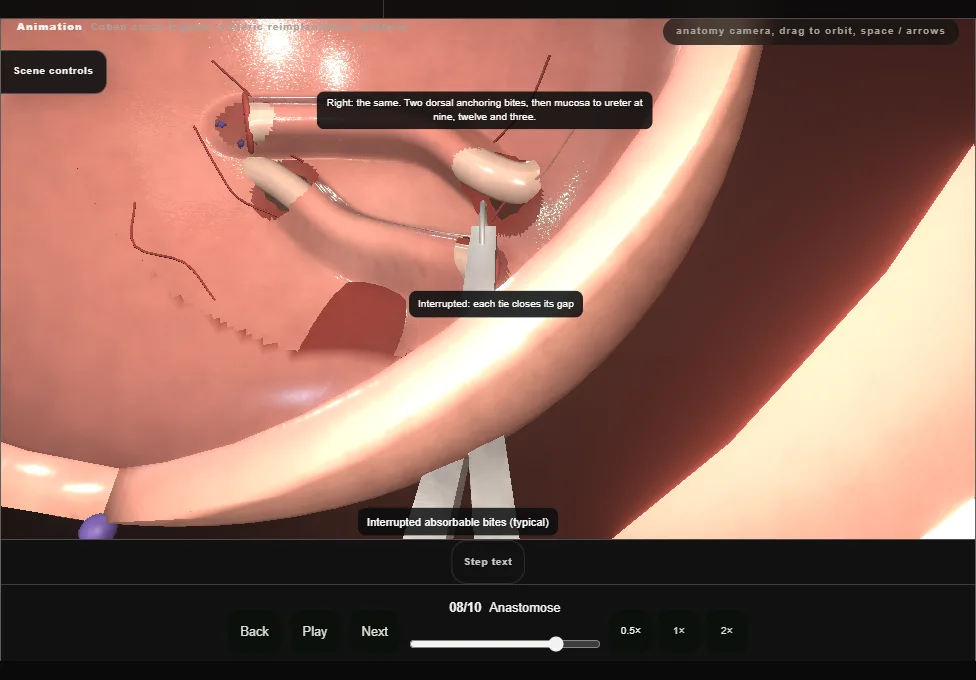
- Each ureter is trimmed back to bleeding edge and spatulated.
- Two dorsal bites take the ureter to trigone muscle and mucosa and stop it retracting into the tunnel.
- Interrupted bites at nine, twelve and three then bring mucosa to ureter, each tie closing its gap.
- Left, then right.
- 09
Close the old sites and check
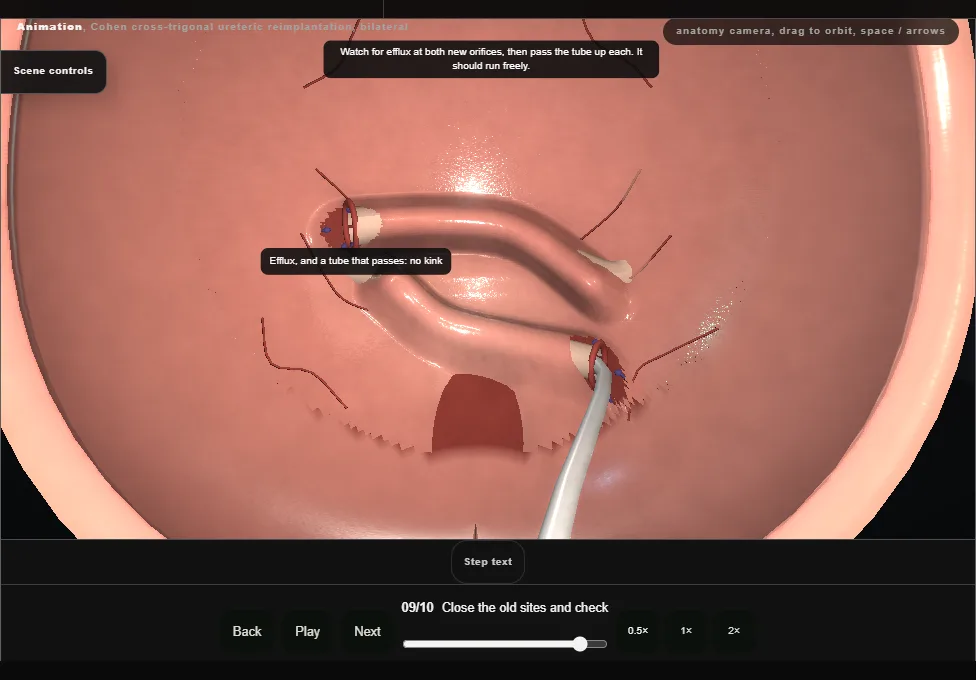
- The mucosa is closed over each original orifice with shallow bites, because a ureter now lies just beneath; the left closure stops short of the right ureter’s new orifice.
- Efflux is seen at both new orifices, and the feeding tube is passed up each and removed: it should run freely.
- 10
Close the bladder
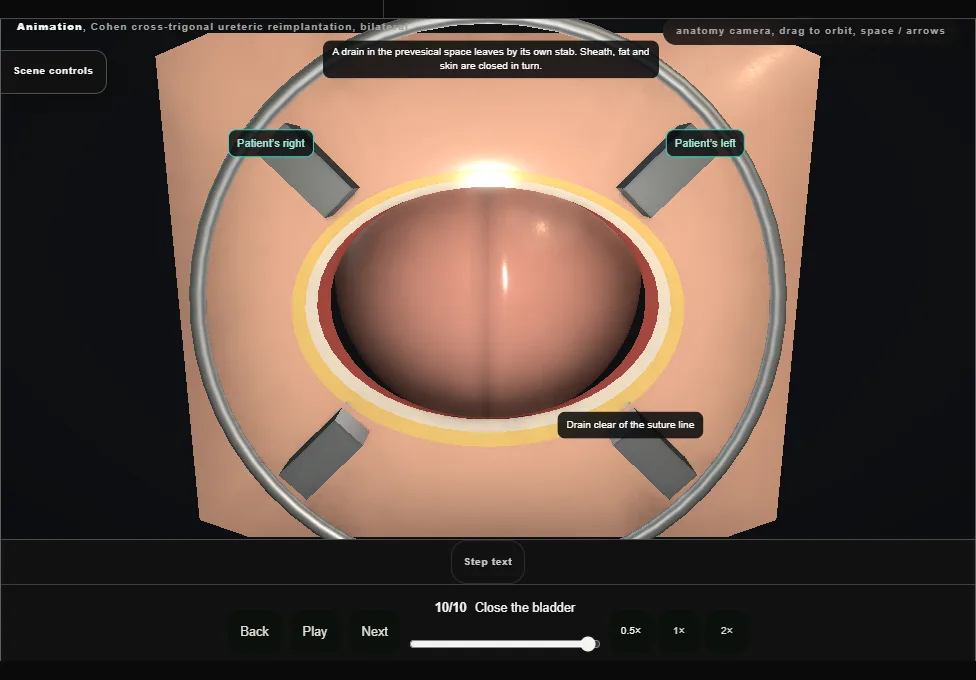
- A urethral catheter is placed and the bladder is closed in two layers, mucosa then muscle, and tested with irrigation.
- A drain lies in the prevesical space and leaves through its own stab, clear of the suture line.
- Sheath, fat and skin are closed in turn.
Derived from paediatric/CohenReimplantScene.tsx at build time: every step title and caption above is the authored
ProcedureDef text, reproduced verbatim, and this page shares its readable-points renderer with the animation
itself. 10 of 10 steps have a captured frame.
Text fingerprint 5fe1df93a46a20ce. A caption edit without a re-capture fails the production
check, so the sheet and the animation cannot drift apart silently.