
UrOops3D, danger-zone atlas
Operative animation, Bladder neck incision

Transurethral incision of the prostate and bladder neck incision

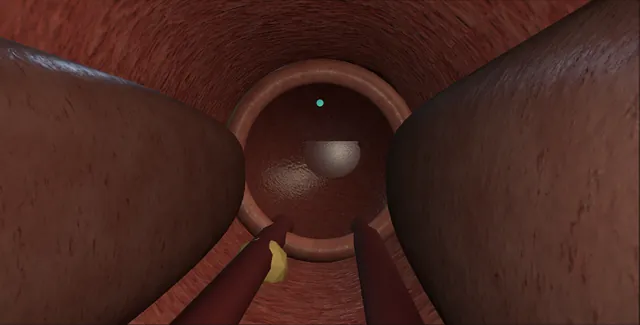
The small prostate and the high bladder neck: obstruction without enough adenoma to be worth resecting.

One incision with a knife electrode at seven o'clock, a straight line from just distal to the ureteric orifice through the neck towards the verumontanum and short of it, and the ring springs open.

This page is the choice, the limits, the depth, and the retrograde ejaculation that still has to be in the consent.

Core tier FRCS core urology, BPH / LUTS and bladder outlet obstruction Interactive 3D

Operative visualisation

Schematic scene preview: Bladder neck incision (TUIP)
Preparing the 3D anatomy…

UrOops3D · UroRef · © Nity G

Click me next Section 2 of 8 Anatomy The structures this operation works between, and the one it must not cross.

The structures in the scene

Bladder neck incision: how the structures relateFrom the verumontanum along a short prostatic urethra to the bladder neck. External sphincter: an incision carried past the veru reaches it Verumontanum (danger). Verumontanum: the incision stops a few millimetres short One incision at seven o'clock. One incision at seven o'clock: depth judged here Surgical capsule and the fat beyond it (danger). One incision at seven o'clock: Collings knife drawn back from the neck Bladder neck. Bladder neck: in the line of the cut: button, not run along Neck arteries at five and seven (danger). Bladder neck: can be within a centimetre: start distal to them Ureteric orifices (danger).Distal: penile endProximal: bladder!External sphincterVerumontanumOne incision at seveno'clock!Surgical capsuleand the fatbeyond itBladder neck!Neck arteries atfive and seven!Ureteric orificesan incision carried past theveru reaches itthe incision stops a fewmillimetres shortdepth judged hereCollings knife drawn back fromthe neckin the line of thecut: button, notrun alongcan be within a centimetre:start distal to themTargetDangerLandmark
From the verumontanum along a short prostatic urethra to the bladder neck. Schematic, not to scale; relationships only.
  • From the veru the prostatic urethra is short and the bladder neck a tight ring ahead with the orifices just beyond it on the trigone.
  • The knife starts inside the neck at seven o'clock, distal to the right orifice, and is drawn back toward the veru; the trench deepens through the neck fibres, with depth judged against the capsule.
  • There is one incision only, and the channel that results runs between the orifice and the veru along that line.
  • ›Bladder neck - the tight ring of circular fibres that springs open when it is divided; the target.
  • ›Ureteric orifices - at the corners of the trigone, sometimes within a centimetre of the neck; the incision starts distal to them.
  • ›Verumontanum - the distal limit; the incision stops a few millimetres short of it.
  • ›Surgical capsule and the fat beyond it - depth is judged against the capsule.
  • ›The neck arteries at five and seven o'clock - the one at seven lies in the line of the incision; touched with the button, not run along.
  • ›The Collings knife - a fine wire electrode drawn toward the sheath on cutting current, the cut made on the withdrawal.
  • ›External sphincter - two centimetres beyond the veru; injured by an incision carried past it.
Click me next Section 3 of 8 Steps The operation in order, with the landmark that guards each move.

Operative steps

  1. Who gets an incision The prostate under about thirty grams on ultrasound or examination, the high or tight bladder neck in a younger man, the primary bladder neck obstruction of the urodynamic trace, and the bladder neck contracture after a previous resection. The gain over a resection is a shorter, less bloody operation with less retrograde ejaculation, and no TUR syndrome. The loss is a higher re-operation rate over the years and no tissue for histology. A man with a large lateral lobe or a median lobe that fills the neck is not helped by an incision and needs a resection or an enucleation.
  2. Consent and set-up The consent names retrograde ejaculation, bleeding, infection, a catheter for a night, the small risks of incontinence and stricture, and the chance of a later resection. A spinal or general anaesthetic, lithotomy, the legs padded. A 24 or 26 French continuous-flow resectoscope sheath with the working element, a 30 degree telescope, the Collings knife electrode on cutting current, the button electrode for haemostasis, saline with a bipolar system or glycine with monopolar, and a 20 or 22 French catheter on the trolley.
  3. Cystoscopy: the two limits The sheath goes in under vision on the visual obturator. The sphincter, then the verumontanum: the distal limit of the incision is a few millimetres proximal to the veru, never beyond it. The prostatic urethra is short and the lateral lobes small; the bladder neck is a tight ring ahead. In the bladder both ureteric orifices are found and their distance from the neck is measured against the loop, because the incision starts just distal to them and an orifice that sits close to the neck is in the line of the knife.
    where it bites: the two limits are the orifices proximally and the veru distally; everything happens between them.
  4. The Collings knife A fine wire electrode on a single support, on cutting current, that is drawn toward the sheath the way the loop is. The knife is placed at seven o'clock, just inside the bladder neck and distal to the right orifice, with the scope advanced so the knife is beyond the tissue to be cut. The scope is then drawn back, so the knife runs from the neck toward the veru along the same line: the cut is made on the withdrawal, under vision, with the veru watched.
  5. The incision at seven o'clock The first stroke goes from the neck to a point short of the veru through the mucosa; the same line is cut again, deeper each time, never a new line beside it. The circular fibres of the neck part and the ring springs open, and the cut passes through the small amount of adenoma; depth is judged against the surgical capsule. The trench is inspected along its length so that it is the same depth from the neck to the apex.
    where it bites: depth is judged against the capsule; a cut through the capsule and the fat beyond it enters the perivesical space and extravasates.
  6. The same line, checked There is one incision only, at seven o'clock. Between strokes the scope is drawn back to look at the veru and confirm that the incision has stopped short of it, and the trench is checked for the same depth along its length, from the neck to short of the veru.
  7. Haemostasis With the incision complete the neck has sprung open into a wide channel. The irrigation is slowed and the edges of the trench inspected. The arteries of the neck enter at five and seven o'clock, and the incision runs at seven, so a bleeding point at its edge is common; it is touched with the button on coagulation until it whitens, not run along the trench, which reopens it. Both orifices are looked at again with their jets, because the incision started close to the right one.
  8. The catheter and the note A 20 or 22 French two-way catheter goes in over the incision, usually without irrigation, and comes out the next morning or the same day if the urine is clear. The note records the site of the incision at seven o'clock and the depth reached, the orifices and the verumontanum seen intact, the catheter and the plan for its removal. The patient is told that ejaculation may be dry, that the benefit is felt once the catheter is out and the oedema settles, and that a resection may be needed years later.
Click me next Section 4 of 8 Danger zones Where this operation bites, and why it bites there.
Critical relationship

Danger zones

The spatial relationships the animation is built to make automatic. Before you read each one, ask yourself: at this point in the operation, what is about to go wrong, and what is my first move? The save for each sits in the Complications tab.

  • RiskThe orifices - within a centimetre of the neck behind a high bladder neck; the incision starts distal to them, measured, not guessed.
  • RiskToo deep - through the capsule and the fat beyond it into the perivesical space: extravasation of irrigant, a suprapubic swelling, a drain.
  • RiskThe neck arteries - at five and seven o'clock; the one at seven is in the line of the cut.
  • RiskPast the veru - the sphincter; an incision carried distal to the veru causes incontinence.
Practise it Take me into the scene Opens the animation at a danger moment and asks you to predict the mechanism and your first move before it reveals.
Click me next Section 5 of 8 Complications The save for each one: the first move, the escalation trigger, the op-note line.

Complications and immediate saves

Trigger each of these live in the Animation tab, then read the save: the first move, the escalation trigger, and the line that goes in the op note.

Too deep: extravasation

  • the trench through the capsule and the fat beyond it into the perivesical space: irrigant leaving the field, a deficit, a suprapubic swelling.
The save
  1. Stop cutting in that trench; secure haemostasis at the edges. first move
  2. A small extraperitoneal extravasation: catheter for a week, antibiotics, and a cystogram before it comes out.
  3. A large deficit, abdominal distension or peritonism: imaging, a drain, and possibly laparotomy with senior help. escalation trigger
  4. Note: the site and depth, the deficit, the catheter and the imaging plan. document

Orifice in the incision

  • the knife started at the orifice instead of distal to it: the slit is gone into the cut, no jet.
The save
  1. Stop cutting at that corner; do not coagulate it. first move
  2. Cannulate the orifice with a wire or ureteric catheter while it can still be found and stent it for four to six weeks.
  3. If it cannot be found: ultrasound at two weeks and three months for obstruction.
  4. Loin pain, fever or a rising creatinine: image and drain the kidney. escalation trigger
  5. Note: which orifice, stented or not, and the imaging plan. document

Bleeding from the neck

  • the neck arteries enter at five and seven o'clock; the one at seven is in the line of the cut: a jet from the edge filling the field.
The save
  1. Slow the irrigation and find the point; it is at the edge of the trench, not in its floor. first move
  2. Touch it with the button on coagulation until it whitens; do not run the electrode along the trench.
  3. A three-way catheter with irrigation overnight if the field oozes after the points are done.
  4. Bleeding that will not clear: catheter and traction, senior help, and a return to theatre if it continues. escalation trigger
  5. Note: the point, its control, the catheter and the irrigation plan. document

Carried past the veru

  • an incision that ran distal to the veru has entered the sphincter: stress incontinence.
The save
  1. Stop. Withdraw into the bulbar urethra and, looking forward, check the sphincter ring. first move
  2. No more cutting or coagulation at the apex in that sector.
  3. Catheter as planned; tell the patient before the trial without catheter; pelvic floor physiotherapy from the start.
  4. Incontinence persisting beyond six to twelve months: urodynamics and a continence surgeon. escalation trigger
  5. Note: the sector, what was seen of the ring, and the plan for review. document

Retrograde ejaculation

  • dry orgasm afterwards: the neck no longer closes.
The save
  1. It was in the consent; confirm the patient understood and that fertility was discussed before the operation. first move
  2. Fertility wanted afterwards: sperm can be recovered from post-ejaculatory urine; refer to andrology. escalation trigger
  3. Note: the counselling before and the discussion after. document
Click me next Section 6 of 8 Troubleshooting When the case turns: the problem, then the next move.

Intra-operative troubleshooting

When the case turns: the problem, then the next move.

  • ActionCannot see the orifice near the neck - into the bladder and look from there; the incision does not start until both orifices have been seen.
  • ActionThe knife will not cut - check the generator on cut, the return electrode and the irrigant; a coated knife is cleaned or changed.
  • ActionThe trench is deep at the neck and shallow at the apex - go back along the same line toward the apex; the depth is even from end to end.
  • ActionUnsure whether the trench is deep enough - another pass on the same line only, never a new line beside it, watching the veru.
  • ActionEverything bleeds at the neck - the neck arteries: find each point, button on the point, and do not run along the trench.
  • ActionThe neck still looks tight - deepen the same line, not a second incision; a large lateral lobe means this was the wrong operation.
Click me next Section 7 of 8 FRCS viva Say it out loud, then mark yourself against the model answer.

FRCS viva questions

The examiner stems this scene prepares you for. Try to answer out loud first, then reveal, and learn the discriminator, the detail that turns a pass into a strong pass.

QWhen would you offer a bladder neck incision instead of a TURP, and what would you tell the patient?reveal answer
  • I would offer an incision to a man with bladder outlet obstruction and a small prostate, under about thirty grams, without an obstructing median lobe, and to the younger man with primary bladder neck obstruction shown on urodynamics, or a bladder neck contracture after previous surgery.
  • The advantages over resection are a shorter operation with less bleeding, a lower rate of retrograde ejaculation, no TUR syndrome and a shorter catheter time.
  • The disadvantages are a higher re-treatment rate over five to ten years and no tissue for histology, so the PSA and examination need to be reassuring first.
  • I would explain that the operation divides the muscle ring at the neck rather than removing tissue, that the symptomatic outcome for a small gland is similar to TURP, and I would consent for retrograde ejaculation, bleeding, infection, a catheter overnight, and the small risks of incontinence, stricture and the need for a later resection.
  • A man with a big lateral lobe or a median lobe filling the neck would be advised to have a resection or enucleation instead.
Strong pass

Say both

  • Naming the size threshold and the urodynamic indication
  • The lower rate of retrograde ejaculation and the higher re-treatment rate
Examiner note
Naming the size threshold and the urodynamic indication, the lower rate of retrograde ejaculation and the higher re-treatment rate.
QDescribe the technique of a bladder neck incision.reveal answer
  • Under regional or general anaesthesia in lithotomy I would pass a continuous-flow resectoscope under vision and identify the verumontanum as the distal limit, then enter the bladder and identify both ureteric orifices and their distance from the neck, because the incision must start distal to them.
  • Using a Collings knife on cutting current, I would place the knife just inside the bladder neck at seven o'clock, distal to the right orifice, and draw it back toward the verumontanum, cutting on the withdrawal, stopping a few millimetres proximal to the veru.
  • I would repeat along the same line, deeper each time, through the circular fibres of the neck and the small amount of adenoma, judging depth against the surgical capsule.
  • This is a single incision at seven o'clock, with no second incision.
  • I would coagulate bleeding points at the edges with the button, confirm both orifices with efflux and the veru intact, and leave a 20 to 22 French catheter overnight.
  • I would document the site, the depth reached and the landmarks seen.
Strong pass

Say both

  • The orifices measured before the cut
  • One straight incision at seven o'clock started distal to them and stopped short of the veru
Examiner note
The orifices measured before the cut, and one straight incision at seven o'clock started distal to them and stopped short of the veru.
QHow deep does the incision go, and what happens if you go too deep?reveal answer
  • The incision divides the circular fibres of the bladder neck along the one line at seven o'clock, through the small amount of adenoma, and depth is judged against the surgical capsule.
  • Once the fibres are divided the neck can no longer act as a ring and springs open, which is the purpose of the operation.
  • Too deep, through the capsule and the fat beyond it, is the perivesical or periprostatic space, and irrigant cutting into it extravasates: the surgeon sees fluid leaving the field, the irrigant deficit grows, and the patient develops a suprapubic swelling or, if the peritoneum is breached near the dome, abdominal distension and peritonism.
  • A small extraperitoneal extravasation is managed with a catheter for a week and antibiotics, with a cystogram before the catheter comes out; a large deficit or peritonism needs imaging, a drain and possibly laparotomy.
  • Going too deep laterally also enters the venous plexus and bleeds.
  • So the incision is deepened along the same line only.
Strong pass

Say both

  • Dividing the neck fibres as the reason the neck springs open
  • The extravasation picture and its management if the cut goes too deep
Examiner note
Dividing the neck fibres as the reason the neck springs open, and the extravasation picture and its management if the cut goes too deep.
QWhat are the complications of bladder neck incision?reveal answer
  • Retrograde ejaculation is the commonest and must be in the consent, particularly for the younger man.
  • Bleeding from the neck arteries, which enter at five and seven o'clock, the one at seven in the line of the incision, is controlled with point coagulation and occasionally needs irrigation overnight.
  • Extravasation from an incision carried too deep, through the capsule, is managed with catheter drainage.
  • Injury to a ureteric orifice from an incision started too proximally, and sphincter injury with incontinence from an incision carried past the verumontanum, are both errors of the limits and are prevented by identifying the orifices and the veru before cutting.
  • Urethral stricture and bladder neck contracture can follow, the latter paradoxically after an incision that heals with scar.
  • Infection and epididymitis occur as after any endoscopic procedure.
  • The main late issue is re-treatment, higher than after TURP, and the absence of histology, so the man must have had a PSA and examination beforehand.
Strong pass

Say all three

  • Grouping the complications around the two limits
  • The orifices and the veru
  • Naming re-treatment and no histology as the trade-offs
Examiner note
Grouping the complications around the two limits, the orifices and the veru, and naming re-treatment and no histology as the trade-offs.
Click me next Section 8 of 8 Evidence The guidance each of these answers is built on.

Evidence and guidance

Two minutes

Close the lap: recall it before you leave.

Say it aloud, then reveal. Reading is not remembering.

  1. 01 The relationship Say the critical spatial relationship out loud, then reveal. reveal
    Memory frame

    From the veru the prostatic urethra is short and the bladder neck a tight ring ahead with the orifices just beyond it on the trigone.

    Why?
    The knife starts inside the neck at seven o'clock, distal to the right orifice, and is drawn back toward the veru; the trench deepens through the neck fibres, with depth judged against the capsule. There is one incision only, and the channel that results runs between the orifice and the veru along that line.
  2. 02 The first move Too deep: extravasation. Your first move? reveal
    First move

    Stop cutting in that trench; secure haemostasis at the edges.

  3. 03 The escalation trigger Too deep: extravasation. What makes you call for help? reveal
    Escalate when

    A large deficit, abdominal distension or peritonism: imaging, a drain, and possibly laparotomy with senior help.

  4. 04 The discriminator What turns a pass into a strong pass? reveal
    Strong pass

    Say both

    • Naming the size threshold and the urodynamic indication
    • The lower rate of retrograde ejaculation and the higher re-treatment rate
    Examiner note
    Naming the size threshold and the urodynamic indication, the lower rate of retrograde ejaculation and the higher re-treatment rate.
  5. 05 The pitfall Where does this operation bite first? reveal
    Pitfall

    The orifices

    Why?
    within a centimetre of the neck behind a high bladder neck; the incision starts distal to them, measured, not guessed.

Revision practice with self-marked answers, not an assessment of clinical competence. Kept in this browser only; it does not sync between devices.