
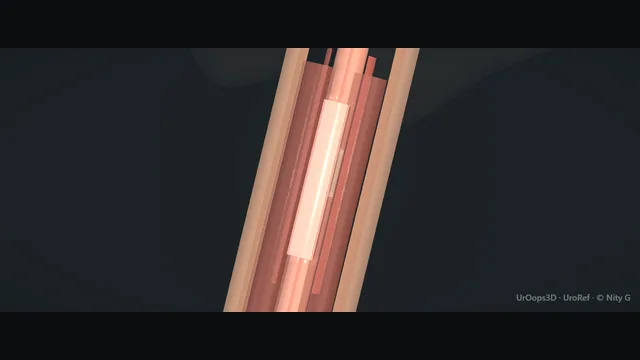
Recurrent stricture
- the repair narrows again, months to years out, from scar left at the excision margins, a tensioned or ischaemic anastomosis, or a graft that failed to take.
The save
- Recognise the pattern: a stream that improved after catheter removal, then slows again with straining over the following months. first move
- Assess with flow rate, calibrated endoscopy and contrast studies; define whether the recurrence is at the anastomosis, the onlay, or a new segment.
- Short, web-like recurrences at the anastomosis respond to endoscopic incision or dilation in selected patients, accepting that repeat instrumentation alone rarely cures.
- Longer or dense recurrences are re-operated: revision urethroplasty, often with substitution where primary anastomosis has already been used.
- Complex or panurethral recurrence → specialist reconstructive centre for staged repair rather than serial dilation. escalation trigger
- Note: original technique, site of recurrence, and the objective flow data before and after each intervention. document