
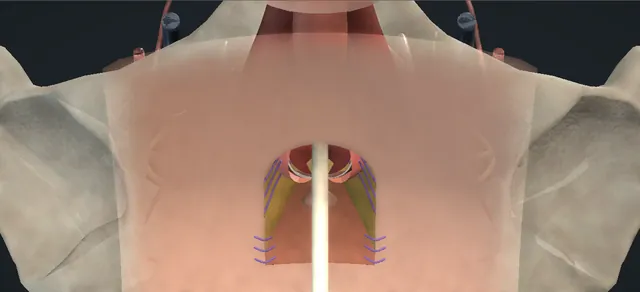
Outlet stenosis
- the urethrostomy narrows over months: an ischaemic flap tip, tension at the apex, spongy tissue in the bites, or the disease recurring in the proximal urethra.
The save
- Calibrate gently to confirm the narrowing and to see where it is: the skin ring, or the urethra above it. first move
- A flexible scope through the outlet separates a stenosed skin ring from recurrent urethral disease; the two are revised differently.
- Revision of a failed perineal urethrostomy: V-Y plasty of the ring, augmentation, or a redo, in a reconstructive unit. escalation trigger
- The patient is told what has narrowed and why; a self-dilatation holding pattern is a bridge, not the answer.
- Op note and clinic letter: the outlet calibre, where the narrowing lies, what the scope showed, and the revision plan. document