
Flexible cystoscopy
Flexible transurethral inspection of the urethra and bladder, with selected minor working-channel procedures when appropriate.
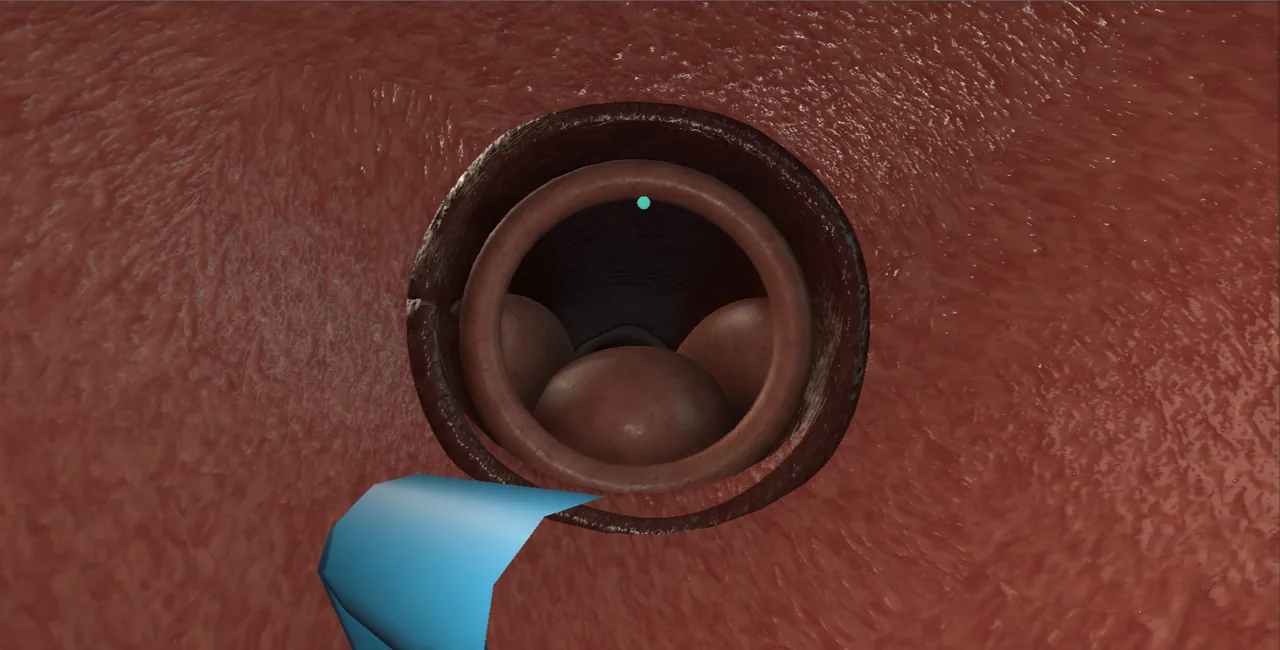 Interactive 3D Interactive flexible cystoscopy, beat by beat Open the 3D animation
Teaching catalogue only. This coverage record is not a patient pathway or operative instruction.
Typical place in practice
Evaluation or surveillance of haematuria, lower-tract symptoms, mucosal abnormalities, strictures, devices and previously treated bladder pathology.
Alternatives and neighbouring procedures
Imaging, urine cytology or rigid cystoscopy may complement or replace flexible inspection for specific diagnostic or therapeutic questions.
Same procedure family, explicit technique branches
These are variations of this canonical operation. Complication modules below identify whether they apply to all branches or only to named approaches.
Diagnostic flexible cystoscopy
A small flexible scope permits systematic office-based urethral and bladder inspection.
Flexible surveillance cystoscopy
Scheduled inspection searches for recurrence after prior urothelial disease treatment.
Flexible cystoscopy with stent retrieval
Graspers retrieve a planned ureteric stent or other accessible lower-tract device.
High-level sequence
Coverage outline only; not a step-by-step technical guide.
- Confirm indication, infection status and consented minor interventions
- Enter the urethra under vision and inspect systematically
- Survey bladder landmarks with controlled distension
- Photograph or retrieve a device only as planned
- Document a complete map and any need for rigid assessment or biopsy
Operative notes
Concise operative notes covering the key steps, landmarks and watch points, in the order you encounter them.
Flexible cystoscopy
What it does: bladder check with a bendy scope, awake patient.
- Gel in, as for a catheter. Water on.
- At the sphincter, hold the scope back. Ask the patient to breathe out slowly or try to void. It relaxes and opens. It hurts less. Never push.
- Quick look on the way in. Full check of urethra and prostate on the way out.
- Survey the bladder half full, in a set order: trigone, right orifice, right wall, dome, left wall, left orifice, back wall, front wall. Watch each orifice jet. Scope bends better one way? Turn it 180 degrees.
- "J move" for the bladder neck: bend the tip fully, push to the dome, pull back. Straighten the tip before moving on or coming out.
- Stent out: check the register first (side, date, why). Graspers through the channel, closed on the curl. Scope and stent out together. Resists or encrusted: stop, do not pull.
From the UroRef Operative Quick Guide. Open the note page →
Every failure mode is its own module.
Timing and variation coverage are recorded for each module.
Urinary infection or sepsis
Lower-tract instrumentation can introduce or disseminate infection, especially when drainage is impaired or bacteriuria is present.
Applies to: Diagnostic flexible cystoscopy · Flexible surveillance cystoscopy · Flexible cystoscopy with stent retrievalUrethral trauma or false passage
Forced passage, poor visualisation or an unrecognised stricture can injure the urethra.
Applies to: Diagnostic flexible cystoscopy · Flexible surveillance cystoscopy · Flexible cystoscopy with stent retrievalHaematuria and dysuria
Minor mucosal trauma may cause short-lived bleeding or discomfort; persistent symptoms require a different explanation.
Applies to: Diagnostic flexible cystoscopy · Flexible surveillance cystoscopy · Flexible cystoscopy with stent retrievalFailed or incomplete examination
A stricture, pain, bleeding, poor visibility or bladder anatomy may prevent a complete diagnostic survey.
Applies to: Diagnostic flexible cystoscopy · Flexible surveillance cystoscopy · Flexible cystoscopy with stent retrievalDevice retrieval injury or failure
An encrusted, migrated or trapped device may not be safely removable through the flexible scope and traction can injure the ureter or urethra.
Applies to: Flexible cystoscopy with stent retrievalMissed mucosal lesion
Incomplete distension, poor visibility or subtle morphology can leave clinically important urothelial disease undetected.
Applies to: Diagnostic flexible cystoscopy · Flexible surveillance cystoscopySources for this module
Infection prevention, recognition and procedure-associated infection context.
Accessed 2026-08-03 · opens source British Association of Urological Surgeons Patient information leaflets by procedureUK patient-facing procedure, alternatives, recovery and complication framing.
Accessed 2026-08-03 · opens source