
Kidney-sparing endoscopic treatment of upper-tract urothelial carcinoma
Ureteroscopic or percutaneous biopsy and ablation of selected upper-tract urothelial tumours within an intensive surveillance pathway.
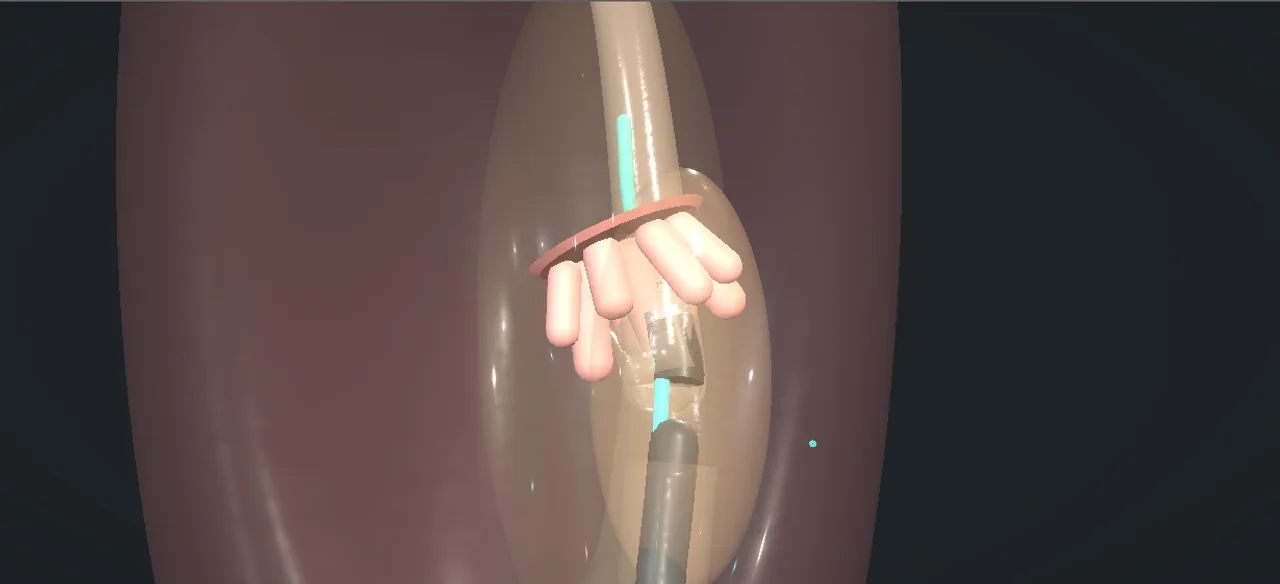 Interactive 3D Interactive ureteroscopic biopsy and laser ablation Open the 3D animation
Teaching catalogue only. This coverage record is not a patient pathway or operative instruction.
Typical place in practice
Risk-appropriate low-risk disease or an imperative kidney-sparing indication after complete staging, grading and shared decision-making.
Alternatives and neighbouring procedures
Radical nephroureterectomy, segmental ureterectomy, systemic treatment, or surveillance in exceptional contexts.
Same procedure family, explicit technique branches
These are variations of this canonical operation. Complication modules below identify whether they apply to all branches or only to named approaches.
Ureteroscopic laser ablation
Biopsies and treats visible tumour through the ureter.
Percutaneous resection or ablation
Provides a larger working channel for selected renal pelvic or calyceal lesions.
Antegrade ureteroscopic treatment
Approaches lesions inaccessible from below.
Adjuvant upper-tract instillation pathway
Adds locally delivered treatment under a product- and protocol-specific governance plan.
High-level sequence
Coverage outline only; not a step-by-step technical guide.
- Confirm risk category with imaging, cytology and biopsy where feasible
- Map the entire upper tract and bladder
- Ablate or resect visible disease while preserving wall integrity
- Secure drainage without obscuring pathology or seeding risk
- Undertake scheduled second-look and long-term bladder/upper-tract surveillance
Every failure mode is its own module.
Timing and variation coverage are recorded for each module.
Ureteric perforation, extravasation or later stricture
Deep energy or access trauma can breach and later narrow the ureter.
Applies to: Ureteroscopic laser ablation · Antegrade ureteroscopic treatmentBleeding or renal vascular injury
Percutaneous tract and tumour resection can cause collecting-system or parenchymal haemorrhage.
Applies to: Percutaneous resection or ablation · Antegrade ureteroscopic treatmentInfection or sepsis
Instrumentation, pressure and temporary drainage can cause systemic infection.
Applies to: All variantsAdjacent-organ or pleural injury
Percutaneous access can traverse pleura, bowel, liver or spleen.
Applies to: Percutaneous resection or ablation · Antegrade ureteroscopic treatmentResidual, recurrent or understaged tumour
Sampling limitations and field change make recurrence and progression central to this pathway.
Applies to: All variantsTumour seeding along a tract
Percutaneous access creates a rare route for extra-urinary implantation.
Applies to: Percutaneous resection or ablation · Antegrade ureteroscopic treatmentChemical inflammation, obstruction or systemic exposure
Local treatment can leak, inflame or obstruct the upper tract and has agent-specific systemic risks.
Applies to: Adjuvant upper-tract instillation pathwaySources for this module
Kidney-sparing UTUC treatment, segmental surgery and nephroureterectomy.
Accessed 2026-08-03 · opens source British Association of Urological Surgeons Patient information leaflets by procedureUK patient-facing procedure, alternatives, recovery and complication framing.
Accessed 2026-08-03 · opens source