
Paediatric urinary stone procedures
Size- and anatomy-adapted extracorporeal, retrograde, percutaneous and bladder stone treatment within a metabolic prevention pathway.
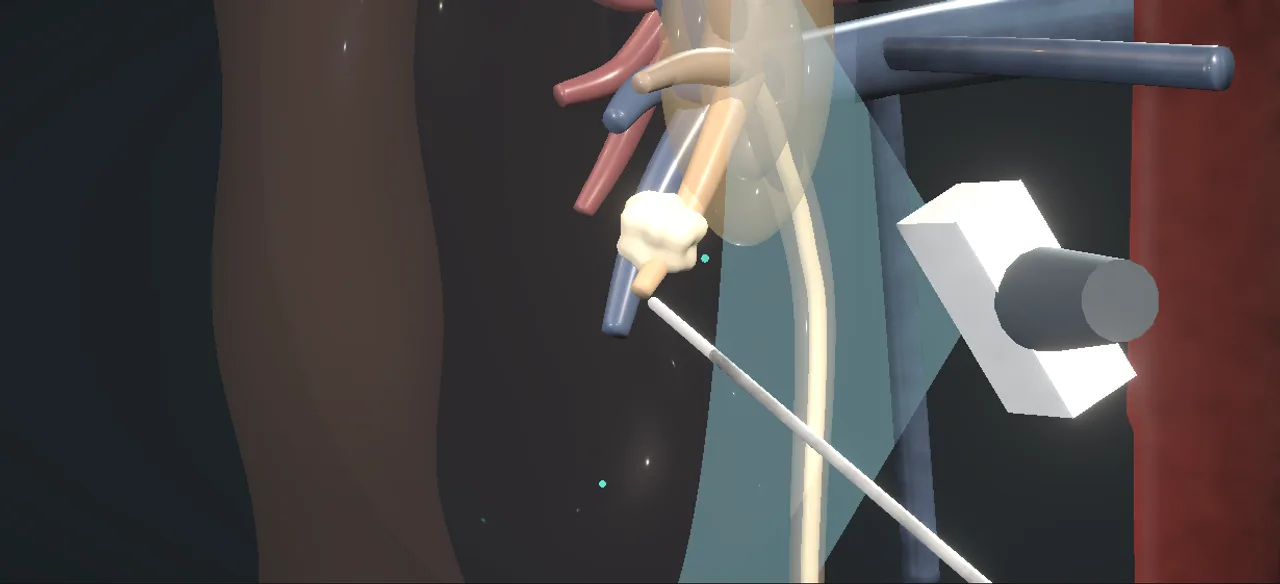 Interactive 3D Interactive paediatric mini-PCNL and ureteroscopy Open the 3D animation
Teaching catalogue only. This coverage record is not a patient pathway or operative instruction.
Typical place in practice
Symptomatic, obstructing, infected, growing or unlikely-to-pass stones after considering child size, anatomy, composition and recurrence risk.
Alternatives and neighbouring procedures
Observation or medical expulsive/preventive care in suitable cases; urgent drainage without stone treatment for an infected obstructed system.
Same procedure family, explicit technique branches
These are variations of this canonical operation. Complication modules below identify whether they apply to all branches or only to named approaches.
Shock-wave lithotripsy
Treats selected renal or ureteric stones without urinary-tract incision.
Ureteroscopy or RIRS
Treats ureteric and intrarenal stones through the natural urinary tract.
Paediatric PCNL
Treats larger or complex renal stone burdens through a flank tract.
Cystolitholapaxy
Treats bladder calculi while investigating the cause.
Laparoscopic or open stone removal
A selected option for complex anatomy, very large stones or concurrent reconstruction.
High-level sequence
Coverage outline only; not a step-by-step technical guide.
- Define stone burden, anatomy, infection and metabolic context
- Select the least morbid route likely to achieve the treatment goal
- Use age-appropriate access and limit pressure and tissue trauma
- Confirm drainage and manage fragments or devices
- Complete stone analysis, metabolic work-up and recurrence prevention
Every failure mode is its own module.
Timing and variation coverage are recorded for each module.
Ureteric perforation, avulsion or later stricture
Small-calibre and anomalous ureters are vulnerable to access and instrument trauma.
Applies to: Ureteroscopy or RIRSBleeding or renal vascular injury
Percutaneous tracts and renal surgery can cause haemorrhage or parenchymal loss.
Applies to: Paediatric PCNL · Laparoscopic or open stone removalInfection or sepsis
Infected urine, high intrarenal pressure and residual obstruction can cause systemic infection.
Applies to: All variantsPleural, bowel or solid-organ injury
Small body size and congenital anatomy narrow safe access windows.
Applies to: Paediatric PCNL · Laparoscopic or open stone removalResidual fragments or recurrent stones
Stone clearance and metabolic prevention must be tracked separately.
Applies to: All variantsStent, nephrostomy or fragment obstruction
Temporary devices and fragmented stone can obstruct or migrate.
Applies to: All variantsRenal growth or functional impact
Repeat procedures, obstruction, infection and parenchymal injury can affect a developing kidney.
Applies to: All variantsSources for this module
Common congenital, acute scrotal and paediatric reconstructive procedures.
Accessed 2026-08-03 · opens source European Association of Urology EAU Guidelines on UrolithiasisSWL, ureteroscopy, RIRS, PCNL, bladder stones and decompression options.
Accessed 2026-08-03 · opens source