
Paediatric ureterocele and duplex-system surgery
A reconstructive ladder for obstructing ureterocele and duplex systems, from endoscopic decompression to upper- or lower-tract reconstruction.
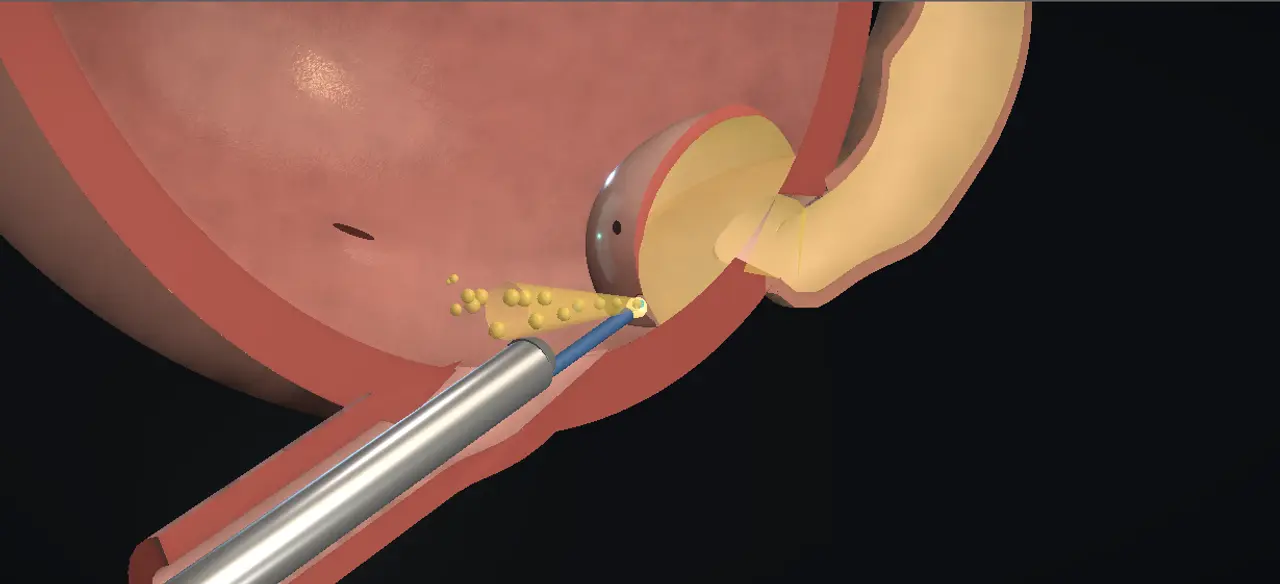 Interactive 3D Interactive endoscopic ureterocele incision Open the 3D animation
Teaching catalogue only. This coverage record is not a patient pathway or operative instruction.
Typical place in practice
Obstruction, infection, reflux, impaired moiety function or outlet compromise after mapping duplex anatomy and bladder effects.
Alternatives and neighbouring procedures
Observation in selected asymptomatic low-risk anatomy, infection prevention and surveillance, or staged treatment as the child grows.
Same procedure family, explicit technique branches
These are variations of this canonical operation. Complication modules below identify whether they apply to all branches or only to named approaches.
Endoscopic ureterocele puncture or incision
Opens the ureterocele to relieve obstruction with limited initial morbidity.
Ipsilateral ureteroureterostomy
Drains a functioning obstructed moiety into the unaffected ureter.
Common-sheath ureteric reimplantation
Treats reflux or distal obstruction while preserving the duplex unit.
Upper-pole heminephrectomy and ureterectomy
Removes a poorly functioning moiety and selected ureter.
Ureterocelectomy and bladder reconstruction
Removes the sac and reconstructs trigone/outlet in complex anatomy.
High-level sequence
Coverage outline only; not a step-by-step technical guide.
- Map moiety function, ureteric course, reflux and outlet anatomy
- Choose decompression, reconstruction or ablative pathway
- Preserve viable moiety and shared blood supply
- Restore dependent drainage without creating obstruction or reflux
- Monitor infection, bladder function and growth of remaining renal tissue
Every failure mode is its own module.
Timing and variation coverage are recorded for each module.
New or persistent vesicoureteric reflux
Decompression changes the distal antireflux mechanism and may expose reflux into one or more moieties.
Applies to: Endoscopic ureterocele puncture or incisionPersistent or recurrent obstruction
An inadequate opening, anastomotic scarring or complex distal anatomy can limit drainage.
Applies to: All variantsUrinary leak or urinoma
Ureteric and renal reconstruction can leak into the retroperitoneum or pelvis.
Applies to: All variantsLoss of function in the remaining moiety
Shared vessels or inadvertent collecting-system injury can damage the preserved lower pole.
Applies to: Upper-pole heminephrectomy and ureterectomyUreteric devascularisation or injury
Duplex ureters can share a delicate adventitial blood supply.
Applies to: All variantsUrinary infection
Residual stasis, reflux and devices contribute to ongoing infection risk.
Applies to: All variantsBladder-neck or contralateral ureteric injury
Complex trigonal surgery can affect continence and the opposite upper tract.
Applies to: Common-sheath ureteric reimplantation · Ureterocelectomy and bladder reconstruction