
Paediatric pyeloplasty for pelvi-ureteric junction obstruction
Open, laparoscopic and robotic reconstruction of the pelvi-ureteric junction, including crossing-vessel and non-dismembered variations.
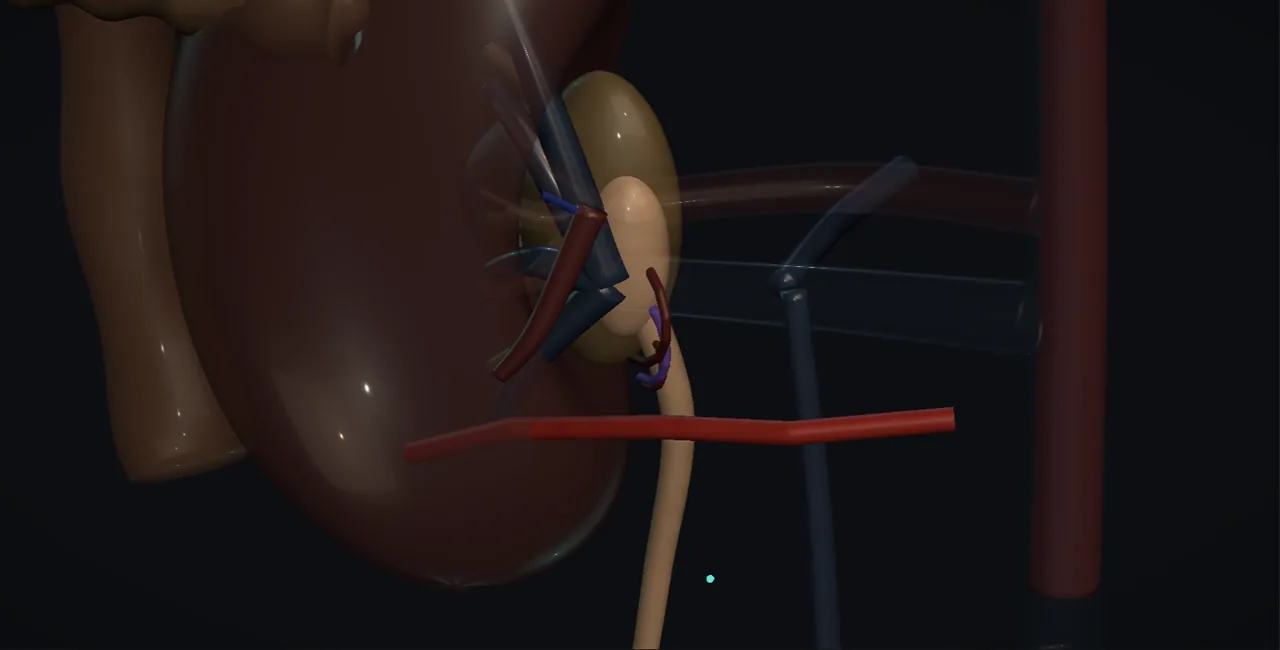 Interactive 3D Interactive dismembered pyeloplasty Open the 3D animation
Teaching catalogue only. This coverage record is not a patient pathway or operative instruction.
Typical place in practice
Selected symptomatic or functionally significant upper-tract obstruction after serial anatomical and functional assessment.
Alternatives and neighbouring procedures
Observation with imaging for stable low-risk dilatation, temporary drainage in acute compromise, or endoscopic treatment in unusual selected older patients.
Same procedure family, explicit technique branches
These are variations of this canonical operation. Complication modules below identify whether they apply to all branches or only to named approaches.
Open dismembered pyeloplasty
Excises the narrowed junction and re-anastomoses ureter to a tailored renal pelvis.
Laparoscopic dismembered pyeloplasty
Recreates the same reconstruction through laparoscopy.
Robotic dismembered pyeloplasty
Facilitates intracorporeal suturing, typically in larger children.
Non-dismembered or flap pyeloplasty
Remodels selected anatomy without complete transection.
High-level sequence
Coverage outline only; not a step-by-step technical guide.
- Confirm laterality, function and anatomic cause
- Expose the junction while preserving ureteric blood supply
- Address crossing vessels and excise or remodel obstruction
- Create a dependent watertight anastomosis
- Provide selected drainage and follow functional recovery
Every failure mode is its own module.
Timing and variation coverage are recorded for each module.
Urinary leak or urinoma
Anastomotic or drainage failure can cause retroperitoneal or intraperitoneal leakage.
Applies to: All variantsRecurrent or persistent PUJ obstruction
Scarring, kinking, missed anatomy or ischaemia can limit drainage.
Applies to: All variantsBleeding or crossing-vessel injury
Aberrant or segmental vessels can be injured during mobilisation and tailoring.
Applies to: All variantsUrinary infection
Stasis, devices and urine leakage can lead to infection.
Applies to: All variantsStent or drain migration, blockage or retained device
Internal and external drainage require explicit removal or exchange tracking.
Applies to: All variantsBowel, solid-organ or port complication
Minimally invasive abdominal access adds approach-specific risks.
Applies to: Laparoscopic dismembered pyeloplasty · Robotic dismembered pyeloplastySources for this module
Common congenital, acute scrotal and paediatric reconstructive procedures.
Accessed 2026-08-03 · opens source British Association of Urological Surgeons Patient information leaflets by procedureUK patient-facing procedure, alternatives, recovery and complication framing.
Accessed 2026-08-03 · opens source