
Suprapubic catheter insertion and exchange
Percutaneous or open bladder drainage through the lower abdominal wall, with later exchanges through a mature tract.
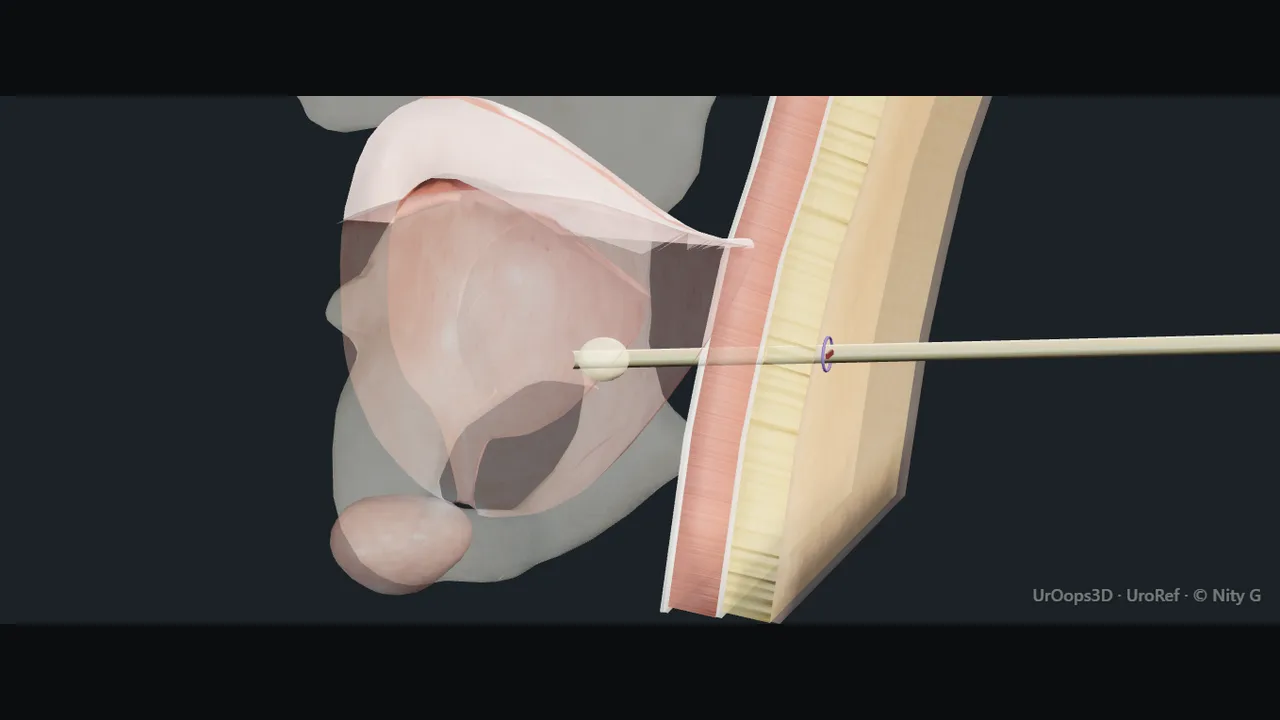 Interactive 3D Interactive operative model Open the 3D animation
Teaching catalogue only. This coverage record is not a patient pathway or operative instruction.
Typical place in practice
When urethral drainage is impossible, contraindicated or undesirable, and for selected long-term bladder-management pathways.
Alternatives and neighbouring procedures
Urethral or intermittent catheterisation, urinary diversion or upper-tract drainage depending on the clinical problem.
Same procedure family, explicit technique branches
These are variations of this canonical operation. Complication modules below identify whether they apply to all branches or only to named approaches.
Percutaneous trocar SPC
A distended, localised bladder is entered on a needle-confirmed line with a catheter carried on a trocar or stylet; a separate technique from the wire-guided kit, not a step within it.
Seldinger SPC
Urine is aspirated through the needle, the guidewire goes in floppy tip first, a sheath-dilator follows over the wire, the dilator and wire come out leaving the peel-away sheath, and the catheter passes through the sheath before the balloon is inflated and the sheath is split away.
Open SPC
The bladder is exposed directly when percutaneous access is unsuitable or another open procedure is being performed.
Mature-tract SPC exchange
An existing catheter is replaced promptly while the tract remains patent.
High-level sequence
Coverage outline only; not a step-by-step technical guide.
- Confirm indication, bladder filling and absence of unsafe intervening anatomy, with ultrasound where available
- Check the kit and catheter, mark the midline entry and infiltrate local anaesthetic
- Enter the bladder with the needle and confirm it by aspirating urine before anything wider is loaded
- Establish the tract by the chosen technique (wire-guided sheath, trocar or open) and confirm the catheter is intravesical before the balloon is inflated
- Secure the catheter, confirm free drainage and record technique, kit, catheter, balloon volume and the exchange plan
Operative notes
Concise operative notes covering the key steps, landmarks and watch points, in the order you encounter them.
Suprapubic catheter
What it does: drain the bladder through the skin above the pubis.
- Prove the bladder is full. Examine. Aspirate urine with a needle.
- Old lower tummy scar? Bowel may stick under it. Go well to the side, or use ultrasound.
- Fill the bladder to 500 mL if not full. Full bladder rises against the wall and pushes bowel up, out of the way.
- Spinal cord injury patient? Big fills can spike BP. (This is autonomic dysreflexia.) Consider GA.
- Tilt the head of the bed down.
- Entry point: 2-3 cm above the pubic bone. Too low and you hit the bone.
- Freeze skin and rectus sheath.
- Aspirate urine with the needle first. That needle angle is your track.
- 1 cm blade cut.
- Trocar: one hand pushes, one hand stops overshoot. Aim down and back, towards the pelvis. Never straight in, 90 degrees to skin.
- Urine returns. Out with the trocar. In with the catheter, all the way.
- Inflate the balloon. Peel away the sheath. Draw back till the balloon sits on the bladder wall. Secure without traction.
- Watch: Bowel injury ~2 in 100. Mostly neuropathic bladders.
- 2026 update: Most units now use Seldinger kits (needle, wire, dilator, peel sheath). Less force.
- 2026 update: Ultrasound guidance is routine where available.
From the UroRef Operative Quick Guide. Open the note page →
Every failure mode is its own module.
Timing and variation coverage are recorded for each module.
Bowel or intraperitoneal injury
An intervening viscus or a high peritoneal reflection may be entered, with presentation ranging from immediate concern to delayed peritonitis.
Applies to: Percutaneous trocar SPC · Seldinger SPC · Open SPCBleeding or abdominal-wall haematoma
The tract may injure abdominal-wall or bladder vessels, particularly when access is off midline or difficult.
Applies to: Percutaneous trocar SPC · Seldinger SPC · Open SPC · Mature-tract SPC exchangeUrinary infection or sepsis
Bacteriuria, instrumentation and impaired drainage can progress from local infection to systemic illness.
Applies to: Percutaneous trocar SPC · Seldinger SPC · Open SPC · Mature-tract SPC exchangeCatheter outside the bladder
Loss of the tract or failure to confirm bladder entry can result in extravesical balloon inflation and absent drainage.
Applies to: Percutaneous trocar SPC · Seldinger SPC · Mature-tract SPC exchangeTract loss during exchange
A suprapubic tract can narrow rapidly after removal; early or difficult exchange may create a false passage.
Applies to: Mature-tract SPC exchangeBlockage, encrustation and bladder stones
Long-term catheter biofilm and mineral deposition can impair drainage and contribute to recurrent stones.
Applies to: Percutaneous trocar SPC · Seldinger SPC · Open SPC · Mature-tract SPC exchangePersistent leakage or tract problems
Bypassing, granulation, skin irritation or failure of the tract to close may complicate ongoing care or removal.
Applies to: Percutaneous trocar SPC · Seldinger SPC · Open SPC · Mature-tract SPC exchangeSources for this module
Infection prevention, recognition and procedure-associated infection context.
Accessed 2026-08-03 · opens source British Association of Urological Surgeons Patient information leaflets by procedureUK patient-facing procedure, alternatives, recovery and complication framing.
Accessed 2026-08-03 · opens source