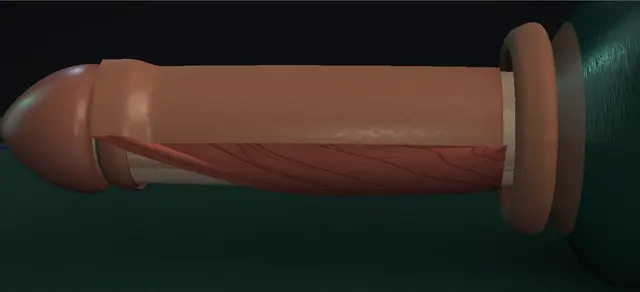
Schematic model. The ventral division, the patient's right as the side the pedicle is brought round, and the pedicle lying over the finished repair are authoring decisions where the book chapter leaves the choice open or is silent.
Operative animation, Penile flap urethroplasty
Penile circular fasciocutaneous flap urethroplasty: a skin island on a dartos pedicle, laid as a ventral onlay
A one-stage substitution urethroplasty for a long stricture of the penile urethra.
A circular band of distal penile skin is raised on a pedicle of dartos and the superficial lamina of Buck's fascia, divided, turned through a right angle and sewn on to the opened urethra as a ventral onlay, skin to the lumen.
Keep the subdermal plexus on the shaft skin, open the whole stricture, tailor the island to the defect and leave the pedicle without tension.
Advanced tierFRCS urethral stricture disease, urethral reconstruction, tissue transferInteractive 3D
How to use this module. Play through the eight steps, or use Back and Next. Watch the two cuts take different layers, the shaft skin peel back, the ring open to a strip and come round on its pedicle, and the island turned over on to the opened urethra. The triggers show skin loss, a pouch, a fistula and torsion.
The layers of the penile shaft, and what the skin island takes with it. Schematic, not to scale; relationships only.
From outside in, the shaft is skin with its subdermal plexus, dartos, the superficial and deep laminae of Buck's fascia, then the corpora, with the urethra in its spongiosum on the ventral side.
The flap separates those layers on purpose and differently at each line.
At the distal line the cut goes through dartos and the superficial lamina, so they leave with the island.
At the proximal line it stops at skin, so the shaft skin keeps its plexus and the dartos stays with the island.
The ring, opened to a strip, reaches the ventral urethra on that pedicle.
›Penile skin and its subdermal plexus - the shaft skin survives on this plexus once the dartos has gone with the island; it is kept on the skin through the whole deglove.
›Dartos - the vascular layer under the skin; with the superficial lamina of Buck's fascia it is the pedicle the island lives on.
›Superficial lamina of Buck's fascia - divided at the distal incision and raised with the dartos, so the pedicle is thick and well vascularised.
›Deep layer of Buck's fascia - left on the corpora; the dorsal vein, arteries and nerves lie beneath it and are not disturbed.
›Skin island - a circular band of hairless distal penile skin; opened to a strip, tailored, and turned skin to the lumen.
›Corpus spongiosum and urethra - opened in the ventral midline through the whole stricture; its two cut borders take the two running suture lines.
›Corpora cavernosa - beneath the deep fascia; nothing in this operation enters them.
›Corona and subcoronal skin - the distal line lies just proximal to the corona; the cuff left there is what the advanced shaft skin is sewn to.
Mark the islandThe patient is supine. A traction stitch through the glans puts the penis on stretch. Under loupe magnification the penile skin is marked all the way round a short distance proximal to the corona, and a second circumferential mark is made a measured band's width proximal to the first. The band between the two lines is the flap: distal penile skin, which is hairless. In an uncircumcised man the inner prepuce is used for the flap in place of penile skin. where it bites: the band is the only skin the repair has: lines that wander give an island of uneven width.
Distal incisionThe distal mark is incised and the cut is taken down through the dartos and the superficial lamina of Buck's fascia. Those layers travel with the island as its pedicle. Dissection then runs proximally on the deep layer of Buck's fascia, which stays on the corpora over the dorsal vessels and nerves. where it bites: a cut through the deep layer of Buck's fascia is in the dorsal neurovascular bundle dorsally and on the tunica at the sides.
Proximal incision and degloveThe proximal mark is incised through skin alone, staying above the dartos. The dissection is carried proximally in that plane to the base of the penis, keeping the subdermal plexus with the penile skin, and the penis is degloved to the penoscrotal junction. What remains is a ring of penile skin supported by a broad, well-vascularised pedicle. Haemostasis is with bipolar diathermy. where it bites: shaft skin stripped of its subdermal plexus necroses; a pedicle that is thinned or buttonholed starves the island.
Divide and transposeThe ring of skin and its pedicle are divided sharply in the midline, ventrally or dorsally, whichever preserves the healthier blood supply. The strip is rotated through a right angle and transposed to lie beside the urethra, parallel to it and without tension. where it bites: a pedicle that is tight or twisted threatens the island and can turn the shaft about its axis.
UrethrotomyA self-retaining ring retractor is set. A catheter is passed through the meatus to the stricture and the urethra is incised on its tip in the ventral midline. The urethrotomy is extended proximally into healthy tissue until the whole stricture is laid open. Stay sutures on the lateral edges of the opened urethra give traction, and the urethra is calibrated with bougies. Cystourethroscopy confirms that the proximal urethra and the bladder are free of disease. where it bites: a urethrotomy that stops in scar leaves a stricture at the end of the repair.
Tailor, turn over, first edgeThe urethral defect is measured and the skin island tailored to fit it. The island is turned over on to the opened urethra, skin to the lumen, and its pedicle edge is secured to the corresponding lateral border of the corpus spongiosum with a running absorbable stitch. where it bites: an island left wider than the defect has surplus to balloon; one cut too small sits under tension.
Apices and free edgeThe proximal and distal apices of the island are sewn to the ventral wall of the corpus spongiosum with interrupted full-thickness stitches. The remaining free edge is run to the opposite border of the spongiosum. Before the anastomosis is completed, a urethral catheter is passed easily into the bladder. where it bites: the apices are where the repair meets healthy urethra: a gap there leaks and a tight ring there strictures.
Skin closureThe repair is inspected for tension and bleeding, the wound is irrigated and the retractor removed. The penile skin is advanced distally and sewn to the subcoronal border with four quadrant stitches, with further interrupted stitches between them. The suture line is dressed, the penis is wrapped loosely, the glans stitch is removed and the catheter is secured to the abdominal wall on drainage. where it bites: a tight wrap on skin that has given up its dartos invites necrosis.
The spatial relationships the animation is built to make automatic. Before you read each one, ask yourself: at this point in the operation, what is about to go wrong, and what is my first move? The save for each sits in the Complications tab.
RiskPatient selection - the EAU guideline is against genital skin in lichen sclerosus and against penile skin flaps after failed hypospadias repair with scarred skin. Where a graft and a flap are equally indicated it prefers the graft.
RiskThe two planes - deep to dartos and the superficial lamina of Buck's fascia at the distal line; superficial to dartos at the proximal line. Swapping them devascularises the island or the shaft skin.
RiskThe subdermal plexus - it stays on the shaft skin all the way to the penoscrotal junction. The book names it as the protection against skin necrosis.
RiskThe pedicle - broad, untwisted and slack from the root to the island. Tension or a twist costs the island its supply and can rotate the shaft.
RiskThe ends of the stricture - the urethrotomy runs into healthy urethra at both ends before anything is sewn; the apices are fixed there with interrupted stitches.
RiskThe width of the island - tailored to the measured defect. Skin is more distensible than urethra and surplus pouches.
Trigger each of these live in the Animation tab, then read the save: the first move, the escalation trigger, and the line that goes in the op note.
Penile skin necrosis
the advanced shaft skin, living on its subdermal plexus alone, turns dusky and then black, usually toward the suture line.
The book lists it; the EAU guideline describes it as superficial in the flap arm of the trial it cites.
The save
Take the wrap off and look at the whole shaft, the glans and the repair beneath.first move
Superficial loss is dressed and left to demarcate.
Full-thickness loss, spreading redness or an exposed repair: senior review the same day, with debridement and skin cover planned by the reconstructive team.escalation trigger
Notes: the extent and depth of the loss day by day, with photographs by consent, and the plan.document
Flap sacculation and post-void dribbling
the island balloons into a pouch that fills on voiding and empties afterwards as a dribble.
Both are on the book's list; one series attributes the dribbling to skin being more distensible than urethra.
The save
Dribbling alone: teach the patient to press along the urethra after voiding to empty it.first move
A swelling, recurrent infection or a poor stream: image the urethra to show the pouch and any narrowing beyond it.
A pouch that obstructs, infects or holds debris is referred to the reconstructive team for revision.escalation trigger
Clinic letter: the symptoms, the imaging findings and what was advised.document
Urine leak and urethrocutaneous fistula
urine escapes through a suture line: early as a leak on the study at catheter removal, later as an opening on the ventral skin.
The save
A leak on the study at catheter removal: the catheter stays in and the study is repeated.first move
An established fistula is imaged for a narrowing distal to it before anything is planned.
A fistula that persists is repaired by the reconstructive team once the tissues have settled.escalation trigger
Notes: the site of the leak on imaging, the drainage in place and the date of the next study.document
Penile torsion
the shaft is turned about its axis toward the side the pedicle was brought round, by a pedicle that is short or twisted for its lie.
The save
Look for it before the skin is closed: the glans and the line of the repair should face straight down the midline.first move
Free the pedicle further toward the base of the penis and lay it again until the shaft sits straight.
Torsion found afterwards that troubles the patient is referred to the reconstructive team.escalation trigger
Op note: the side of division, the side the pedicle was brought round and the lie of the glans at closure.document
When the case turns: the problem, then the next move.
ActionLichen sclerosus, or scarred skin after hypospadias repair - genital skin is not used; the EAU guideline is against it in both. Oral mucosa is the substitute.
ActionA graft and a flap would both do - the EAU guideline prefers the graft. The flap earns its place when the urethral bed is poorly vascularised.
ActionThe patient is uncircumcised - the inner prepuce is used for the flap in place of penile skin.
ActionThe stricture is short, or confined to the glanular urethra - a rectangular, ventrally based penile fasciocutaneous flap limits the circumferential dissection.
ActionThe defect is longer than the ring - the circular flap is extended with a mid-ventral longitudinal limb as a Q-flap.
ActionA longitudinal penile flap is chosen - it is not extended proximally on to hair-bearing penile skin.
ActionOne side of the pedicle carries the better supply - divide in the midline that preserves it: the book allows ventral or dorsal division.
ActionThe suture lines ooze - a haemostatic sealant such as fibrin glue can be used with the sutures to reinforce the repair.
The examiner stems this scene prepares you for. Try to answer out loud first, then reveal, and learn the discriminator, the detail that turns a pass into a strong pass.
QA man in his fifties has a long stricture of the penile urethra that has recurred after a graft urethroplasty. He is circumcised, his penile skin is healthy and he has no lichen sclerosus. What are his options?reveal answer
I would define the stricture with urethrography and urethroscopy and examine the penile skin and the mouth.
A long penile stricture needs a substitution urethroplasty, in one stage or two.
The EAU guideline says to use a graft above a flap when both are equally indicated, and to use a flap when the urethral bed is poorly vascularised, which is his position after a failed graft.
A distal circular penile fasciocutaneous flap gives a long strip of hairless skin on its own blood supply, laid as a ventral onlay in one stage.
I would not offer it in lichen sclerosus or in scarred skin after hypospadias repair, where the guideline is against genital skin.
His alternatives are a further oral mucosa graft and a staged repair.
Strong pass
Giving the reason for a flap in this man, the urethral bed, and naming lichen sclerosus as the reason to keep genital skin out of the urethra.
QDescribe how you raise the flap.reveal answer
With the penis on stretch on a glans stitch I mark two circumferential lines, the first just proximal to the corona and the second a measured distance proximal to it, outlining the band.
I cut the distal line through skin, dartos and the superficial lamina of Buck's fascia, so that those layers go with the island.
I cut the proximal line through skin only and deglove the shaft to the penoscrotal junction above the dartos, keeping the subdermal plexus on the skin.
That leaves a ring of skin on a broad dartos pedicle.
I divide the ring and its pedicle in the midline, ventrally or dorsally according to which keeps the better supply, turn the strip through a right angle and lay it beside the urethra, and I check that the pedicle is neither tight nor twisted.
Strong pass
Say both
The two planes and what each protects: deep to dartos and the superficial lamina distally for the island
Superficial to dartos proximally for the shaft skin
Examiner note
The two planes and what each protects: deep to dartos and the superficial lamina distally for the island, superficial to dartos proximally for the shaft skin.
QHow do you inset it, and what makes it fail?reveal answer
I open the urethra in the ventral midline over a catheter and carry the cut through the whole stricture into healthy urethra, then calibrate.
I measure the defect and tailor the island to it.
I turn the island over, skin to the lumen, and run its pedicle edge to one border of the spongiosum.
I fix the apices with interrupted full-thickness stitches, pass the catheter, and run the free edge to the other border.
I use the flap as an onlay and avoid a tube: in McAninch and Morey's series of 66 men the stricture recurred after 7 of 54 onlay repairs and after 7 of 12 tubularised ones.
Technical failure comes from stopping the urethrotomy in scar, from an island that is redundant or tight, and from a pedicle under tension.
Strong pass
Say all three
Choosing an onlay over a tube
Giving the evidence for it
Carrying the urethrotomy into healthy urethra at both ends
Examiner note
Choosing an onlay over a tube and giving the evidence for it, and carrying the urethrotomy into healthy urethra at both ends.
QWhat do you tell him about results and complications?reveal answer
I would tell him it is a durable operation in experienced hands.
In the San Francisco series of 124 men without lichen sclerosus reported by Whitson and colleagues, the estimated stricture-free survival was 95 per cent at one year, 84 per cent at five and 79 per cent at ten, and smoking, previous hypospadias repair and longer strictures predicted failure.
The complications particular to a penile skin flap are superficial necrosis of the shaft skin, penile torsion, reduced penile sensation and post-void dribbling, with fistula and recurrent stricture as after any urethroplasty.
In the small randomised trial the EAU guideline cites, patency was no different from an oral mucosa graft, but that morbidity was higher and the operation longer.
That is why the guideline prefers a graft when either would do.
Strong pass
Say both
Quoting a long-term figure with its source
Knowing that the flap buys the same patency as a graft at the cost of more penile morbidity
Examiner note
Quoting a long-term figure with its source, and knowing that the flap buys the same patency as a graft at the cost of more penile morbidity.
Curriculum. Supports learning relevant to the ISCP Urology Curriculum syllabus topic Urethral stricture disease. Not a workplace-based assessment and not evidence of competence.
Two minutes
Close the lap: recall it before you leave.
Say it aloud, then reveal. Reading is not remembering.
01The relationshipSay the critical spatial relationship out loud, then reveal.reveal
Memory frame
From outside in, the shaft is skin with its subdermal plexus, dartos, the superficial and deep laminae of Buck's fascia, then the corpora, with the urethra in its spongiosum on the ventral side.
Why?
The flap separates those layers on purpose and differently at each line. At the distal line the cut goes through dartos and the superficial lamina, so they leave with the island. At the proximal line it stops at skin, so the shaft skin keeps its plexus and the dartos stays with the island. The ring, opened to a strip, reaches the ventral urethra on that pedicle.
02The first movePenile skin necrosis. Your first move?reveal
First move
Take the wrap off and look at the whole shaft, the glans and the repair beneath.
03The escalation triggerPenile skin necrosis. What makes you call for help?reveal
Escalate when
Full-thickness loss, spreading redness or an exposed repair: senior review the same day, with debridement and skin cover planned by the reconstructive team.
04The discriminatorWhat turns a pass into a strong pass?reveal
Strong pass
Giving the reason for a flap in this man, the urethral bed, and naming lichen sclerosus as the reason to keep genital skin out of the urethra.
05The pitfallWhere does this operation bite first?reveal
Pitfall
Patient selection
Why?
the EAU guideline is against genital skin in lichen sclerosus and against penile skin flaps after failed hypospadias repair with scarred skin. Where a graft and a flap are equally indicated it prefers the graft.
Revision practice with self-marked answers, not an assessment of clinical competence. Kept in
this browser only; it does not sync between devices.