
Endoscopic treatment of urethral stricture
A shared hub for dilatation and direct-vision incision of a selected urethral narrowing, with recurrence and false-passage risk compared across techniques.
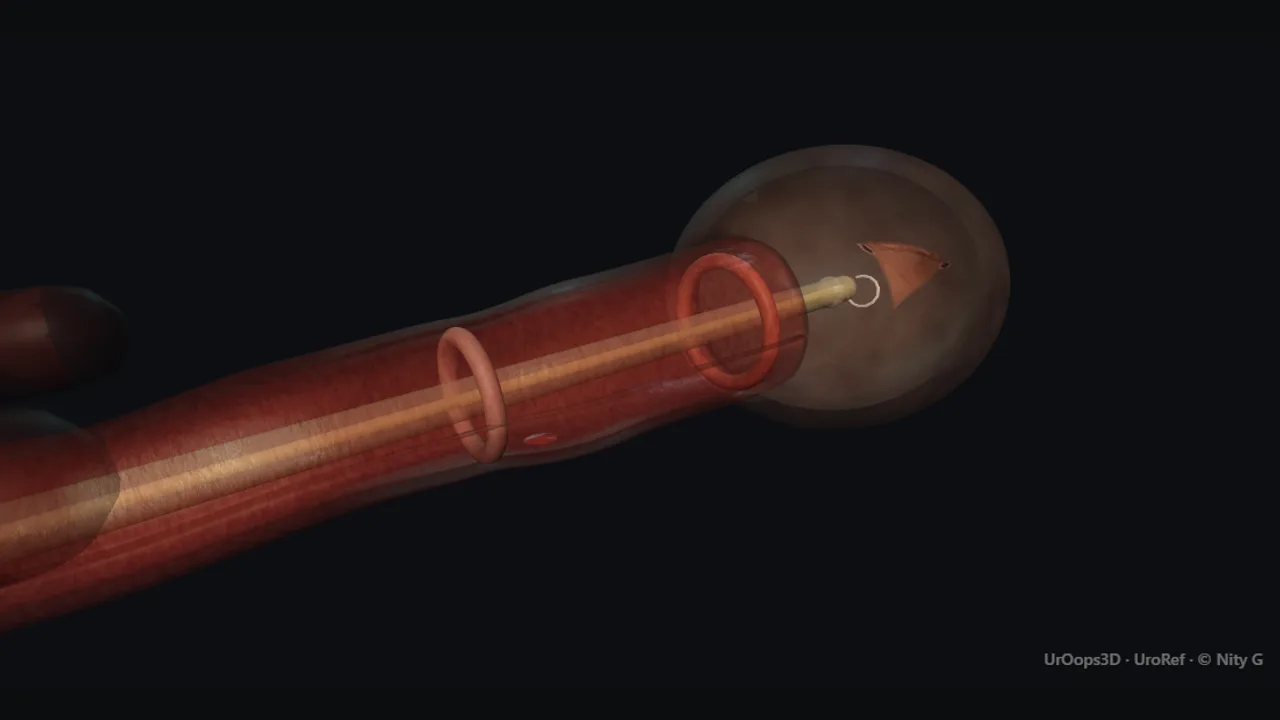 Interactive 3D Interactive operative model Open the 3D animation
Teaching catalogue only. This coverage record is not a patient pathway or operative instruction.
Typical place in practice
A short, selected primary stricture or a planned temporising intervention after assessment of site, length and cause.
Alternatives and neighbouring procedures
Observation in selected cases, intermittent self-dilatation, or definitive urethroplasty according to stricture characteristics and patient priorities.
Same procedure family, explicit technique branches
These are variations of this canonical operation. Complication modules below identify whether they apply to all branches or only to named approaches.
Graduated dilatation
Progressively enlarges the narrowed segment without making a formal incision.
Direct-vision internal urethrotomy
Incises the scar under direct vision to restore a lumen.
Drug-coated balloon pathway
A device-specific variation whose indications and evidence require local governance.
High-level sequence
Coverage outline only; not a step-by-step technical guide.
- Define the stricture and establish safe access
- Traverse the true lumen under vision or wire guidance
- Dilate or incise the scar in a controlled plane
- Inspect the treated segment and bladder
- Leave drainage when indicated and plan recurrence surveillance
Operative notes
Concise operative notes covering the key steps, landmarks and watch points, in the order you encounter them.
Meatotomy
What it does: widen a tight meatus (the hole at the tip).
- No. 10 blade into the meatus. Bevel up. 1-2 cm.
- Withdraw the blade. Press up gently as it comes out.
- Repeat till instruments pass.
From the UroRef Operative Quick Guide. Open the note page →
Every failure mode is its own module.
Timing and variation coverage are recorded for each module.
Urethral bleeding or spongiosal injury
Bleeding ranges from transient haematuria to deeper spongiosal trauma and may signal that the intended plane has been lost.
Applies to: All variantsFalse passage or urethral perforation
Instrument or wire passage outside the true lumen can create extravasation, impair drainage and complicate later reconstruction.
Applies to: All variantsUrinary infection
Instrumentation and temporary drainage can be followed by lower or systemic urinary infection.
Applies to: All variantsRecurrent stricture
Scar recurrence is a defining longer-term limitation and should be tracked separately from immediate technical success.
Applies to: All variantsSphincter injury or new incontinence
Proximal treatment close to the continence mechanism can rarely impair sphincter function.
Applies to: Direct-vision internal urethrotomySources for this module
Dilatation, DVIU, anastomotic, graft, flap, staged and perineal procedures.
Accessed 2026-08-03 · opens source British Association of Urological Surgeons Patient information leaflets by procedureUK patient-facing procedure, alternatives, recovery and complication framing.
Accessed 2026-08-03 · opens source