
Simple prostatectomy for benign prostatic obstruction
Open or minimally invasive enucleation of a large benign prostatic adenoma while leaving the peripheral prostate and seminal structures in situ.
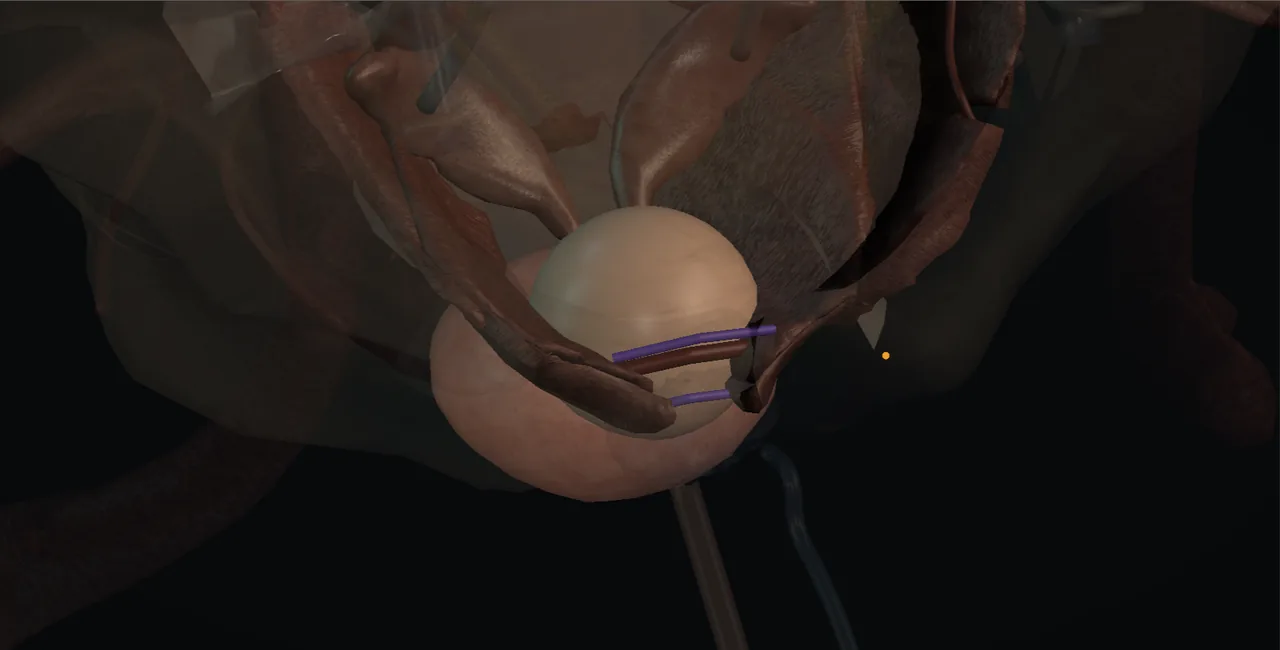 Interactive 3D Interactive Millin prostatectomy Open the 3D animation
Teaching catalogue only. This coverage record is not a patient pathway or operative instruction.
Typical place in practice
Large-volume benign prostatic obstruction, particularly when anatomy or associated bladder pathology favours a transvesical or transcapsular operation.
Alternatives and neighbouring procedures
Endoscopic enucleation, staged transurethral treatment, catheter strategies or other outlet procedures according to expertise and patient factors.
Same procedure family, explicit technique branches
These are variations of this canonical operation. Complication modules below identify whether they apply to all branches or only to named approaches.
Open transvesical simple prostatectomy
The bladder is opened and adenoma enucleated through the bladder neck, allowing concurrent intravesical work.
Open transcapsular simple prostatectomy
The adenoma is approached through the anterior prostatic capsule without opening the bladder widely.
Laparoscopic simple prostatectomy
Laparoscopic dissection reproduces adenoma enucleation and reconstruction through port access.
Robot-assisted simple prostatectomy
Robotic suturing supports haemostasis, bladder-neck reconstruction and capsular or bladder closure.
High-level sequence
Coverage outline only; not a step-by-step technical guide.
- Define gland, bladder and ureteric anatomy and choose the approach
- Expose the bladder neck or prostatic capsule
- Develop the adenoma–capsule plane while protecting urethra and sphincter
- Control the prostatic fossa and reconstruct the outlet
- Close the bladder or capsule, confirm drainage and plan recovery
The operation, step by step
A step that touches one of this module's danger zones is marked and cross-linked below.
- SetupGeneral anaesthesia, supine or lithotomy position according to approach, group-and-save with blood available, antibiotic prophylaxis and lower-body warming; applies to open transvesical, transcapsular and laparoscopic or robotic routes.
- AccessLower midline or Pfannenstiel incision for open approaches or standard robotic ports, then a transverse cystotomy for the transvesical route.
- Open the bladder and inspect: identify the ureteric orifices and trigone first, and pass stents when the adenoma distorts them. danger zone: Ureteric orifices and trigone
- Incise the mucosa circumferentially around the bladder neck, clear of the orifices on each side.
- Develop the plane between adenoma and capsule with scissors or the dissector, staying on the white capsular fibres and angled away from the rectum posterior to the capsule. danger zone: Rectum posterior to the capsule
- Control the dorsal venous complex and capsular vessels at the apex before they bleed, not after. danger zone: Dorsal venous complex and capsular vessels
- Deliver the adenoma circumferentially, enucleating each lobe down to its apex.
- Divide the urethra under vision on the adenoma side, preserving the external sphincter and urethral apex. danger zone: External sphincter and urethral apex
- Inspect the fossa for residual adenoma and check the orifices for brisk reflux of blood.
- Secure haemostasis: figure-of-eight sutures at the 5 and 7 o’clock positions, diathermy to the fossa, and a running bladder-neck mucosal stitch.
- Reconstruct the bladder neck in a tennis-racket closure sized to the catheter, keeping both orifices clear.
- Leave a urethral catheter and a suprapubic catheter, then fill the bladder to test the closure.
- Close the cystotomy in two layers.
- ClosureWatertight cystotomy closure, retropubic drain to a bag, and mass closure of the wound.
- AftercareUrethral irrigation until clear, suprapubic catheter clamped in sequence, trial of void or cystogram per protocol at one to two weeks, and the drain out once dry.
Operative notes
Concise operative notes covering the key steps, landmarks and watch points, in the order you encounter them.
Open simple prostatectomy
What it does: shell the adenoma out, big prostate.
Freyer, through the bladder
- Open the bladder.
- Cut round the adenoma base. Spare the orifices.
- Plane at 6 o'clock. Finger sweeps round.
- Scissors at the apex, close to the adenoma. The sphincter is mm away.
Millin, behind the pubis
- Dorsal vein stitched first.
- Capsule cut below the bladder neck.
- Enucleate from behind.
- 2026 update: Rare now. HoLEP or robotic does this.
- 2026 update: The finger plane IS the HoLEP plane. One concept.
From the UroRef Operative Quick Guide. Open the note page →
Open incisions to know
What it does: the standard cuts, and how to open each.
- Midline: skin, fat, linea alba. Find the midline via the urachus. (Urachus = fetal tube, bladder dome to umbilicus.) Finger in the wound top, pull up. A ridge rises. Cut on the ridge.
- Peritoneum: 2 clips, pinch, no bowel, cut between. Enlarge with scissors between 2 fingers.
- Pfannenstiel: curved cut 2 cm above the pubis. Open sheath in the same curve. Sweep sheath off both recti, up and down. Separate the recti in the middle. Do not cut them. Cut the recti off the pubis = Cherny. Rarely needed.
- Loin, over the 12th rib: cut onto the rib tip. 3 cm diathermy through latissimus dorsi. Then cut in front of the rib tip, through the obliques, onto Gerota's fascia. (Gerota's = the kidney's fascia wrapper.) Sweep the peritoneum inwards with a finger. Cut muscle along the rib, centrally. Avoid the pleura.
From the UroRef Operative Quick Guide. Open the note page →
Every failure mode is its own module.
Timing and variation coverage are recorded for each module.
Major bleeding, clot retention or transfusion requirement
The broad enucleation surface and capsular vessels can cause substantial perioperative or delayed haemorrhage.
Applies to: Open transvesical simple prostatectomy · Open transcapsular simple prostatectomy · Laparoscopic simple prostatectomy · Robot-assisted simple prostatectomyBladder, ureteric-orifice or rectal injury
Distorted large-gland anatomy and deep dissection place adjacent urinary and rectal structures at risk.
Applies to: Open transvesical simple prostatectomy · Open transcapsular simple prostatectomy · Laparoscopic simple prostatectomy · Robot-assisted simple prostatectomyUrine leak or fistula
Failure of bladder, capsular or outlet closure may cause pelvic urine leakage and prolonged drainage.
Applies to: Open transvesical simple prostatectomy · Open transcapsular simple prostatectomy · Laparoscopic simple prostatectomy · Robot-assisted simple prostatectomyUrinary infection or wound infection
A large urinary tract operation, catheterisation and an abdominal wound create urinary and surgical-site infection risk.
Applies to: Open transvesical simple prostatectomy · Open transcapsular simple prostatectomy · Laparoscopic simple prostatectomy · Robot-assisted simple prostatectomyVenous thromboembolism or cardiopulmonary complication
Major pelvic surgery, blood loss, positioning and reduced mobility contribute to systemic postoperative complications.
Applies to: Open transvesical simple prostatectomy · Open transcapsular simple prostatectomy · Laparoscopic simple prostatectomy · Robot-assisted simple prostatectomyUrinary incontinence
Temporary urgency or stress leakage may occur, while apical or sphincter injury can cause persistent incontinence.
Applies to: Open transvesical simple prostatectomy · Open transcapsular simple prostatectomy · Laparoscopic simple prostatectomy · Robot-assisted simple prostatectomyRetrograde ejaculation and sexual-function change
Adenoma enucleation and bladder-neck reconstruction commonly alter ejaculation and can affect erectile or orgasmic function.
Applies to: Open transvesical simple prostatectomy · Open transcapsular simple prostatectomy · Laparoscopic simple prostatectomy · Robot-assisted simple prostatectomyBladder-neck contracture or urethral stricture
Outlet reconstruction and catheter-related healing may create recurrent narrowing.
Applies to: Open transvesical simple prostatectomy · Open transcapsular simple prostatectomy · Laparoscopic simple prostatectomy · Robot-assisted simple prostatectomySources for this module
Contemporary outlet procedures, selection, variants and functional trade-offs.
Accessed 2026-08-03 · opens source European Association of Urology EAU Guidelines on Urological InfectionsInfection prevention, recognition and procedure-associated infection context.
Accessed 2026-08-03 · opens source British Association of Urological Surgeons Patient information leaflets by procedureUK patient-facing procedure, alternatives, recovery and complication framing.
Accessed 2026-08-03 · opens source