
Urethral catheterisation and difficult urethral access
A family of transurethral bladder-drainage techniques, escalating from standard atraumatic placement to visually or wire-guided access when anatomy or obstruction makes passage difficult.
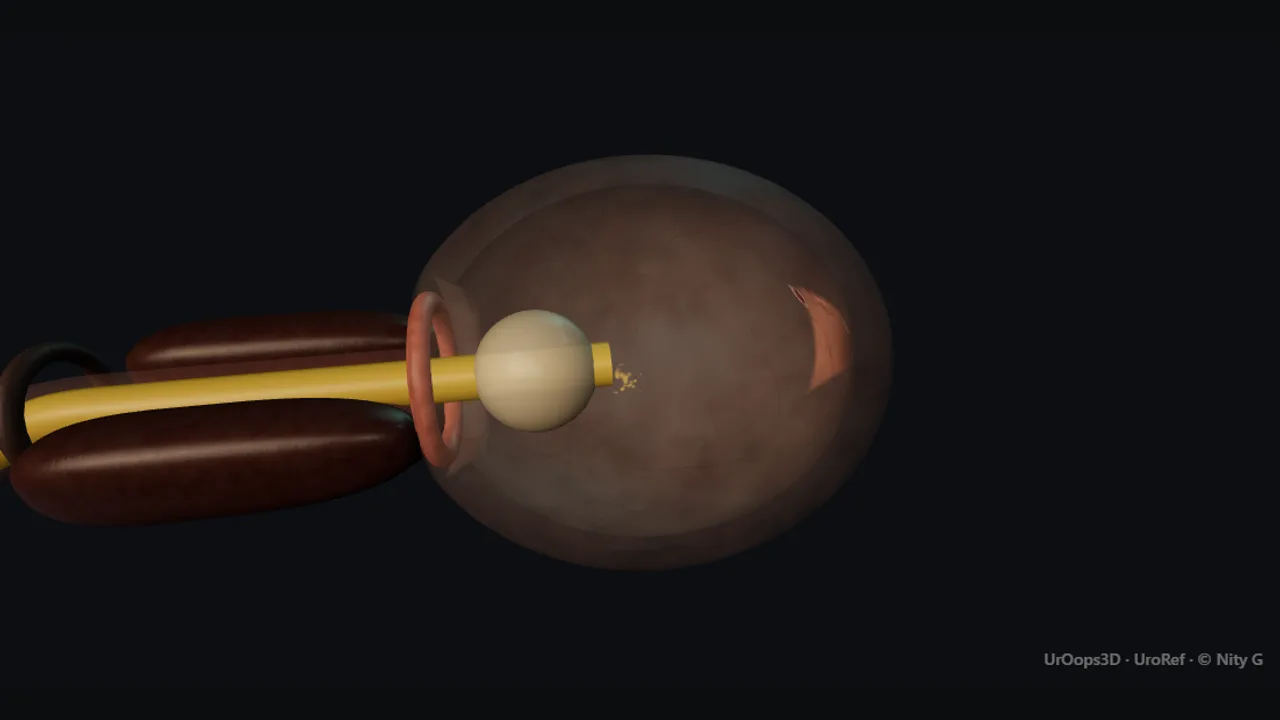 Interactive 3D Interactive model: the catheter, curve by curve Open the 3D animation
Teaching catalogue only. This coverage record is not a patient pathway or operative instruction.
Typical place in practice
Bladder drainage, urine-output monitoring, perioperative care, retention management and access for lower-tract investigation.
Alternatives and neighbouring procedures
Suprapubic drainage, intermittent catheterisation or upper-tract drainage may be considered when urethral access is unsuitable.
Same procedure family, explicit technique branches
These are variations of this canonical operation. Complication modules below identify whether they apply to all branches or only to named approaches.
Standard transurethral catheter
A lubricated catheter is passed without force after confirming the indication and urethral suitability.
Coude or specialist-tip catheter
Tip geometry and catheter stiffness are selected for known outlet anatomy; the direction of the tip remains controlled.
Guidewire-assisted catheterisation
A wire is placed into the bladder under appropriate confirmation and a catheter is passed over it.
Cystoscopic catheterisation
Endoscopy identifies the true lumen and permits controlled wire placement when blind attempts are unsafe or unsuccessful.
High-level sequence
Coverage outline only; not a step-by-step technical guide.
- Confirm indication and exclude suspected urethral injury
- Prepare, lubricate and select the least traumatic suitable device
- Advance without force while preserving orientation
- Confirm intravesical position before balloon inflation
- Secure, connect drainage and document difficulty or trauma
Operative notes
Concise operative notes covering the key steps, landmarks and watch points, in the order you encounter them.
Meatotomy
What it does: widen a tight meatus (the hole at the tip).
- No. 10 blade into the meatus. Bevel up. 1-2 cm.
- Withdraw the blade. Press up gently as it comes out.
- Repeat till instruments pass.
From the UroRef Operative Quick Guide. Open the note page →
Every failure mode is its own module.
Timing and variation coverage are recorded for each module.
False passage or urethral perforation
Resistance, repeated blind attempts, misdirected specialist tips or a wire outside the true lumen can injure the urethra.
Applies to: Standard transurethral catheter · Coude or specialist-tip catheter · Guidewire-assisted catheterisation · Cystoscopic catheterisationBalloon inflation in the urethra
Failure to establish intravesical position before inflation can cause pain, bleeding, obstruction and significant urethral injury.
Applies to: Standard transurethral catheter · Coude or specialist-tip catheter · Guidewire-assisted catheterisationCatheter-associated urinary infection
Instrumentation and duration of catheterisation create infection risk, especially with breaks in the closed drainage system.
Applies to: Standard transurethral catheter · Coude or specialist-tip catheter · Guidewire-assisted catheterisation · Cystoscopic catheterisationHaematuria and urethral bleeding
Mucosal trauma may produce bleeding and can obscure whether a false passage has occurred.
Applies to: Standard transurethral catheter · Coude or specialist-tip catheter · Guidewire-assisted catheterisation · Cystoscopic catheterisationBypassing, blockage or failed drainage
Kinking, debris, clot, malposition or an inappropriate catheter can prevent effective bladder decompression.
Applies to: Standard transurethral catheter · Coude or specialist-tip catheter · Guidewire-assisted catheterisation · Cystoscopic catheterisationLater urethral stricture
Urethral trauma and prolonged catheter pressure may heal with narrowing and recurrent obstructive symptoms.
Applies to: Standard transurethral catheter · Coude or specialist-tip catheter · Guidewire-assisted catheterisation · Cystoscopic catheterisationSources for this module
Infection prevention, recognition and procedure-associated infection context.
Accessed 2026-08-03 · opens source British Association of Urological Surgeons Patient information leaflets by procedureUK patient-facing procedure, alternatives, recovery and complication framing.
Accessed 2026-08-03 · opens source